
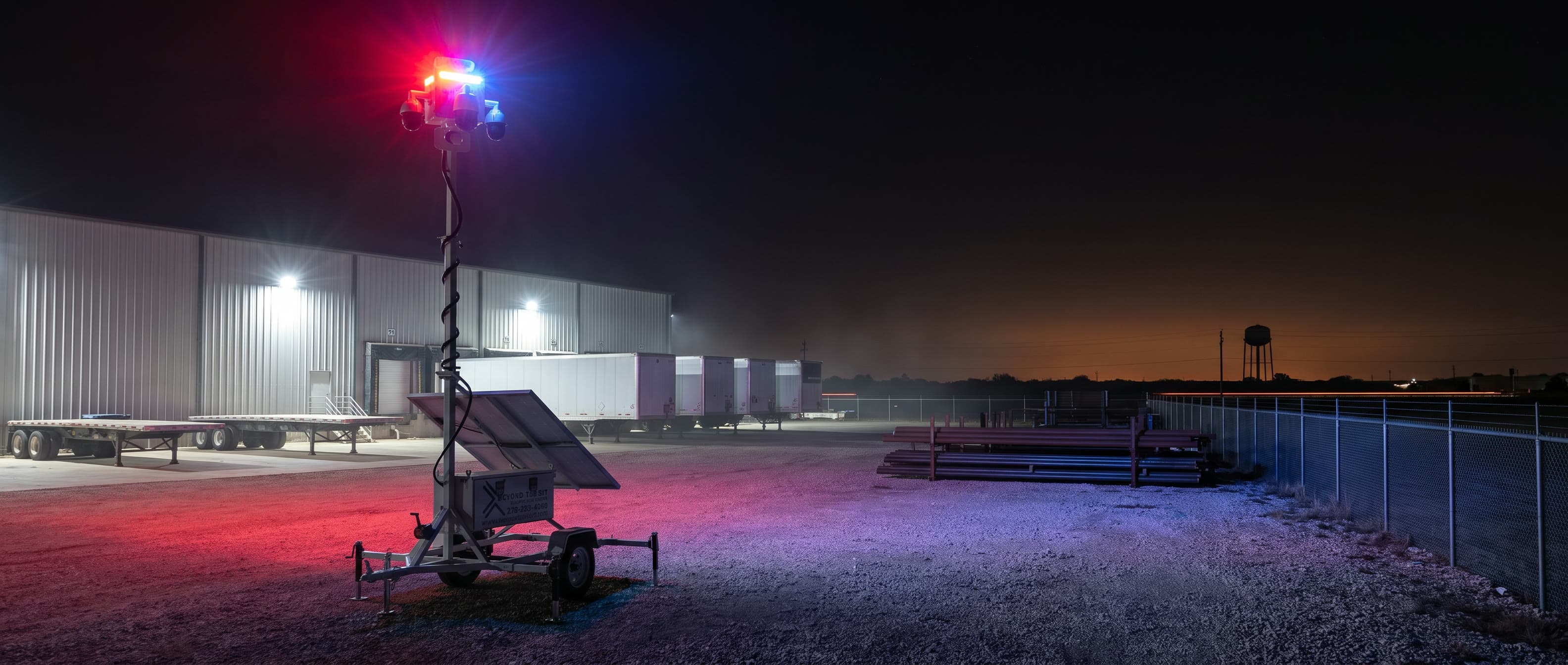
November 10, 2026 — Beyond the Bit Security Trailers
Why does an I-35 tilt-wall build near Waco need security for months, not weeks?
Because a tilt-wall box doesn’t close in the way a wood-frame building does. Panels have to be formed, poured, cured, and lifted one at a time, which stretches the open-and-unfenced phase of the job to months instead of weeks — and that stretch is exactly when a site carries the most exposed material and the least protection around it.
A strip retail pad or a small office build can go from slab to a lockable shell in a matter of weeks. A distribution box running several hundred thousand square feet along the I-35 corridor doesn’t work that way. The site sits open for a full season or more while panels go up, steel gets set, and the roof comes together section by section, and every week of that is a week the project depends on something other than a locked door.
That long open window is also why the Thanksgiving and year-end shutdown weeks hit a tilt-wall job harder than a typical build. A project with a closed, lockable shell can send the crew home for a holiday week without much to think about. A site still mid-pour, with panels down on the casting slab and steel staged for a crane that isn’t coming back until after the break, is left exactly as open as it was the day before everyone left.
What makes tilt-wall construction take so much longer to close in?
Each panel is its own small project before it ever stands up. A crew forms it flat on a casting slab poured right on the site, pours the concrete, and then waits days for it to cure enough to survive a crane pick — and a box this size can run well over a hundred panels before the shell is standing, let alone roofed and dried in.
That casting-and-lift sequence is why the schedule runs long even on a job with plenty of crews and no weather delays. Dock doors, racking, and the rest of the interior buildout don’t start until the shell is closed, which on a project this size can be months after the first panel went flat on the ground. A build running that long changes the math on renting coverage versus owning it outright, since the exposure window is measured in a full season rather than a few weeks.
The casting yard itself adds to the footprint, too. A GC running a box this size usually lays out several casting beds at once so more than one panel can cure in parallel, which spreads the most valuable staged material — formed panels, rebar, embeds — across a wider stretch of open ground than a smaller job would ever need. More ground staged with more material, for more months, is the opposite of what a thin temporary fence and an occasional drive-by were ever built to cover.
Why is the I-35 corridor through Waco filling up with these builds right now?
Because Waco sits roughly halfway between Dallas–Fort Worth and Austin on I-35, which puts it in reach of both metro areas at once without the land cost of either one. That geography has pulled a steady run of warehouse and distribution real estate into McLennan County over the past couple of years, with more than one large tilt-wall box going up along the corridor at a given time.
Some of that work is brand-new construction on raw ground; some of it is an older building getting repositioned or expanded to catch the same demand. Either way, it’s the same underlying pattern: Waco and the surrounding I-35 corridor are absorbing a share of the warehouse and logistics growth that used to land almost entirely inside the Metroplex, and the jobsites doing that work don’t come with Metroplex-level security infrastructure already sitting around them.
In practice, a Waco job behaves closer to a DFW job than it does to a market further out like Tyler or Abilene — the general contractors, subs, and crews running these builds are frequently the same companies working the Metroplex, just on a site a couple of counties south. What hasn’t caught up at the same pace is the monitored-security vendor landscape. National camera-trailer brands built their footprint inside DFW first, and a lot of them still price the drive south before they price the work, which leaves a gap between how familiar this market feels to a superintendent and how well it’s actually covered.
What’s actually exposed on a tilt-wall site before the building can be locked?
Everything that makes the building worth building. Panels staged flat on the casting slab, structural steel waiting for erection, and the racking, dock equipment, and mechanical gear that start arriving once there’s finally a shell to put them in — all of it sits in an open yard behind a temporary fence that a pair of bolt cutters gets through in seconds.
Trade and industry security reporting has flagged jobsite material and equipment theft as a rising cost on commercial projects in recent years, and a long tilt-wall schedule is the kind of job that pattern tends to find — it gives a casual thief months of opportunity instead of weeks, and a single construction site with no eyes on it overnight looks the same to someone driving by whether it’s in Waco or anywhere else on the corridor.
How does a trailer cover ground that has no fence and no power yet?
The same way it does on any other site in the fleet. Solar panels keep the battery charged, a cellular connection handles the video, and neither one leans on anything the site itself provides — no permanent power tap and no internet drop required, which matters on a job where the permanent utility service often isn’t live until the building is most of the way closed in.
Detection zones get drawn around what actually matters on a casting yard — the panel rows, the steel laydown, the equipment corral — with the frontage road and any neighboring parcel masked out so passing traffic doesn’t generate an alert every few minutes. Motion gets categorized as a person, a vehicle, or something else before it ever reaches a human, and Central Texas summer heat and spring hail don’t change how any of that performs after dark or in bad weather. A live operator at our Texas-licensed monitoring partner reviews what the cameras flag, and can fire the trailer’s strobe and speak through its loudspeaker directly at whoever tripped it, which ends most of these visits before anything leaves the yard.
How far out is Waco for a DFW-based fleet, and what should a superintendent do next?
Close enough to be normal service territory rather than a special trip. Richardson to Waco runs about one hour and forty-five minutes by road, and a typical deployment still lands in the same one-to-two-week window the rest of the fleet runs on, from signed order to a trailer parked and live on the casting yard.
Waco and the I-35 corridor, at a glance
A build running a full season of open casting yard before it closes in is exactly the kind of job worth putting coverage in the bid package early, not after a panel of steel goes missing off the laydown. Start with a site assessment rather than a guess at how many units the yard needs — it comes back with an actual placement plan built around the casting slab, the steel row, and however many zones the site breaks into, running on one flat monthly rate that bundles monitoring, delivery, install, cellular data, and teardown into a single line.