
Service Area — Potter County
Watched in
Amarillo, Texas.
Amarillo is about five and a half hours from our yard. It is the longest haul we run and we will say so plainly: this is planned multi-unit work, quoted for the distance and scoped properly before anybody gets in a truck. What is drawing us up here is that the Panhandle has started building generation and data capacity at a scale the region has never seen, on open ground with nothing else on it for miles — which is a site profile that a fence and a sign do essentially nothing for.
The I-40 corridor and campus-scale construction on open ground
Panhandle development right now is mostly about power and the things that consume it. Large energy and data campus projects are going up on parcels measured in thousands of acres, and the construction that comes with them is heavy on exactly the material thieves want: feeder cable, switchgear, transformers, conduit, busway and grounding, staged outside for months because the buildings are not ready to take it. Wind and solar construction across the region runs the same pattern on a flatter footprint — cable, inverters and plant sitting on caliche a long way from a paved road.
Closer in, Amarillo's east-side industrial and rail district and the commercial work along I-40 are more conventional builds, and they fail conventionally: plant, tools, fuel, wire and catalytic converters. But the campus work is the reason there is a page here, and it is the work that genuinely justifies bringing a fleet five and a half hours north.
A fence around a thousand acres is a suggestion
Perimeter security assumes a perimeter somebody can actually watch. On a campus-scale Panhandle site the fence line runs for miles across ground with no natural chokepoints, no adjacent buildings, no ambient light and no traffic to make anyone conspicuous. A patrol drives past a given point every couple of hours at best. Between passes, that point is unobserved, and whoever is standing at it knows exactly how long they have.
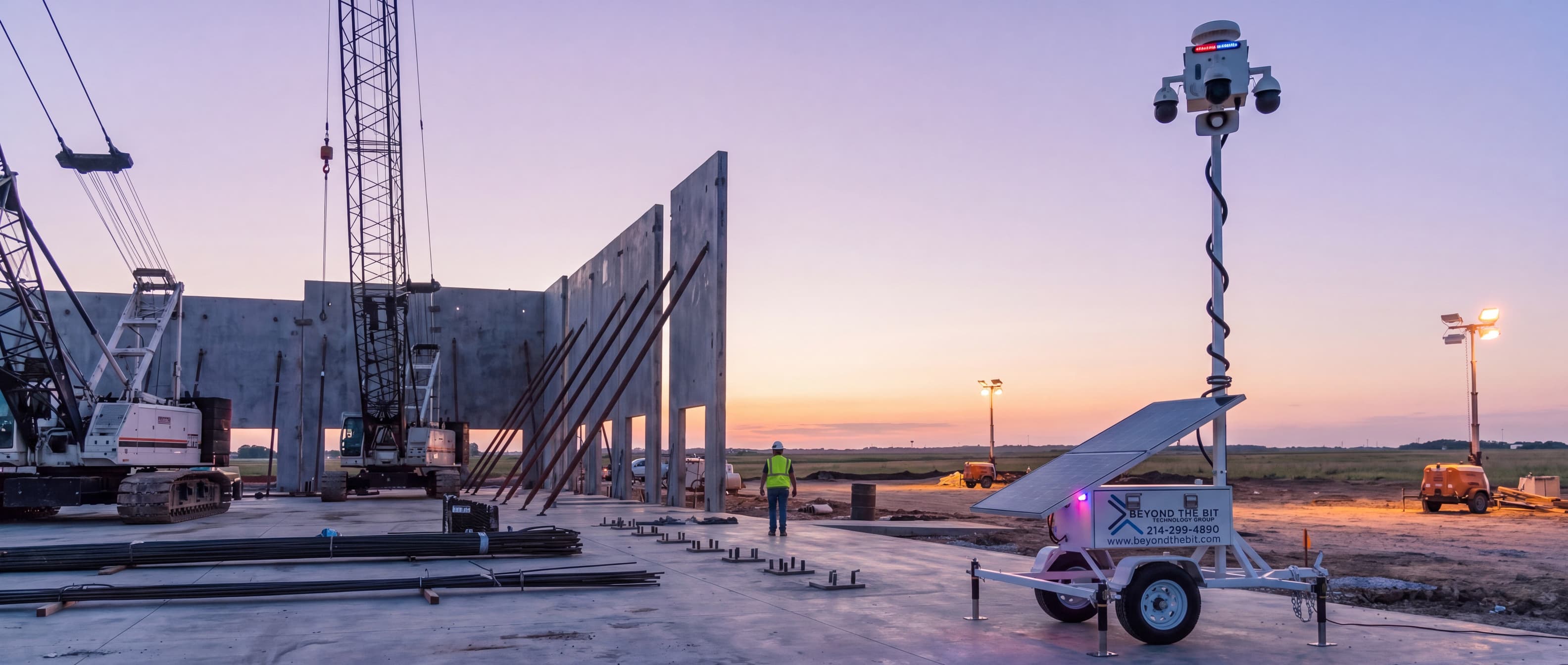
What works on that geometry is not more fence. It is putting eyes on the small number of places where the value actually concentrates — the laydown, the equipment corral, the gate, the substation tie-in — and having somebody watching them live rather than reviewing them later. Flat open ground is the best case for a mast: raised roughly two storeys with nothing to block the sightline, one unit covers a lot of area, and the strobe and the lit mast are visible from a long way off, which does real work on a site whose main defence used to be that it was hard to find.
Detection zones go around the material and the access points; the rangeland, the highway and the neighboring parcel are masked out, so a site that generates headlights and wildlife all night does not generate alerts all night. When a person crosses into a zone, an operator at our Texas-licensed monitoring partner has live video within moments and can talk through the trailer while somebody is still deciding whether to open the truck.
Getting a trailer to the Panhandle
About five and a half hours, and we quote it as what it is. Panhandle work is planned multi-unit deployment for the length of the project — typically several trailers positioned around a campus perimeter and its laydowns, delivered together on our own trucks on one date. Typical deployment is 1–2 weeks from signed quote to units on the ground, and the site assessment happens properly, on the ground, before any of that is priced.
Our crew places every unit, raises the masts and aims the cameras with the monitoring center live on the call, then walks your site team through the call list before driving back. On a site this remote the call list is doing more work than usual — the nearest responder may be a long way out, and the order of names matters. Solar power and cellular data mean nothing waits on site utilities, which on Panhandle campus ground are frequently the last thing to be energised. Units reposition as the work moves across the site, planned into the deployment rather than billed as separate events. W-9, certificate of insurance and net-30 terms are standard.
Field Photo — 2025 Deployment
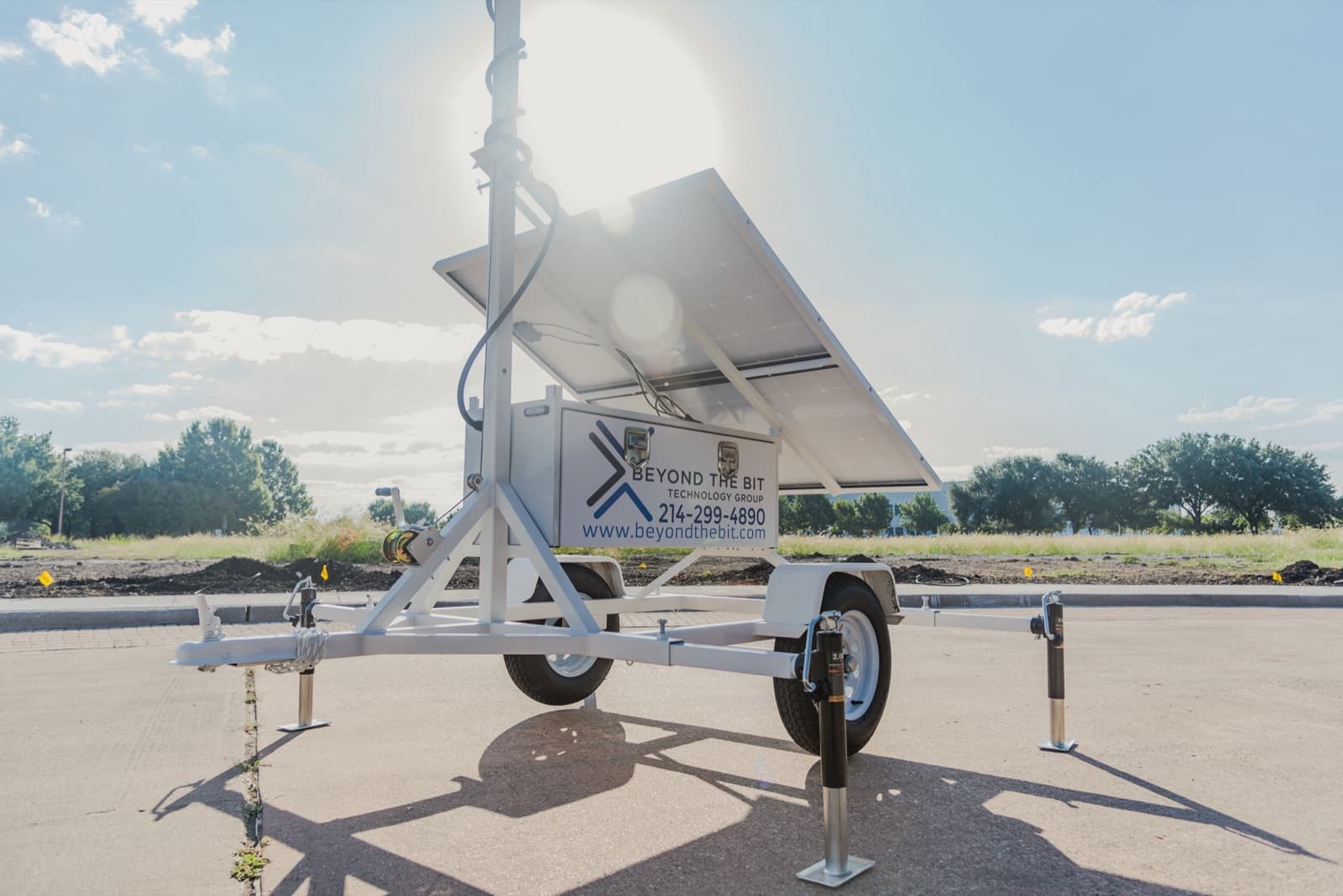
Solar array from behind, strobe lit on the cabinet corner. The winch at the mast base is what raises the head — one person, a few minutes, no ladder.
Plate 04 — Array and strobe
Where These Trailers Work
Common Amarillo deployments.
Watching a site in Amarillo? Call 214-299-4890
Questions — Amarillo
Asked before booking.
Amarillo is five and a half hours away. Is that realistic?
For the right project, yes, and for the wrong one, no. A single trailer on a single small site does not justify the run and we will say so rather than quote it. What does work is campus-scale or multi-site work deployed as one planned programme: several units delivered together on our own trucks, monitored through the same chain and the same call list, quoted for the length of the build. That is how every Panhandle conversation we have starts.
Does the monitoring work the same way that far from Dallas?
Yes, because none of it depends on the distance from our yard. The cameras connect over cellular, and the video goes to a live operator at our Texas-licensed monitoring partner who verifies it and speaks through the trailer's loudspeaker — that chain is identical whether the trailer is in Richardson or in Potter County. What distance changes is the physical side: how quickly a crew can get to the unit for service, and how the deployment is scheduled. That is why Panhandle work is planned rather than reactive.
What can a trailer cover on a site measured in thousands of acres?
Not all of it, and nobody should claim otherwise. What it covers is where the value concentrates — the laydown yards, the equipment corral, the gate and access roads, the electrical staging. Flat open ground is the efficient case, because a mast raised roughly two storeys has an uninterrupted sightline in every direction, so each unit takes in far more area than it would in a built-up market. The site assessment maps where the material actually sits and comes back with unit positions and a count, rather than a number chosen before anyone walked the ground.
Ready to get a trailer on your Amarillo site? Get a quote built around your actual site.
Request a Free Site Assessment