
Service Area — Harris County
Watched in
Houston, Texas.
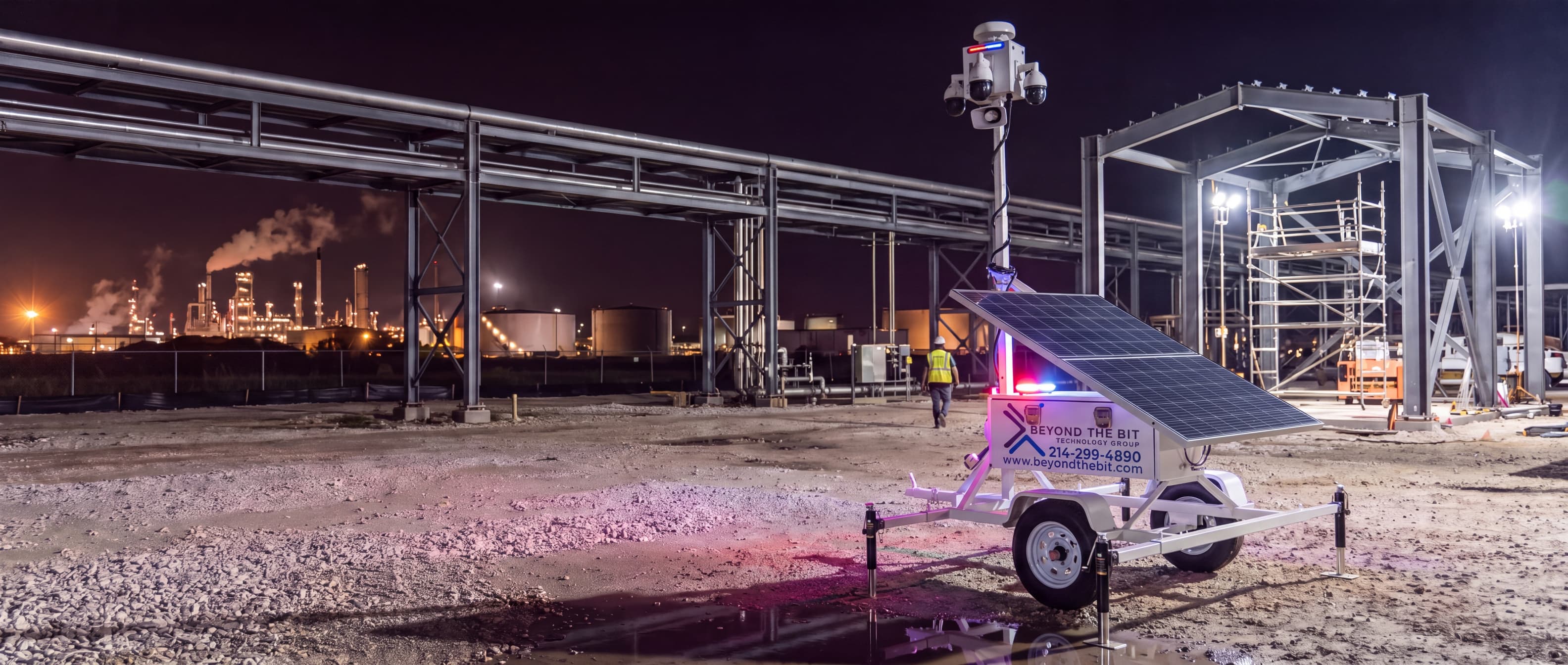
Houston is the biggest construction market in Texas and the one where a fence line does the least work. Industrial builds along the Ship Channel stage pipe, spool, and structural steel across acres — a perimeter long enough that walking it takes real time, and open enough that there is no single gate to guard. That scale is the argument for a mast. It is also why Houston work is almost always planned around multiple units and a full project term rather than one trailer dropped in on short notice: the yard is four hours away, and we would rather tell you that up front than pretend otherwise.
Ship Channel plants, the Grand Parkway ring, the Medical Center, and the Energy Corridor
Four Houston footprints, four different exposures. Ship Channel industrial and petrochemical work is the heaviest: racked pipe, valves, spool pieces, and structural steel laid out across open ground for months at a stretch, with contractor laydown areas that sit well inside a plant boundary but well outside anyone's line of sight after shift change. The Grand Parkway development ring is the opposite problem — new distribution and commercial construction on land that was rice field or pasture a year ago, where the nearest occupied building might be half a mile off and there is no ambient activity at all overnight. Texas Medical Center expansion work runs on tight urban lots hemmed in by live hospital operations, where material and fixtures stage close to the street and a site cannot simply be sealed off because the buildings around it never close. And the Energy Corridor along I-10 carries the office and mixed-use version: structured parking, curtain wall, and mechanical equipment staged on decks, exposed to a frontage road that carries traffic all night. Same city, four different theft patterns, and the same underlying answer — put the camera head above the site, draw zones around what actually matters, and let the trailer hold the ground nobody is standing on.
The Houston problem is perimeter length, not perimeter strength
On a small urban infill job, a good fence and a locked gate are a real obstacle. On a Houston industrial site they are a formality. When a laydown area runs several hundred yards along one side, the fence stops being a barrier and becomes a line on a drawing — there is simply too much of it for anyone to watch, and cutting it takes less time than walking to the gate. The material makes it worth the trouble: copper, cable reels, welding equipment, and pipe move quickly and are hard to identify once they are off site.
A camera trailer changes the geometry rather than the fence. Raising the head roughly two stories puts a long run of perimeter inside one field of view, and detection zones get drawn around the parts that matter — the pipe racks, the conex row, the equipment corral — while the frontage road, the neighbouring plant's traffic, and the public right-of-way are masked out so they never generate an alert. Cameras categorize what moves as a person, a vehicle, or a bicycle, so a truck running the perimeter road at 3 a.m. does not wake anybody up. When something crosses into a zone that should be empty, a live operator at our Texas-licensed monitoring partner has the video in front of them within moments and makes the call: nothing, or somebody who should not be there. If it is real they can fire the strobe and speak through the trailer directly, then work your call list and decide whether this is a police call. On a site with a mile of fence, that is the difference between finding out at 6 a.m. and finding out while it is happening.
What that looks like on a Houston site
A contractor laydown area inside a plant boundary, several hundred feet of spool and valve staged for a turnaround, everything quiet after the last shift leaves. At 2:14 a.m. a pickup pulls off the perimeter road and stops at the fence — not at the gate, where a guard would be, but at the long dark stretch nobody drives past. Two people get out. The camera tags them as people the moment they cross into the material zone, and an operator is looking at live video before they reach the first rack. The strobe fires and the speaker cuts in with a real voice describing what they are wearing. That specificity matters more than volume: a siren is ambient noise on an industrial site, but a person telling you they can see you is not. Most people are back in the truck before the second sentence. If they are not, the operator is already on your call list and building the kind of verified, video-backed report that gets a unit moving instead of a queued alarm ticket.
None of that requires site power, a fibre drop, or an IT ticket. The trailer runs on its own solar and battery, carries its own cellular connection, and works the day it lands on raw dirt — which on a Grand Parkway greenfield site is often months before there is permanent power to connect to.
Getting a trailer to Houston
Straight answer on logistics: Houston is about four hours from our Richardson yard, and we are not going to describe that as a quick run. What it means in practice is that Houston deployments get planned rather than improvised. Typical deployment is 1–2 weeks from signed quote to a trailer standing on your site, the same window as a Metroplex job, because the constraint is scheduling and install, not distance. Our crew handles delivery, mast setup, and camera aim with the monitoring center live on the call, then walks your site team through the call list before leaving.
Where the distance does change the maths is order size and term. A single trailer on a two-week rental four hours out is a poor trade for everybody. Multiple units on a project-length term is a good one, and that happens to match how Houston industrial and distribution work is actually built — long programmes with months of exposure, not short jobs. Our fleet of nearly 100 trailers means a multi-unit Houston order is not waiting on equipment freeing up somewhere else. W-9, certificate of insurance, and net-30 terms are standard, so vendor setup runs through your normal procurement path without a special exception.
Field Photo — 2025 Deployment
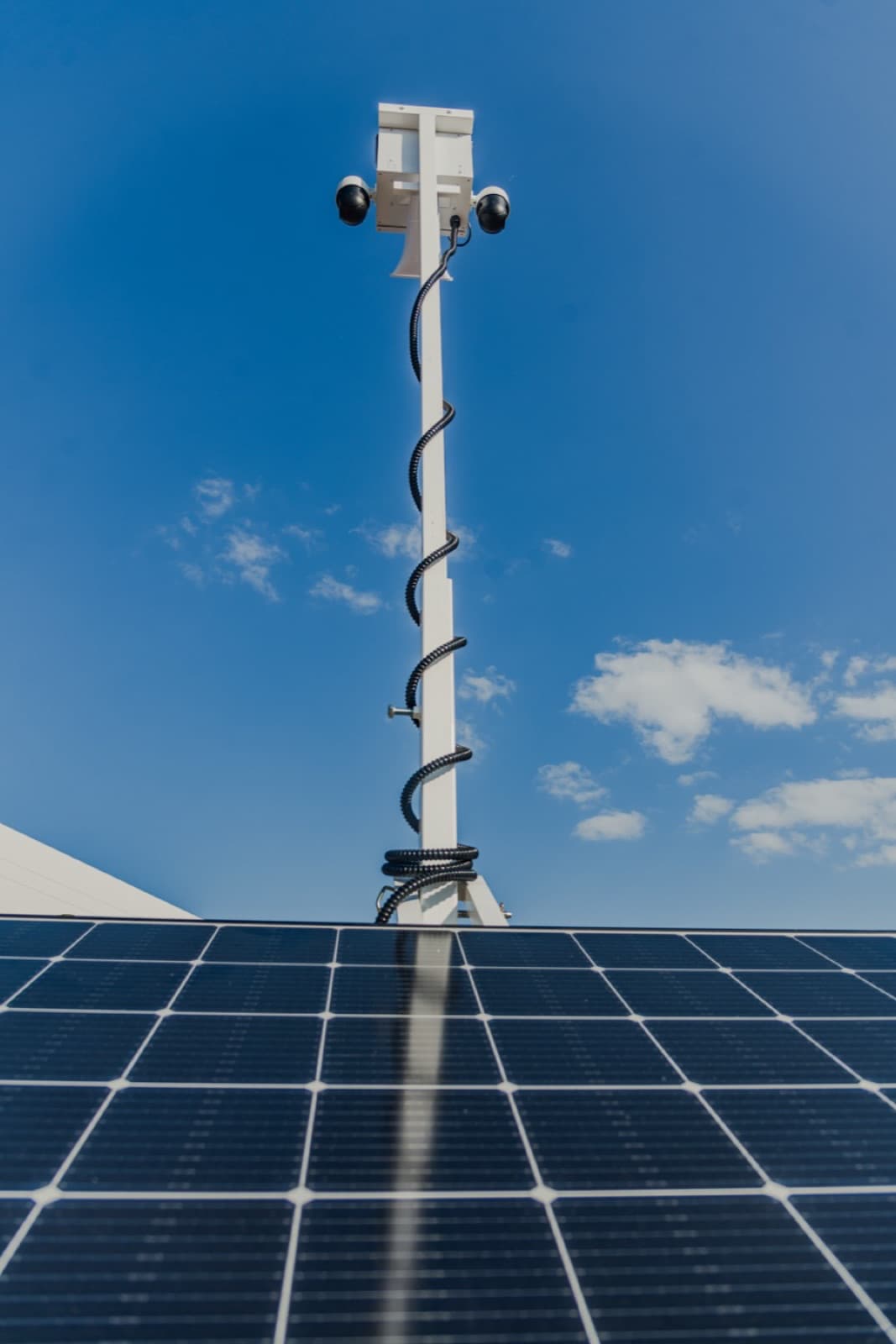
The head assembly: two PTZ cameras on the bracket, a horn speaker under them, and the coiled cable that carries power and video down the mast.
Plate 05 — Mast head, from the array
Where These Trailers Work
Common Houston deployments.
Watching a site in Houston? Call 214-299-4890
Questions — Houston
Asked before booking.
Do you really cover Houston from a Dallas-area yard?
Yes, and we will be straight about what it involves. Houston is roughly a four-hour haul from our Richardson yard, so it is planned work rather than a same-week drop. Deployment still runs 1–2 weeks from signed quote, and the trailer, the monitoring chain, and the install standard are identical to a Metroplex job. What we would not recommend is a single unit on a short rental at that distance — Houston makes sense as a multi-unit or project-length deployment.
How many trailers does a large Houston industrial site need?
It depends on perimeter length and how the material is grouped, which is exactly what the free site assessment is for. As a rule of thumb, a camera head placed at roughly two stories covers a long run of fence line in one view, so the count usually comes down to how many separate laydown or equipment areas you have rather than total acreage. We will walk the site or work from your plan and photos and come back with a number and placement, not a guess.
Ready to get a trailer on your Houston site? Get a quote built around your actual site.
Request a Free Site Assessment