
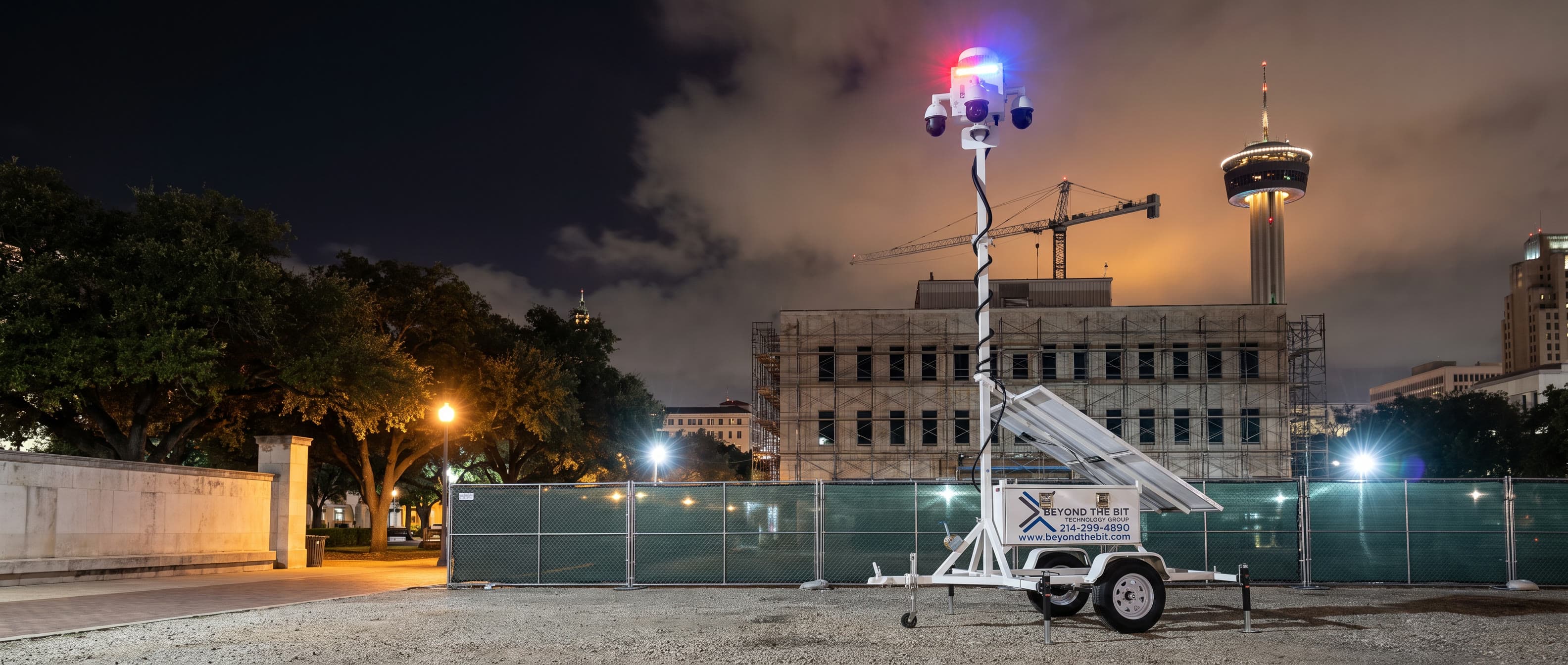
Service Area — Bexar County
Watched in
San Antonio, Texas.
San Antonio is the longest haul we run, about four and a half hours from our Richardson yard, and we would rather say so plainly than let you find out on a schedule. It means San Antonio is a market for planned deployments and project-length terms, not a same-week single-trailer drop. What San Antonio has that the other metros do not is public frontage: a lot of the commercial work here is civic, hospitality, and medical, on sites where people walk past all evening. On that kind of property the visible parts of a trailer do more work than the cameras.
The Loop 1604 ring, downtown civic and hospitality, Port San Antonio, and the Medical Center
The Loop 1604 growth ring is where San Antonio's new commercial and residential construction concentrates — retail pads, medical office, and multifamily on open ground at the edge of the built-up area, with the usual greenfield conditions of long sightlines and no ambient activity overnight. Downtown carries a different profile entirely: civic buildings and hotels under renovation, often occupied or partly occupied, on sites where the fence line runs along a public sidewalk and the work has to coexist with people walking past at all hours. Port San Antonio and the surrounding industrial campuses run to aviation, logistics, and technology facilities with controlled outer boundaries but large interior yards. And the South Texas Medical Center district is under near-continuous expansion, on tight lots wedged between live hospital operations where the surrounding buildings genuinely never close. Each one needs the detection zones drawn differently, and the downtown and civic sites need something the others do not: deterrence somebody can actually see.
On public frontage, being visible is most of the job
A camera nobody can see prevents nothing. It documents. That distinction matters everywhere, but it matters most on a site where the boundary is a public sidewalk and the people who might test the fence are already walking past it in ordinary circumstances.
A trailer is deliberately conspicuous. It is a white unit with a mast raised roughly two stories and a camera head plainly visible from the street, and that alone reframes the property — it reads as watched rather than merely fenced. When somebody does cross into a live zone, the escalation stays visible: the strobe fires, and an operator at our Texas-licensed monitoring partner speaks through the loudspeaker, describing the person and what they are doing. On downtown and civic sites that spoken warning is doing double duty, because it also tells everyone else nearby that the property is actively monitored.
The zone drawing is what keeps that from becoming a nuisance. On a site fronting a public sidewalk, the sidewalk itself gets masked out — pedestrians on a public right-of-way are not an event, and a system that alerts on them gets ignored within a week. Detection is drawn tight around the material, the equipment, and the openings in the building envelope, and cameras categorize what moves as a person, a vehicle, or a bicycle before anything reaches an operator. The result is a system that stays quiet through normal downtown evening activity and speaks up when someone steps over the line that matters.
What that looks like on a San Antonio site
A downtown hotel mid-renovation, scaffold up on two elevations, new mechanical equipment and finish material staged in a fenced area that fronts a side street. Evening foot traffic all around — restaurants a block away, people walking to and from parking. None of it generates an alert, because the public sidewalk and the street are outside the detection zones by design.
At 12:50 a.m. somebody stops at the fence, looks at the equipment staged behind it, and climbs. The moment they land inside the zone the camera classifies a person and an operator has the feed. Strobe, then a voice: a description of the person, the fact that they are on camera, and a clear instruction to leave. On a downtown street that carries an audience, and it ends the attempt for reasons that have nothing to do with how strong the fence was. The operator works your call list either way, and if the person does not leave, what goes to police is a verified account with video behind it rather than an unconfirmed alarm.
For a hospitality or civic client there is a second benefit worth naming: nothing about this requires posting a guard on a public sidewalk overnight, which is its own set of problems on an occupied property.
Getting a trailer to San Antonio
About four and a half hours from Richardson. That is the longest run we do, and it shapes what makes sense. A single trailer on a short rental at that distance is not a good trade for anybody, and we will say so rather than sell it. Multiple units, or a single unit on a project-length term, is a different calculation entirely — and it lines up with how San Antonio civic, hospitality, and medical work is usually scheduled, in programmes measured in months.
Deployment still runs 1–2 weeks from signed quote, because the limiting factor is scheduling and install rather than the drive. Our crew handles delivery, placement, mast raise, and camera aim with the monitoring center live during install, then walks your site contact through the call list before leaving. Public-sector and municipal buyers get the same vendor packet as any commercial account — W-9, certificate of insurance, net-30 terms, plus whatever additional documentation a city or county purchasing process requires, filled out and sent with the quote rather than after it.
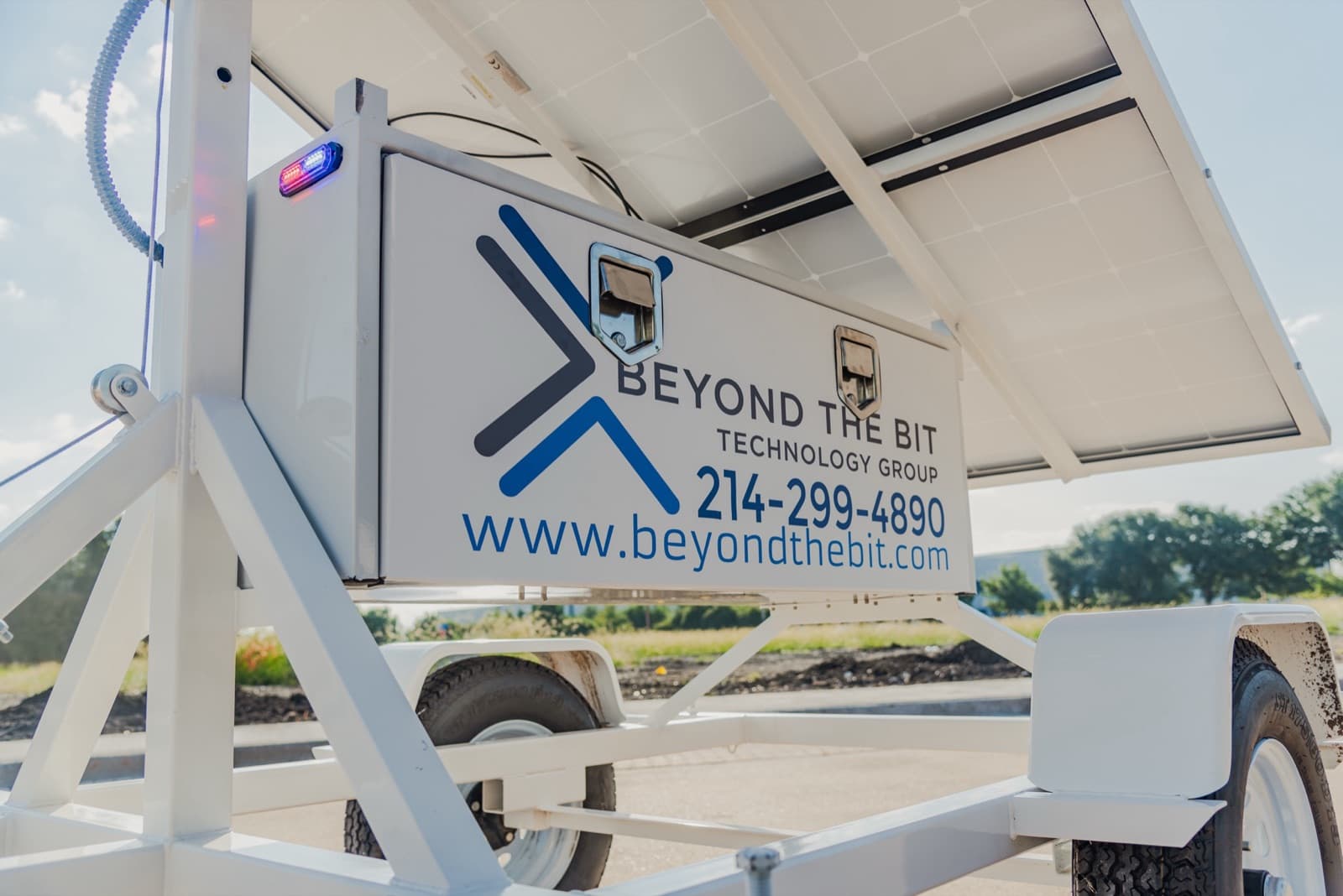
Field Photo — 2025 Deployment
Cabinet, decal and the strobe that fires when a verified intruder is on site. The strobe and the horn speaker are the first two responses, before a person is ever dispatched.
Plate 07 — Cabinet and strobe
Where These Trailers Work
Common San Antonio deployments.
Watching a site in San Antonio? Call 214-299-4890
Questions — San Antonio
Asked before booking.
Is San Antonio too far for this to make sense?
For one trailer on a short rental, honestly, often yes — and we would tell you that rather than take the order. San Antonio is about four and a half hours from our yard, which makes it a market for multi-unit deployments and project-length terms. On that basis it works well, and the deployment window, the monitoring chain, and the install standard are identical to a Metroplex job. If your project is short and small, ask us and we will give you a straight answer about whether it is worth it.
Will the trailer set off alerts from people walking past on a public sidewalk?
It should not, and that is a setup decision we make during install. Detection zones are drawn around your material, equipment, and building openings, and the public right-of-way is masked out — a system that alerts on ordinary pedestrians gets ignored within a week, which defeats the point. Cameras also categorize movement as a person, vehicle, or bicycle before anything reaches an operator, which filters most of what passes a downtown site at night.
Ready to get a trailer on your San Antonio site? Get a quote built around your actual site.
Request a Free Site Assessment