
November 3, 2026 — Beyond the Bit Security Trailers
How do you secure a jobsite over the Thanksgiving shutdown?
The same way you’d secure it on any other night, except the gap runs four or five days straight instead of eight hours — which means a trailer or camera system that only needs to hold up for one overnight shift has to hold up for a long weekend with no crew checking in at all. That means continuous power, continuous monitoring, and a live operator who can act on something the moment it happens, not a system someone glances at when the crew gets back on Monday.
Most jobsite security gets built around the daily rhythm — crew leaves at five, comes back at seven, and whatever happens overnight gets discovered the next morning. Thanksgiving breaks that rhythm. The site goes quiet Wednesday afternoon and nobody’s back on it until the following Monday, sometimes longer if a super takes the whole week. Whatever is watching the site has to be the only thing watching it for that entire stretch.
Why does risk climb over a long weekend instead of a single night?
Because the exposure doesn’t reset each night the way it does on a normal week — it stacks. A site that’s unattended for eight hours gets one dark window a day; a site closed for Thanksgiving gets one dark window that doesn’t end until a crew physically shows back up. Anyone who’s cased the property, watched the gate for a pattern, or simply noticed the lot going still for days running has a much wider window to act in than they’d get on an ordinary Tuesday night.
It also removes the small things that quietly deter opportunists during a normal week — a delivery truck pulling in, a foreman walking the perimeter before locking up, a neighboring business still open next door. All of that goes away for the holiday at the same time the site does, and nothing fills the gap unless something is actually put there to fill it.
What’s actually sitting exposed on a site that’s closed for four days?
Mostly the same things that are exposed every other night, just for longer: staged material, idle equipment, fuel, and — on a site that’s past rough-in — exposed copper. None of that is unique to Thanksgiving. What changes is how long it sits there with nobody around to notice it’s gone before Monday morning.
Copper is worth flagging specifically here, because a shutdown window is exactly the kind of stretch where a stripped run goes unnoticed the longest. The pattern behind that risk is covered in more depth in our piece on copper theft after rough-in, and the same logic applies to any equipment or material that’s easy to move and slow to be missed. A multi-day closure is simply the longest version of the window that post describes.
Does a monitored camera trailer actually watch the site while the crew is gone?
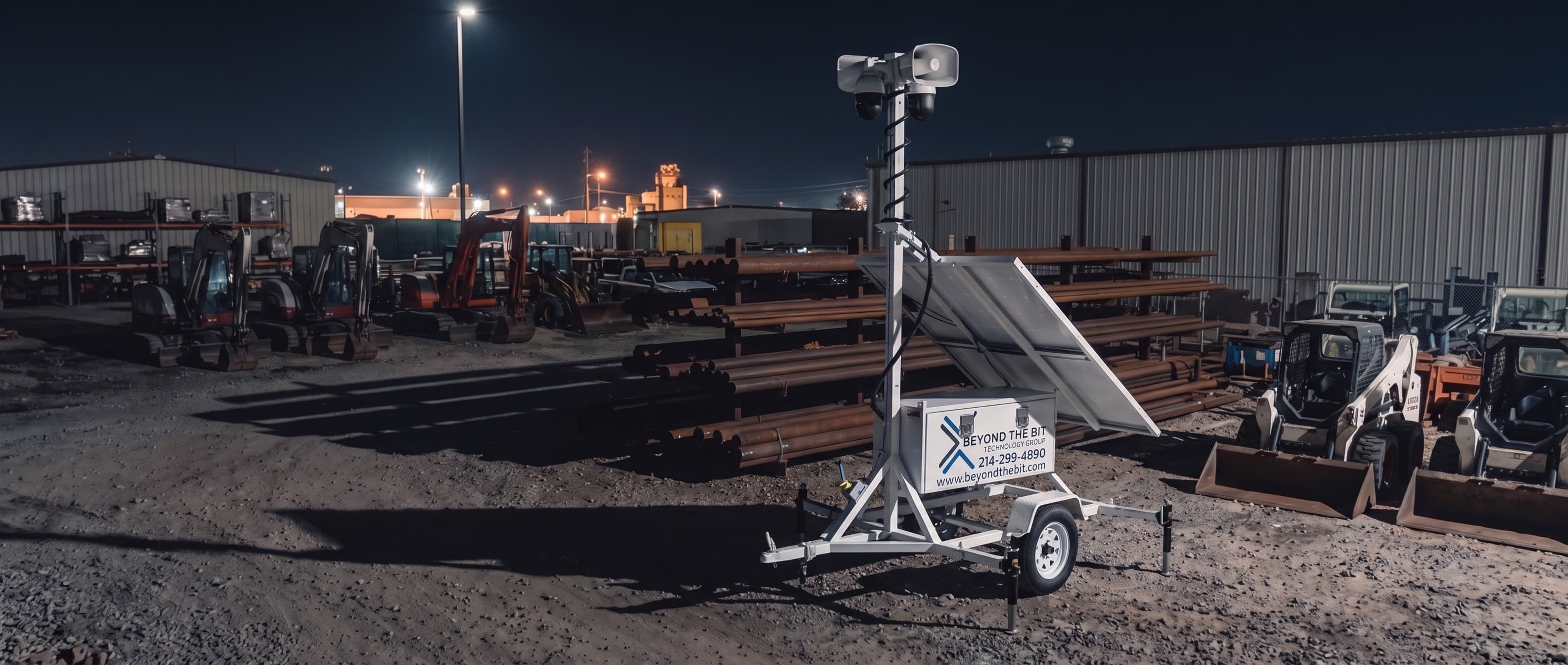
Yes — that’s the entire point of running on solar and battery rather than site power, which most jobsites don’t have reliably connected yet anyway. A Beyond the Bit trailer keeps running cameras, detection, and a cellular uplink the same way whether the crew left ten minutes ago or four days ago; the holiday doesn’t change what the system is doing, only how long it has to do it without anyone checking in.
When something crosses into a masked zone, the detection chain runs the same way it would on any other night: motion gets categorized, a live operator at our Texas-licensed monitoring partner reviews the footage, the trailer’s strobe and speaker can issue a live warning, and the call list gets worked before police are brought in. That chain doesn’t take a holiday, and the operator watching it isn’t relying on a superintendent being reachable from a family dinner three counties away.
What keeps running over a holiday shutdown
What should a superintendent actually do the week before the holiday?
Walk the site with the shutdown specifically in mind, not just the usual end-of-day close-up. That means confirming gates and gang boxes are actually locked rather than latched, fuel tanks and small equipment are staged somewhere less visible from the street, and whoever’s on the monitoring call list is reachable and briefed that the site will sit idle for several days, not one night.
- Update the monitoring call list with whoever is actually reachable over the holiday — not just the usual on-call name.
- Confirm the trailer or camera system has clear sightlines to the gate, laydown yard, and equipment row before everyone leaves.
- Stage fuel, small tools, and anything easy to carry off somewhere less visible from the road.
- Double-check locks on gang boxes and site trailers — a latch that’s been fine all week is the one thing worth re-checking before a four-day gap.
None of that replaces coverage on the open ground a fence can’t reach. It just means the site goes into the shutdown in the best shape it can, on top of whatever is actually watching it.
Does the same risk apply to Christmas and New Year’s too?
Yes, and typically worse, because the December shutdown usually runs longer than Thanksgiving’s. The underlying problem is identical — a site that normally resets every twenty-four hours goes dark for a stretch with nobody physically present — it just stretches further at year-end, often past a full week once a jobsite closes for the holidays.
The fix doesn’t change between the two. Whatever is watching the site over Thanksgiving needs to keep watching it in exactly the same way in December, which is why this is worth treating as a recurring part of the shutdown routine rather than a one-time fix for a single long weekend.
What if I’m only thinking about coverage this close to the holiday?
Ask now rather than the week of. Deployment typically runs one to two weeks from a signed quote to a trailer on site, and that timeline doesn’t compress just because the holiday is close — crews, trucks, and install slots fill up the same way everyone else’s schedule does in late November. The sites that end up covered in time are usually the ones that asked before the week they needed it, not during it.
If a trailer can’t realistically land before Thanksgiving, the right move is to lock down everything that can be locked down manually and get the quote moving anyway, so the site is covered for December instead of scrambling again in three weeks. A site assessment is also what tells you how many units a site this size actually needs, which is worth knowing before the next shutdown shows up rather than after.