
Service Area — Taylor County
Watched in
Abilene, Texas.
Abilene is about three and a half hours west on I-20, and it is currently host to some of the largest data center construction in the country on open ground at the edge of the county. That combination — enormous, electrically dense builds in a market with almost no local monitored-trailer supply — is why we run out here. The nearest fleets are usually Metroplex fleets, and most of them price the drive in before they price the work. We would rather quote it as what it is: a planned deployment on a project big enough to be worth planning around.
I-20, open ground, and the biggest electrical laydowns in Texas
The construction going up east of Abilene is a different animal from a distribution shell. A large data campus is, for most of its schedule, an electrical project with a building around it — switchgear lineups, transformers, generators, thousands of feet of feeder cable, conduit, busway and grounding material, delivered ahead of the interior work and staged outside because there is nowhere else to put it. The copper content of a laydown like that is the highest of any construction type we cover.
The surrounding work carries its own exposure. Taylor County has years of wind and solar construction behind it and more coming, and a renewable laydown is the same story on a different footprint: cable, inverters, transformers and plant sitting on caliche in the middle of nowhere. Along the I-20 corridor the commercial and industrial work is more conventional, and closer to town, but it is still going up on parcels where the neighboring lot is empty and the nearest occupied building is a long way off.
The problem with being the only thing for miles
Out here the site is not competing with a city for attention — it is the only thing on the horizon, lit up, with a gate and a fence and obviously something worth having behind it. That visibility runs both ways. It makes the site conspicuous, and it means nobody is close enough to notice anything wrong. A patrol that swings by twice a night is passing a fence line measured in miles.
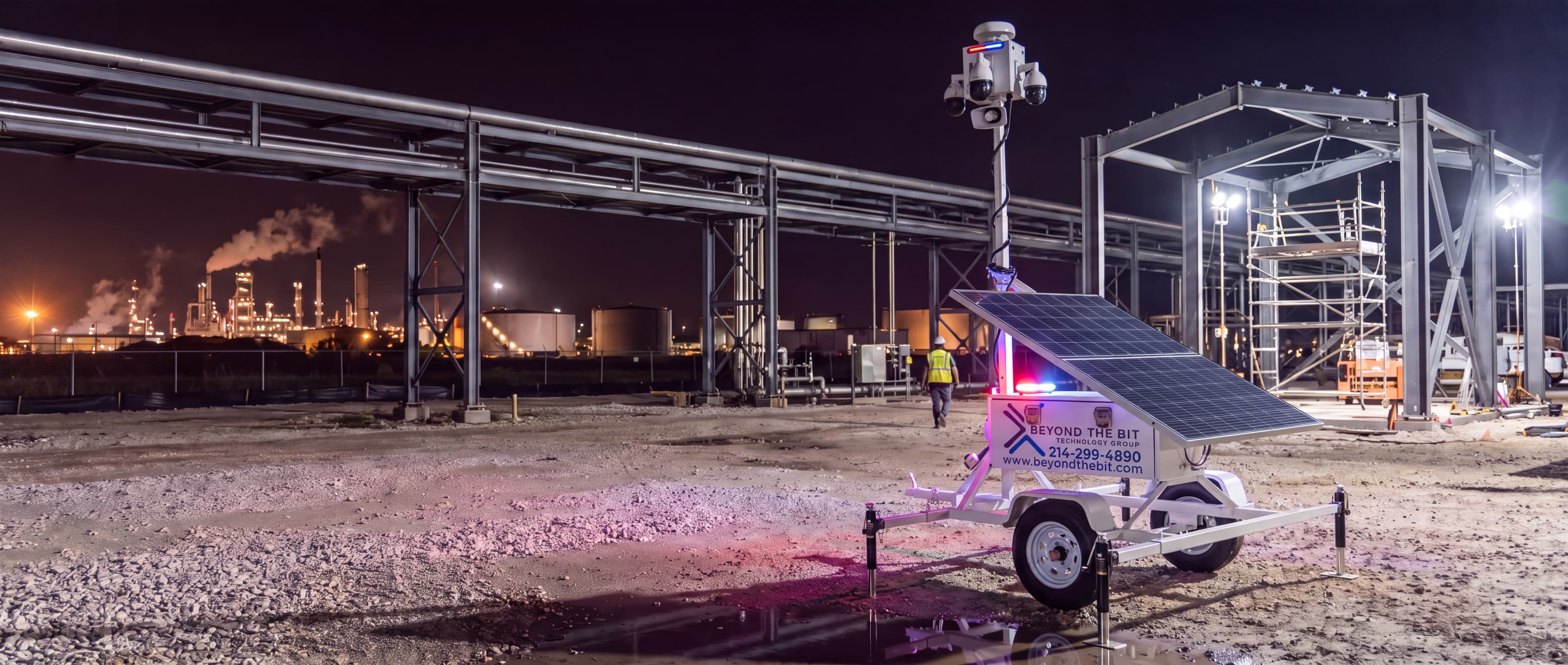
The honest limit of a guard on ground like this is line of sight. One person watches one thing at a time, from one place, and everything else is unwatched while they are doing it. A mast raised over flat open ground has the opposite property: nothing blocks the view, so one unit takes in a very large area, and the cameras do not get tired at four in the morning. On sites this size that usually means several trailers rather than one, positioned around the laydown, the equipment corral and the gate, with the highway and the neighboring pasture masked out so passing traffic generates nothing.
When something real crosses a zone, an operator at our Texas-licensed monitoring partner has live video within moments, fires the strobe, and speaks through the trailer directly. On a site where the entire plan depended on nobody being within twenty miles, being described out loud tends to end the visit quickly.
Getting a trailer to Abilene
About three and a half hours west on I-20 — past the range where a same-week single-trailer drop makes sense, and squarely in the range where a planned multi-unit deployment does. Abilene work is quoted for the length of the project rather than month to month, and typical deployment is 1–2 weeks from signed quote to trailers standing on the ground.
Units stage on our own trucks rather than a freight broker's schedule, which is what keeps a multi-trailer delivery to one date instead of three. Our crew places every unit, raises the masts and aims the cameras with the monitoring center live on the call, then walks your site team through the call list before driving back. Solar power and cellular data mean none of it waits on the site's utilities — on a campus build, permanent power is frequently the last thing to arrive and the laydown has been full for months by then. Repositioning as the work moves is planned into the deployment rather than treated as a new event. W-9, certificate of insurance and net-30 terms are standard; send them with the quote request if a vendor packet has to clear first.
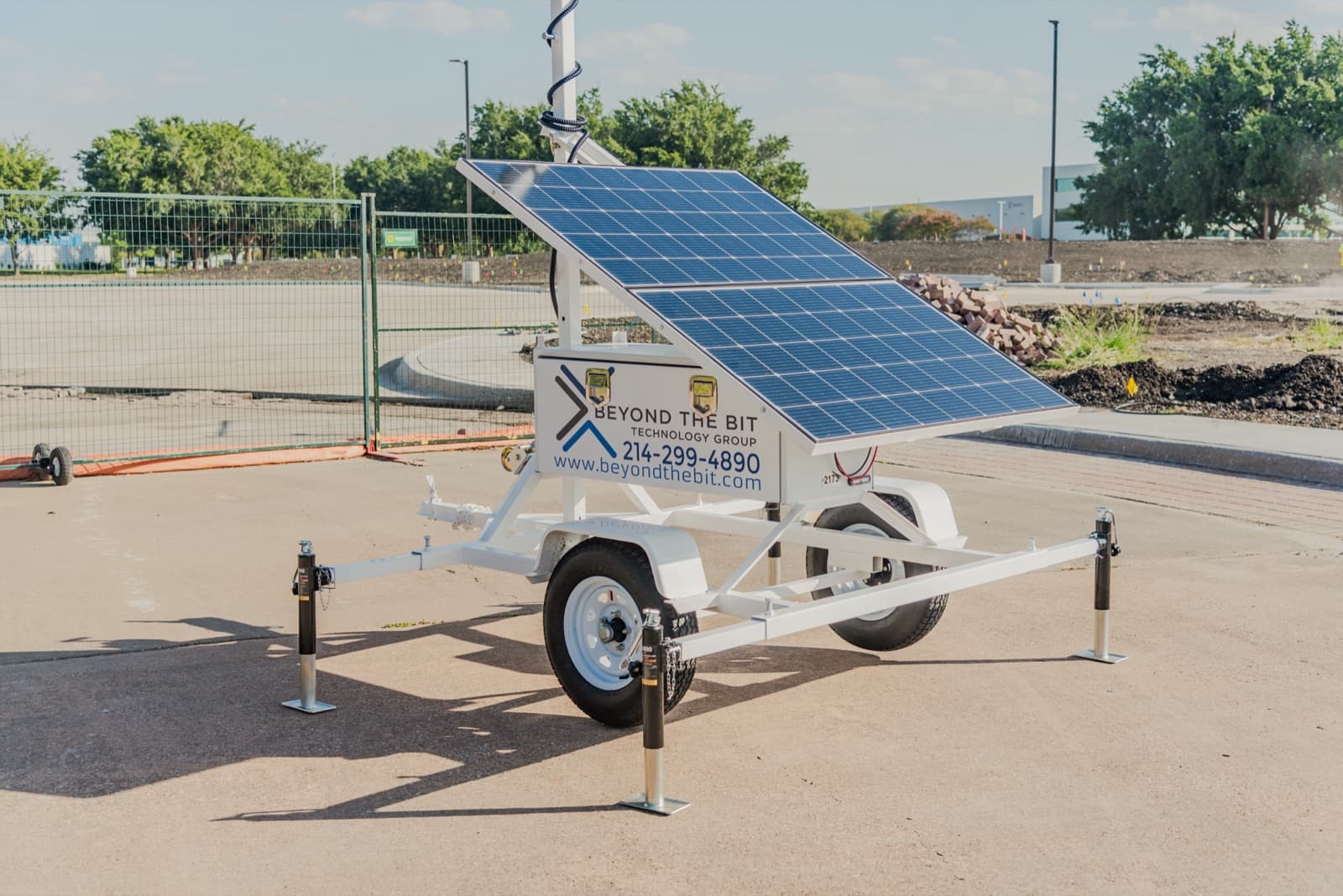
Field Photo — 2025 Deployment
Tongue, axle, two-section array and the equipment cabinet in one frame. Single axle, levelled on four drop-leg jacks once it is spotted.
Plate 02 — Chassis, three-quarter
Where These Trailers Work
Common Abilene deployments.
Watching a site in Abilene? Call 214-299-4890
Questions — Abilene
Asked before booking.
Abilene is outside four hours. Do you actually deploy there?
Yes. Four hours from Dallas is our core radius rather than a hard edge, and Abilene sits just past it at about three and a half hours on I-20. What changes at that distance is the shape of the job, not whether we take it: West Texas work is quoted as a planned multi-unit deployment for the length of the project rather than as a same-week single-trailer drop. Deployment is still the usual 1–2 weeks from signed quote, and the units stage on our own trucks.
How many trailers does a large data center site need?
More than one, and the site assessment is where that gets settled rather than guessed. The number comes from perimeter length, where the laydown and equipment corral sit relative to the gate, and how much of the ground has a clear sightline — flat open sites are efficient to cover because nothing blocks the view, but a campus perimeter is long enough that one mast cannot see all of it. We walk the ground, map the sightlines and the masking, and come back with a unit count and positions rather than a number picked off a drawing.
What is different about securing a data center build versus a warehouse build?
The copper. A distribution shell has its value in structural steel, precast and rooftop mechanical units. A data campus has its value in electrical gear that arrives early and sits outside — feeder cable, switchgear components, transformers, busway, conduit and grounding material, in quantities no warehouse ever stages. It is the highest-value laydown in commercial construction, and the replacement lead times on long-lead electrical equipment mean a theft costs the schedule far more than it costs the insurer.
Ready to get a trailer on your Abilene site? Get a quote built around your actual site.
Request a Free Site Assessment