
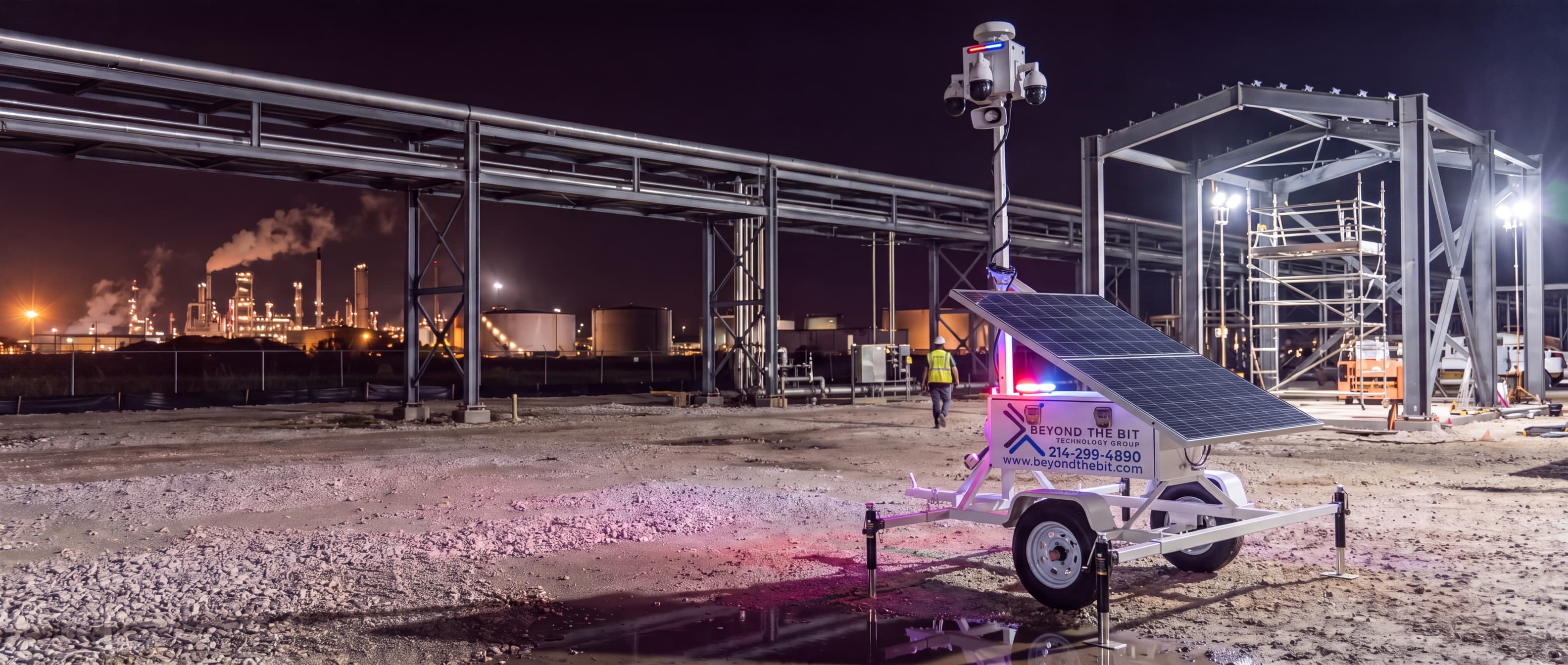
September 1, 2026 — Beyond the Bit Security Trailers
What makes a data center build different from any other jobsite?
The copper, and how early it arrives. For most of its schedule a large data campus is an electrical project with a building going up around it — switchgear lineups, transformers, generators, busway, grounding material and thousands of feet of feeder cable, delivered ahead of the interior work and staged outside because nothing is ready to take it.
That is the highest-value laydown in commercial construction, and it is sitting on gravel behind a temporary fence. A distribution shell has its value in precast panels and steel joists, which are difficult to move and nearly impossible to sell. A data campus has its value in material that fits in a truck bed and has a same-day resale path.
Why does a theft cost more than the material is worth?
Because of lead time. On this class of work the replacement cost of stolen electrical gear is often the smaller number. The larger number is the schedule: long-lead equipment cannot be re-bought at a supply house, and a delay on a project with a commissioning date at the end of it moves every trade behind it.
That inverts how the security decision should be framed. A camera that documents a loss gives you an insurance claim and a police report, both of which are worth having and neither of which returns the six weeks. The thing worth paying for is interruption — stopping the attempt while somebody is still standing on the gravel deciding whether to open the truck.
Where the exposure sits
Doesn’t a project this size already have security?
The campus itself usually does. Sites of that scale run their own gates, their own badging and their own guard force, and they are not the sites we spend most of our time on. The exposure is in everything being built around them, which almost never inherits the campus’s security programme.
- Supplier and vendor facilities going up on nearby industrial ground
- Contractor laydown and equipment yards leased on land that was pasture
- Substation and transmission work feeding the campus
- Housing, retail and commercial build-out chasing the workforce
- Batch plants, staging lots and overflow parking on the perimeter
Those sites have a temporary fence, a gravel laydown, and nobody on them between six in the evening and six in the morning — while carrying material on a schedule the anchor project is waiting on. It is the least-defended ground in the whole programme.
Where is this happening in Texas right now?
In several places at once, which is unusual. A multi-fab semiconductor campus is being built in Grayson County, fifty minutes up US-75, with an entire supplier and contractor economy following it in. Some of the largest data center construction in the country is going up on open ground outside Abilene. The Panhandle is building generation and data capacity at campus scale on parcels measured in thousands of acres.
Those three markets share a problem that DFW does not have. They are not short of construction; they are short of anyone local who can watch it. The nearest monitored-trailer fleets are usually Metroplex fleets, and most of them price the drive in before they price the work — which is how sites this valuable end up defended by a fence and a sign.
The practical consequence is that the security conversation on this work happens late and happens locally. The anchor project’s programme was designed years in advance by people who are never going to extend it to a supplier’s leased laydown four miles down the road. Meanwhile the supplier’s own contractor is standing on ground with no fence, no lighting and no permanent power, holding a switchgear order that landed ahead of schedule, and finding out what that exposure costs the first time something walks off it.
How many trailers does a campus-scale site need?
More than one, and the honest answer is that it comes out of walking the ground rather than reading a drawing. The number depends on perimeter length, where the laydown and equipment corral sit relative to the gate, and how much of the site has an uninterrupted sightline.
Flat open ground is the efficient case. A mast raised roughly two stories with nothing to block the view takes in far more area than the same unit would in a built-up market, which is why West Texas and Panhandle sites often need fewer units per acre than a dense urban infill job. But a campus perimeter measured in miles is still longer than any one mast can see, so coverage is designed around where the value concentrates rather than around the property line.
What does the response chain actually look like at three in the morning?
Motion analytics do the first pass and categorize what moved — person, vehicle, bicycle — inside zones drawn around the laydown, the equipment corral and the access road, with the highway and the neighboring parcel masked out so passing traffic generates nothing all night. A person inside a zone routes to an operator at our Texas-licensed monitoring partner.
That operator looks at the actual video and decides. Software flags; a person decides. If it is real, the strobe fires and the operator speaks through the trailer’s loudspeaker, describing what the person is wearing and which reel they are standing beside. On a site whose entire plan depended on being alone, that ends most visits. When it does not, the operator works the call list with video in hand, which is what gets a sheriff’s office moving at the time rather than taking a report in the morning. The full sequence is on monitoring and response.
When should this be specified — and by whom?
Earlier than it usually is, and by whoever owns the schedule rather than whoever owns the fence line. The material that most needs watching arrives before the building can hold it, which means the security decision has to be made during procurement rather than after the first loss.
Practically, that means raising it when the long-lead electrical package is ordered. If switchgear and feeder cable are landing in eight weeks and permanent power is landing in eight months, the gap between those two dates is the exposure, and it is knowable in advance. That is the same argument we make on construction sites generally, but on this class of work the numbers are large enough that it usually only has to be made once. Sites that have already lost a reel of feeder cable do not need the conversation, and copper is where almost all of them start.