
Service Area — Midland County
Watched in
Midland, Texas.
Midland is about five hours west, past our core radius, and we will say so plainly: this is planned multi-unit work quoted for the distance, not a phone call on Tuesday and a trailer on Thursday. What brings us out here is that the Permian has the purest version of the problem this equipment exists to solve. Pads, tank batteries and service yards with no power, no fence worth the name, and nobody within twenty miles — in a basin where organized theft has grown serious enough that the state stood up a dedicated task force to work it.
Well pads, tank batteries, and the I-20 run to Odessa
Permian exposure does not look like construction exposure. A well pad or a tank battery is a permanent, unmanned, high-value installation sitting on a lease road, often miles from the nearest paved surface and always miles from the nearest person. What walks off is specific and well understood locally: copper from motors and gathering equipment, batteries, catalytic converters, tools, chemicals, plant, and in the organized cases whole tanker loads of produced oil taken straight off a lease.
The service side is a different shape. Midstream and oilfield service laydown yards along the I-20 corridor between Midland and Odessa hold pipe, valves, plant and equipment on open ground behind a fence that anyone with a cutter opens in a minute. Inside the Midland loop the commercial and civic construction is conventional, and it fails the way conventional construction fails everywhere. It is the remote assets that are unusual, and they are what most of our Permian conversations are actually about.
Why the state got involved, and what that means for a site
Oilfield theft in the Permian stopped being an opportunistic nuisance some time ago. The chairman of the Texas Railroad Commission has said publicly that roughly forty percent of producers have experienced some form of theft, and the Legislature created a dedicated task force in its 2025 session specifically to work petroleum and oilfield theft, with DPS running operations against organized rings. When enforcement scales up to that level it is because the activity did first.
What it means on a specific lease is that the people you are defending against are not usually improvising. They know which pads are unmanned, what a gathering line is worth, and how long they have before anybody could possibly arrive. Time is the whole asset, and distance is what gives it to them.
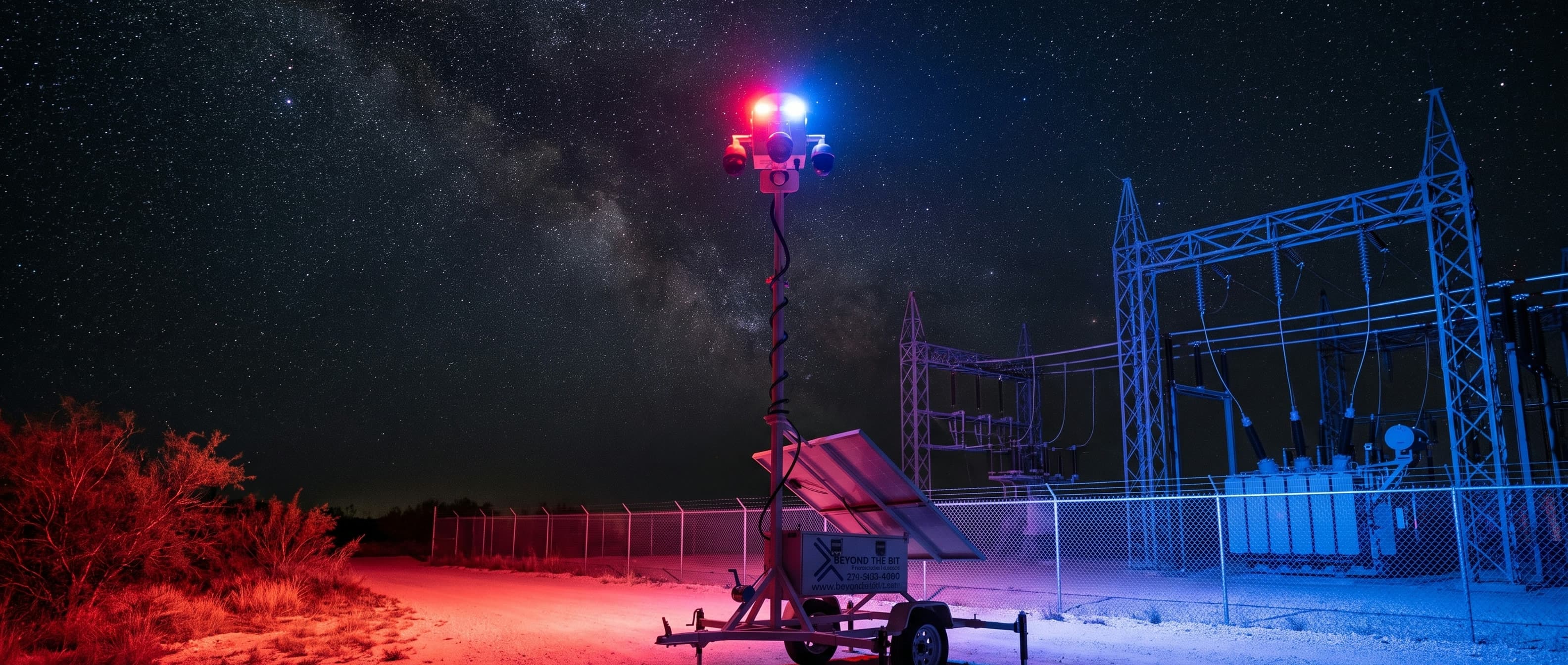
A monitored trailer attacks the time rather than the fence. The unit brings its own solar power and its own cellular connection, so it works on a lease with no service and no signal infrastructure of its own. Detection zones get drawn around the pad equipment, the tank battery and the access road, with the surrounding rangeland masked out. When somebody crosses into a zone, an operator at our Texas-licensed monitoring partner is looking at live video within moments — not a sensor trip, actual video — and can fire the strobe and speak through the loudspeaker before a truck is loaded. On ground where the plan depended on being completely alone, that is a short conversation.
Getting a trailer to the Permian
About five hours west on I-20, and we do not pretend that is a routine drive. Permian work is quoted as a planned deployment for the length of the project or the campaign, typically covering several sites at once, and it is the kind of job worth scoping properly rather than rushing. Typical deployment is 1–2 weeks from signed quote to units standing on the ground.
Trailers stage on our own trucks, which is what keeps a multi-site delivery on one schedule instead of a broker's. Our crew places each unit, raises the mast and aims the cameras with the monitoring center live on the call, then walks your field contact through the call list — and on remote assets the call list matters more than anywhere else, because the person who can actually get to the site may be an hour away and needs to be the right name. Solar power and cellular data mean nothing waits on utilities that a lease road does not have. Units can move as a campaign moves; repositioning across a programme is planned in rather than billed as a new event. W-9, certificate of insurance and net-30 terms are standard.
Field Photo — 2025 Deployment
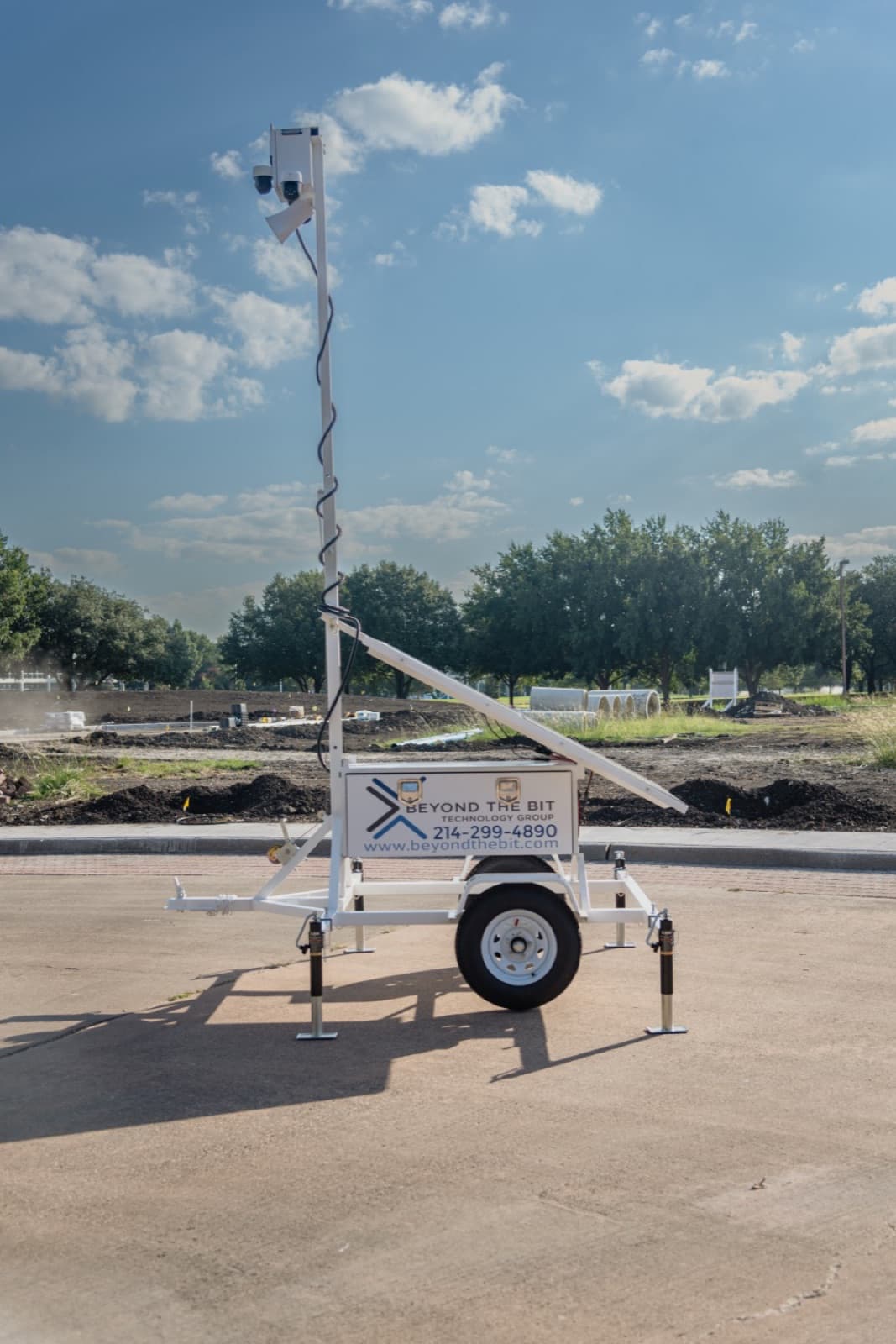
Placed inside the perimeter fence with the mast head clear of the stacked material. Trades keep working around it; the unit does not need power, trenching or a foundation.
Plate 03 — On site, mast raised
Where These Trailers Work
Common Midland deployments.
Watching a site in Midland? Call 214-299-4890
Questions — Midland
Asked before booking.
You are based in Richardson. Why would we use you in the Permian?
For a single trailer on a single pad, you probably would not, and we would tell you that. Where it makes sense is a programme — several remote sites across a lease position or a service company's yards, deployed together, monitored through one chain and one call list. That is the shape of work worth five hours of driving, and it is how we quote West Texas: planned multi-unit deployments for the length of the campaign, staged on our own trucks, rather than one-off drops.
Will a trailer work on a lease road with no power and no site internet?
Yes — that is the specific case this equipment was built for. The trailer carries its own solar panels and battery bank and connects over a cellular modem, so it needs no shore power, no generator, no fuel run and no site network. It is towable to anywhere a truck can reach and sits on its own stabilizer jacks rather than a pad or foundation, which is what lets it cover an unmanned pad or tank battery that has never had a service entrance.
Can a camera trailer do anything about organized oilfield theft?
It changes the economics of the attempt, which is the realistic goal. Organised theft depends on unhurried time on an unwatched site, so the thing that helps is interrupting the visit early with a live voice and a strobe, and producing verified video when it does not stop. Video of a burglary actually in progress is what gets a sheriff's office or DPS to move at the time rather than take a report the next morning, and it is what an insurer and a prosecutor can both use afterwards. It is not a fence and it is not a guard, and anyone who tells you a trailer makes theft impossible is selling something.
Ready to get a trailer on your Midland site? Get a quote built around your actual site.
Request a Free Site Assessment