
October 6, 2026 — Beyond the Bit Security Trailers
How many security trailers does a Houston jobsite actually need?
It comes down to how many separate areas on the site actually hold value, not the total acreage. A single trailer with its mast raised covers a long run of fence line in one field of view, so the real question is how many distinct laydown yards, equipment corrals, or staging pads the job has, and whether a straight sightline connects them. A site walk is what turns that into an actual number.
This is also why Houston work reads differently from a DFW job of the same square footage. A tight urban pad in Plano or Frisco might run on one unit for the whole build. A Ship Channel plant expansion, a Grand Parkway greenfield pad, or an Energy Corridor office deck almost never does, because the ground itself is built at a different scale.
That said, bigger doesn't always mean more units. A Texas Medical Center expansion job can sit on a footprint smaller than a Grand Parkway pad and still need close spacing, because the lot is hemmed in by live hospital operations on every side and material stages right up against a street that never goes quiet. Acreage is a bad proxy for unit count either way, which is exactly why a guess off a site plan alone tends to be wrong in both directions.
Why does a Houston site usually need more units than a DFW site?
Because the perimeter is longer and the exposed areas are further apart, not because Houston crime runs any differently. A Ship Channel contractor laydown can run several hundred feet along one fence line alone, and a Grand Parkway pad often sits on raw ground that was rice field or pasture a year ago, with no neighboring activity to notice anything after dark.
Houston's commercial construction isn't one market, it's four, and each one carries a different shape of exposure. Ship Channel industrial and petrochemical work stages pipe, valves, and structural steel across acres for months at a stretch. Texas Medical Center expansion jobs run on tight, hemmed-in urban lots that can't simply be sealed off because the buildings around them never close. The Energy Corridor along I-10 carries structured parking decks and curtain wall exposed to a frontage road that never goes quiet. Four different footprints, four different theft patterns, and none of them covered by one trailer dropped at the gate.
What's actually driving the unit count, if not total acreage?
Four things, in order: perimeter length, the number of separate material or equipment areas, how long the project runs, and anything that blocks a sightline between zones — a stacked container row, a half-built tilt wall, a berm. A compact site with everything staged in one yard can often run on fewer units than a sprawling one with material spread across three corners, even if the sprawling site is smaller on paper.
That's the information a free site assessment is built to gather, either by walking the ground or working from your site plan and photos. It comes back with a placement plan and a count, not a guess, and every unit on the order runs under the same one flat monthly rate, bundling monitoring, delivery, install, cellular data, and teardown, so a bigger order doesn't mean a pile of separate line items to track.
Does it ever make sense to run just one trailer on a Houston job?
Sometimes, on a small, contained pad with one clear sightline over the whole site — but it's the exception, not the plan to start from. Richardson to Houston runs about four hours, and a single unit on a short rental at that distance is a poor trade for everybody. Multiple units on a full project-length term is the better match, and it's also how Houston industrial and distribution construction actually gets built: long programs running months of exposure, not two-week jobs.
Deployment still runs the same one-to-two-week window as a Metroplex order, signed quote to trailers standing on site, because the constraint is scheduling and install, not the drive. A fleet of nearly 100 trailers means a multi-unit Houston order isn't waiting on equipment to free up somewhere else first, and the standard W-9, certificate of insurance, and net-30 terms run through your normal procurement path without a special exception for the distance.
How does raising the camera mast cut down on how many units you need?
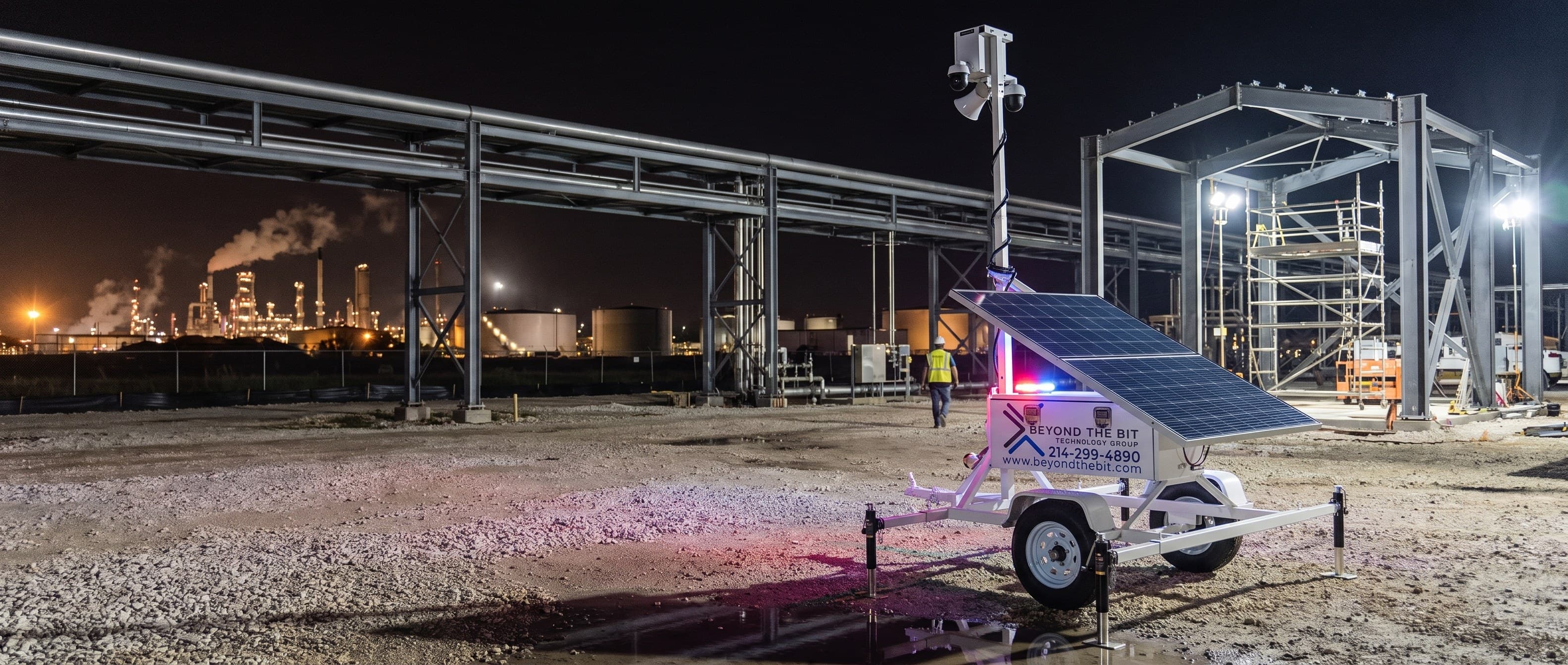
Height does most of the work. Raising the camera head roughly two stories puts a long run of fence line inside one field of view, which is the reason unit count tracks the number of distinct areas on a site rather than its square footage. The same math applies on a large data center or chip fab pad, where the site is big but the material is often grouped into just a few zones.
Detection zones get drawn around what actually matters — the pipe racks, the conex row, the equipment corral — while the frontage road, a neighboring plant's traffic, and the public right-of-way get masked out so they never trigger an alert. Cameras categorize what crosses a zone as a person, a vehicle, or a bicycle, so a truck running the perimeter road at 3 a.m. doesn't wake anybody up on its own.
That masking is also the difference between a camera trailer and a guard walking the same fence line. A person on foot covers whatever's in front of them at that moment and nothing else; a mast raised over a long perimeter holds the whole run in view at once, which is most of why fewer units end up covering more ground than people expect going in.
Sizing a Houston order, at a glance
What happens once something crosses into a zone that should be empty?
A live operator at our Texas-licensed monitoring partner has the video in front of them within moments of the alert, not after it. They look at what's actually on screen, decide whether it's a problem, and if it is, they can fire the trailer's strobe and speak through its loudspeaker directly, describing what the person is wearing in real time.
That specificity is the point more than the volume is — a siren is background noise on an industrial site, but a voice that can clearly see you usually isn't. If the person doesn't leave, the operator is already working your call list and building the kind of video-verified report that gets a real response moving, rather than a queued alarm ticket with nothing behind it. None of that depends on site power, a fiber drop, or an IT ticket — the trailer runs on its own solar and battery and starts working the day it lands on raw dirt, which on a Grand Parkway greenfield pad is often months before permanent power shows up.
What should a Houston superintendent or project exec do next?
Start with the site plan rather than a guess at the number. Send the perimeter, the material zones, and the project timeline to a site assessment and the count comes back matched to how the ground is actually laid out, whether that's one unit on a contained urban pad or a dozen spread across a Ship Channel turnaround.
A Houston order is planned work, not a same-week drop, and that's worth building into the bid package early rather than after the first load of pipe or conduit has already gone missing from a corner of the site nobody was watching.