
Cost
What it costs, and what moves the number.
Every quote is built around one site, so this page does the next most useful thing: it tells you exactly what goes into the rate, what is already included, and which decisions actually change the total. Then you can call us and compare a real number to a real budget.
The Short Answer
What does a security camera trailer rental cost?
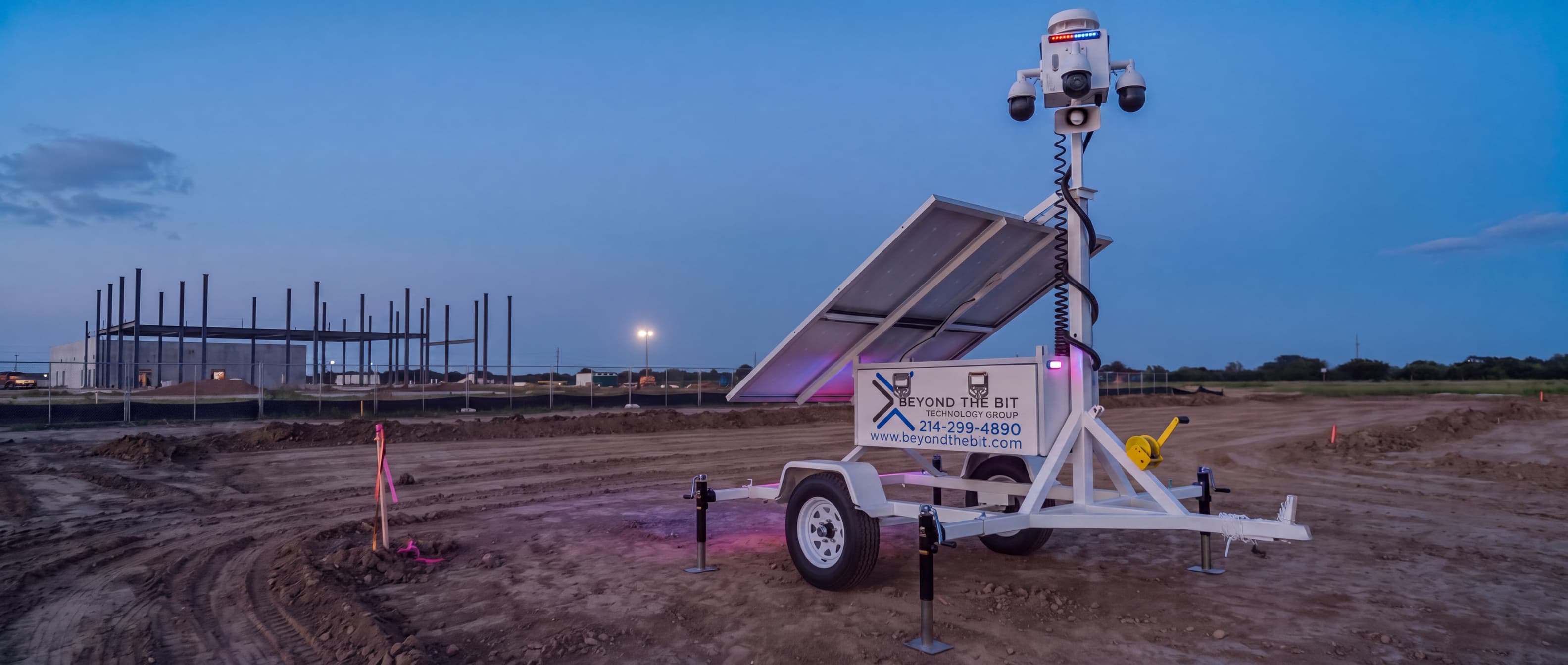
A monitored security camera trailer rents at a flat monthly rate that covers the unit, delivery, live monitoring, power, connectivity, and teardown. What that rate comes to depends on how many units the site needs and how long it needs them, which is why we quote per site instead of publishing one number that would be wrong for almost everyone reading it.
The practical version: one trailer on one site for a normal term is a single predictable monthly line item, not a deposit plus a delivery fee plus a monitoring subscription. Coverage runs month to month, so a build that finishes early or a yard that empties after peak is not carrying security into a quarter it does not need it.
In The Rate
What is included in the monthly rate?
Everything it takes to get the trailer watching your site and off it again. The things vendors in this category commonly bill separately, delivery and relocation in particular, are part of the rate here.
Delivery and placement
Our crew hauls the unit, walks the site with you, sets it, and aims the cameras with the monitoring center live on the other end.
Live video monitoring
Trained operators watching detections and acting on them: audio warning, call list, police escalation when it is real.
Power and connectivity
Solar panels, battery storage, and cellular data. Nothing to trench, no service drop to schedule, no port on your network.
Maintenance for the term
Service on the unit while it is on your site is ours to handle. A trailer that stops watching is our problem, not a repair bill for you.
Teardown and pickup
When the phase or the season ends, we come get it. Nothing is left behind in your yard and nothing is billed for removal.
Cost Drivers
What actually changes the number?
Four things, in roughly this order of impact. If you can answer these before you call, the quote conversation takes about ten minutes.
How many units the site actually needs
This is the biggest factor by far. One raised mast covers a substantial stretch of ground, but a long truck court, a site with two entrances, or a property where the mechanical pads and the vehicle drive sit on opposite ends will need coverage that overlaps rather than a single unit stretched past what it can see. We walk the site before quoting so the count is based on the layout instead of the square footage.
How long the site needs watching
A multi-phase build carrying trailers for the length of a project prices differently from a two-week event placement or a peak-season yard. Longer commitments are the cheaper way to buy coverage, but the arrangement stays month to month either way.
Where the site sits
Everything stages from our yard in Richardson, so the Dallas–Fort Worth core is the shortest haul we run. Tyler and East Texas are core territory rather than an exception, and statewide work in Austin, Houston, San Antonio, or Waco is normal for multi-unit projects.
What the site is carrying
A laydown yard staging copper and equipment through rough-in is a different watching job from an empty lot that needs a presence. What the operators are looking for, and where the cameras have to be pointed, follows from what is actually at risk.
Comparison
Is a trailer cheaper than a security guard?
For watching a whole site overnight, almost always. The reason is structural rather than a matter of rates: one guard covers one post, facing one direction, for the length of one shift. Covering a site around the clock means paying for three or four shifts every day of the week, plus the rotation that absorbs weekends, holidays, and the shift somebody calls out of.
A trailer covers the same ground continuously for a single monthly rate, and the live operator behind it can issue an audio warning and work a call list the moment something is verified. What a guard can do that a unit cannot is make a judgment call in person, check an ID, and sign for a delivery. Plenty of sites run both: a guard on the gate during working hours, a trailer watching everything after the gate closes.
We put the full breakdown, including the hourly rates DFW guard companies commonly quote, in a separate piece on guards versus camera trailers.
Common Questions
Asked before the quote.
Why isn't the price listed on this page?
Because the honest number depends on the site. Unit count, how long the site needs coverage, and where it sits all move it, and a published figure would be wrong for most callers. Send us the site and you get a real number, usually the same day.
Is there a separate delivery or setup charge?
No. Delivery, placement, aiming the cameras, and teardown at the end are part of the rate rather than line items added afterward. The number you approve is the number you pay each month.
Do I have to sign an annual contract?
No. Coverage runs month to month, which is what most jobsites, seasonal yards, and vacant properties actually need. When the phase ends or the building leases, you tell us and we pick the unit up.
What happens to the rate if the trailer has to move?
Repositioning a unit on the same site as the work moves is part of the service, not a change order. Moving to an entirely different property is a scheduling conversation with our crew.
Is a camera trailer cheaper than hiring a guard?
For overnight coverage of a whole site, almost always. One guard covers one post for one shift, so around-the-clock coverage means stacking three or four shifts a day, every day, plus overtime and holiday premiums.
How quickly can I get a number?
Most quotes go out within a business day of the site assessment, and deployment typically runs 1–2 weeks from signature. Calling 214-299-4890 is the fastest route if you already know the site and the dates.
Tell us the site, the dates, and what is sitting on it. You get a number built around that, from a fleet of nearly 100 trailers staged in Richardson.