
Service Area — McLennan County
Watched in
Waco, Texas.
Waco sits about ninety minutes down I-35, which makes it closer to our Richardson yard than some of the Metroplex work we do — a Waco job is a shorter run than a far-west Fort Worth one. So it behaves like a DFW market rather than an outpost, with the same deployment window and no distance premium. What Waco has a lot of is the exact kind of construction a camera trailer suits best: long, flat, repetitive distribution and industrial builds where months of tilt-wall panels and steel joists lie in the open behind a temporary fence.
The I-35 corridor, tilt-wall distribution, and Central Texas industrial parks
The I-35 widening corridor has kept Central Texas in more or less continuous roadwork and adjacent development for years, and the frontage either side of it has filled with distribution and light industrial construction serving the run between DFW and Austin. Those sites share a shape: very large flat footprints, a long temporary fence, a gravel or caliche laydown that holds structural steel and precast for months, and a truck court that is paved and open well before the building is enclosed. Central Texas manufacturing and industrial parks add equipment and process material to the same picture, on parcels where the neighbouring lot is often still empty. It is unglamorous construction and it is unusually exposed, because the value sits outside the building for most of the schedule rather than inside it.
Tilt-wall schedules leave material outside for months
On a vertical urban project, material moves indoors quickly and the enclosed shell becomes its own protection. A tilt-wall distribution build inverts that. Panels are cast on the slab and stand braced in the open for weeks. Steel joists and deck arrive and stack in the laydown. Rooftop mechanical units are delivered and staged at grade before there is a roof to set them on. Electrical gear, conduit, and cable reels come in ahead of the interior work. For most of the schedule the most valuable things on the site are sitting outside, in the dark, behind a fence that exists to satisfy a requirement rather than to stop anybody.
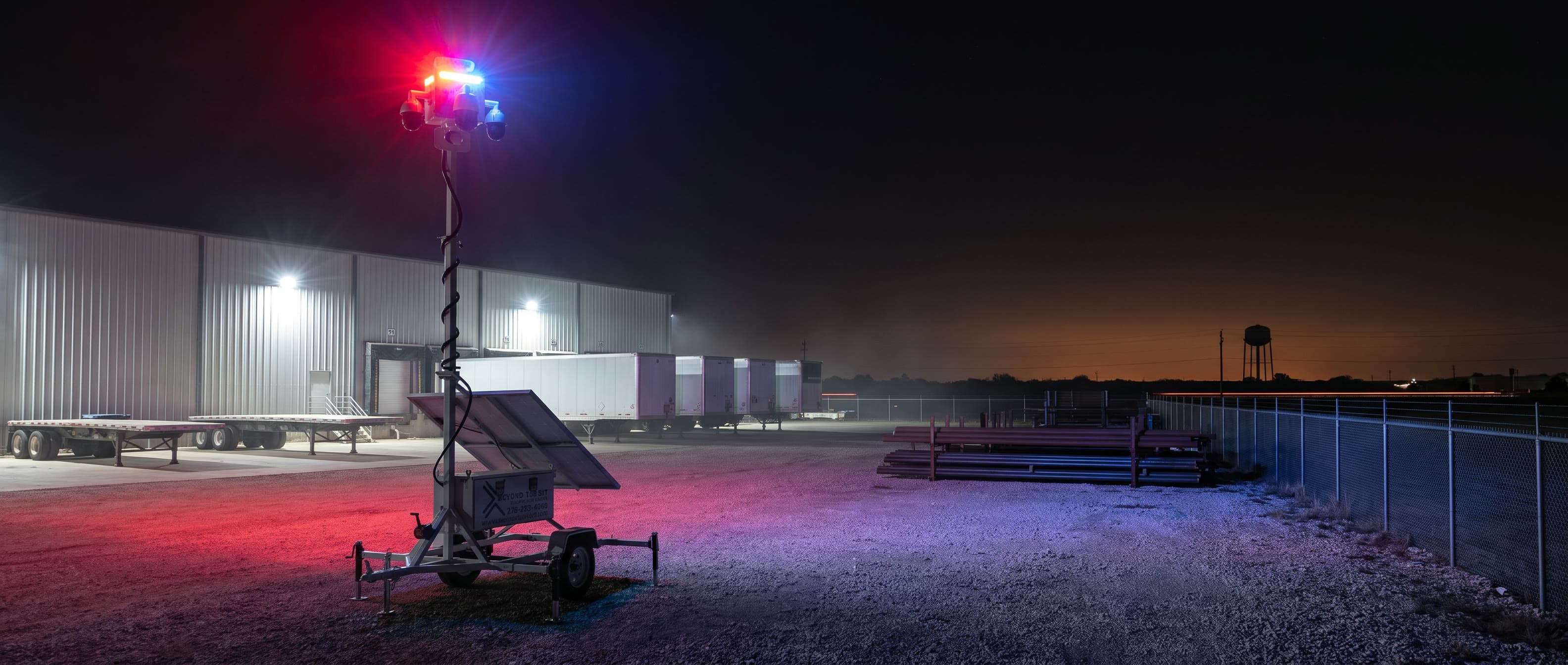
A camera trailer suits that geometry unusually well. One mast raised roughly two stories over a flat site takes in a great deal of ground, because there is nothing to block the view — no towers, no structured parking, no adjacent buildings casting shadows. Detection zones get drawn around the laydown, the equipment corral, and the truck court, while the interstate frontage and the neighbouring empty lot are masked out entirely. Cameras categorize what moves as a person, a vehicle, or a bicycle, so headlights running the frontage road do not generate anything. When something enters a zone that should be empty, an operator at our Texas-licensed monitoring partner has live video within moments, fires the strobe and speaks through the trailer if it is a real person, and works your call list while deciding whether this is a police call.
What that looks like on a Waco site
A distribution shell off the I-35 frontage, panels braced, joists stacked in the laydown, rooftop units staged at grade waiting on the crane. The site is fenced and gated and completely empty from six in the evening. At 2:30 a.m. a truck pulls onto the shoulder and somebody walks the fence line looking for a spot away from the road — which on a site this long is not hard to find.
The camera picks them up as a person the moment they cross into the laydown zone. An operator is watching before they reach the first stack. The strobe fires and the loudspeaker describes them and the truck parked on the shoulder. On a site where the plan depended on nobody being there, being named out loud ends it quickly. If it does not, the operator is already working the call list with video in hand.
What makes this workable rather than exhausting is everything that did not trigger an alert: the traffic on I-35 all night, the headlights sweeping the frontage, the neighbouring empty lot. Those are outside the zones on purpose. A system that cries wolf on a corridor site gets muted by the second week, and a muted system is the same as no system.
Getting a trailer to Waco
Ninety minutes down I-35, scheduled exactly the way we schedule a Fort Worth or Frisco delivery — no special trip, no distance surcharge, no longer quote turnaround. Typical deployment is 1–2 weeks from signed quote to a trailer standing on your site, and because our fleet runs to nearly 100 trailers, a multi-unit order for a large distribution site does not wait in line behind other jobs.
Our crew handles delivery, placement, mast raise, and camera aim with the monitoring center live on the call, then walks your site team through the call list before driving off. If a project runs in phases, trailers can move as the exposure moves — the unit that watched the laydown during structure is often better placed at the truck court once the building is enclosed, and repositioning is part of the job rather than a separate event. W-9, certificate of insurance, and net-30 terms are standard, the same paperwork a Metroplex site gets.
Field Photo — 2025 Deployment
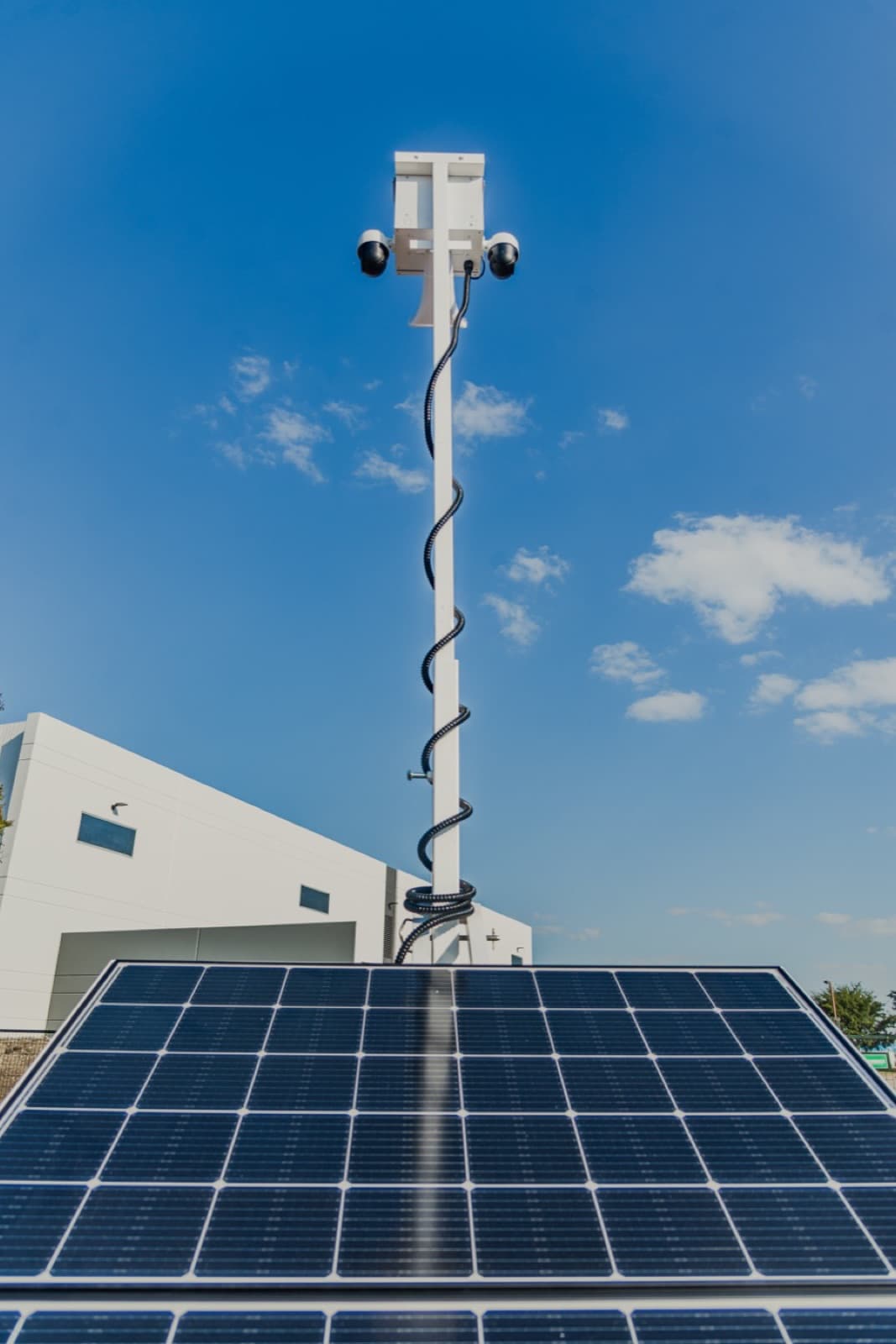
Two-section solar array feeding the battery bank in the cabinet. No generator, no shore-power run — the unit stands where it is spotted.
Plate 08 — Array to camera head
Where These Trailers Work
Common Waco deployments.
Watching a site in Waco? Call 214-299-4890
Questions — Waco
Asked before booking.
Does Waco cost more than a DFW site because of the drive?
No. Waco is about ninety minutes from our Richardson yard — a shorter run than some Metroplex jobs — so it is scheduled and quoted as normal territory with no distance premium and the same 1–2 week deployment window. Quotes are one flat monthly number with delivery, setup, monitoring, cellular data, and service included, and that structure does not change because the site is on I-35 instead of I-635.
Can a trailer be moved as the job progresses?
Yes, and on long tilt-wall and distribution builds it usually should be. The best position during structure — overlooking the laydown and the panel field — is often the wrong one once the building is enclosed and the exposure shifts to the truck court and the yard. Tell us the phasing when we do the site assessment and we will plan the moves into the deployment rather than treating each one as a new event.
What actually goes missing from a Central Texas distribution site?
Rarely the tilt-wall panels, and rarely the joists — the things that are hardest to move are the things that stay. What walks is everything with a resale path and a short carry: copper wire and cable reels, conduit, welding leads, small plant and power tools, batteries and fuel, and increasingly the catalytic converters off anything parked overnight. Rooftop mechanical units staged at grade are the expensive outlier, because they are worth a great deal and sit outside for weeks waiting on a crane. That mix is why detection zones go around the laydown, the equipment corral, and any parked plant rather than around the building footprint — the building is not what is at risk.
Ready to get a trailer on your Waco site? Get a quote built around your actual site.
Request a Free Site Assessment