
Industry — Energy & Utilities
Energy & Utility Site Security Cameras
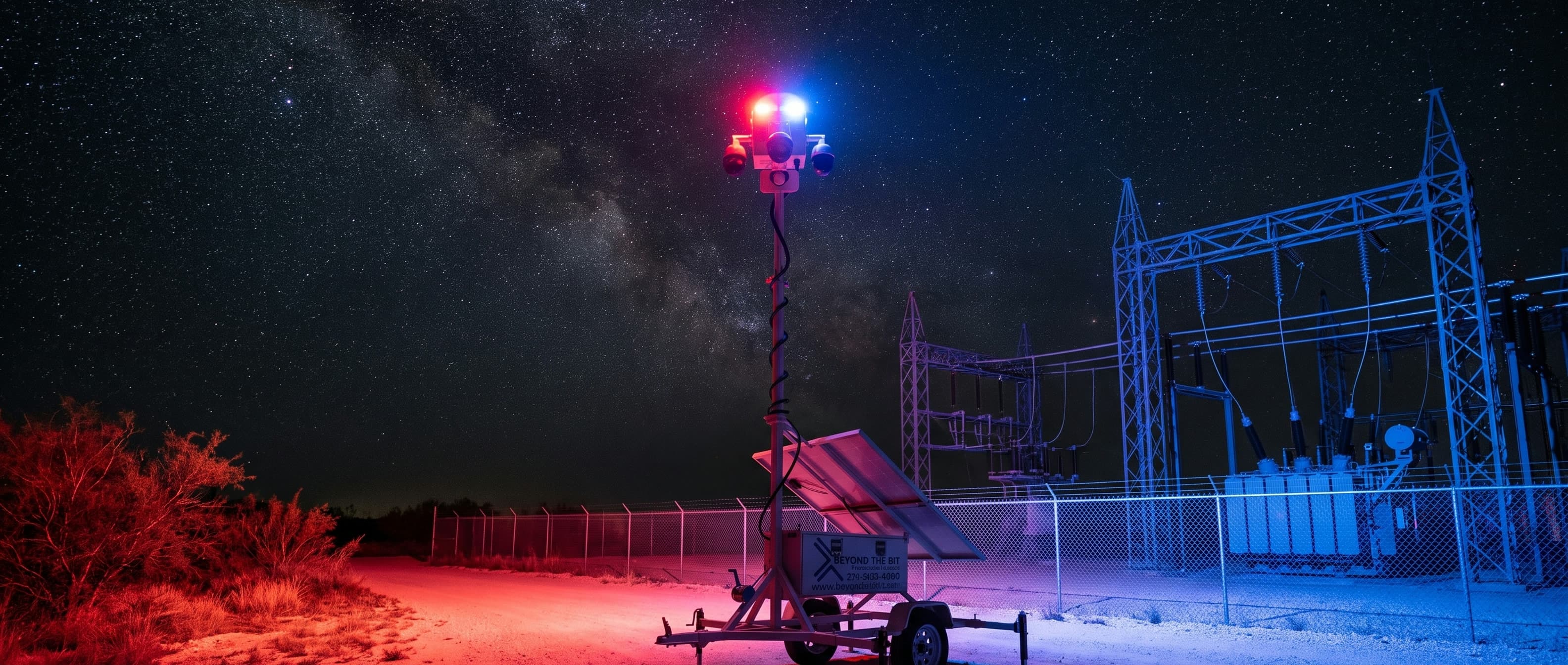
Energy sites are built to run without people, which is exactly what makes them worth stealing from. A substation, a well pad, or a laydown yard can go days between visits, out past the last streetlight, with a fence and a sign as the only thing between grounding copper and a scrap buyer. This trailer puts live eyes on a site that has no power to give it, no crew to watch it, and no neighbors to call it in.
Exposure
Why remote energy sites get hit repeatedly.
Two things make these sites different from a jobsite or a lot: distance and repetition. Nobody drives past, so a theft can take hours instead of minutes. And because the copper gets replaced after the first hit, the same site gets worked again on a schedule. The second visit is often bigger than the first, because by then whoever came back knows the layout.
Copper grounding and wire theft from substations
Grounding conductors are the target, and pulling them does more than cost the copper. It takes out the safety system that protects the equipment and anyone working on it, and the outage risk and repair bill dwarf the scrap value by orders of magnitude.
Remote sites with no power, no fence line, and no witnesses
A site an hour from the nearest crew and out of sight of any road gives a thief unhurried working time. That distance is also why a wired camera system is hard to justify at these locations, which is exactly why they keep getting hit.
Equipment and tool theft from well pads and laydowns
Pumps, generators, spooled cable, and pipe staged for the next phase all sit out in the open on pads and laydown yards. Materials waiting on a crew are the easiest kind to take, because nobody is scheduled to look at them until the crew shows up.
Trespass onto live electrical infrastructure
Someone cutting into energized equipment is a safety and liability event before it is a theft loss. Getting a voice on them while they are still outside the fence matters more here than it does anywhere else on this site.
Deployment
How does a trailer work at a site with no power?
It brings everything with it. Solar panels and battery storage run the unit, and it connects over cellular, so a location with no service drop and no network is a normal deployment rather than a hard one. That is the reason this format fits energy sites better than a fixed install: there is nothing to trench, wire, or connect.
Placement is usually the access road or just inside the perimeter, angled to cover the gate and the equipment yard together. Approach matters more here than at an urban site, because there is generally one way in, and watching it gives an operator time to verify and warn before anyone reaches the fence.
Coverage follows the work. A pad under construction, a laydown holding material for a phase, or a substation that has already been hit once all have a window where they need eyes and a point where they do not. Moving a towable unit to the next site is scheduling, not a new installation.
Field Placement
Deployed on the access road or inside the perimeter of a site that may have no power and no crew for days at a time.
Field Photo — 2025 Deployment
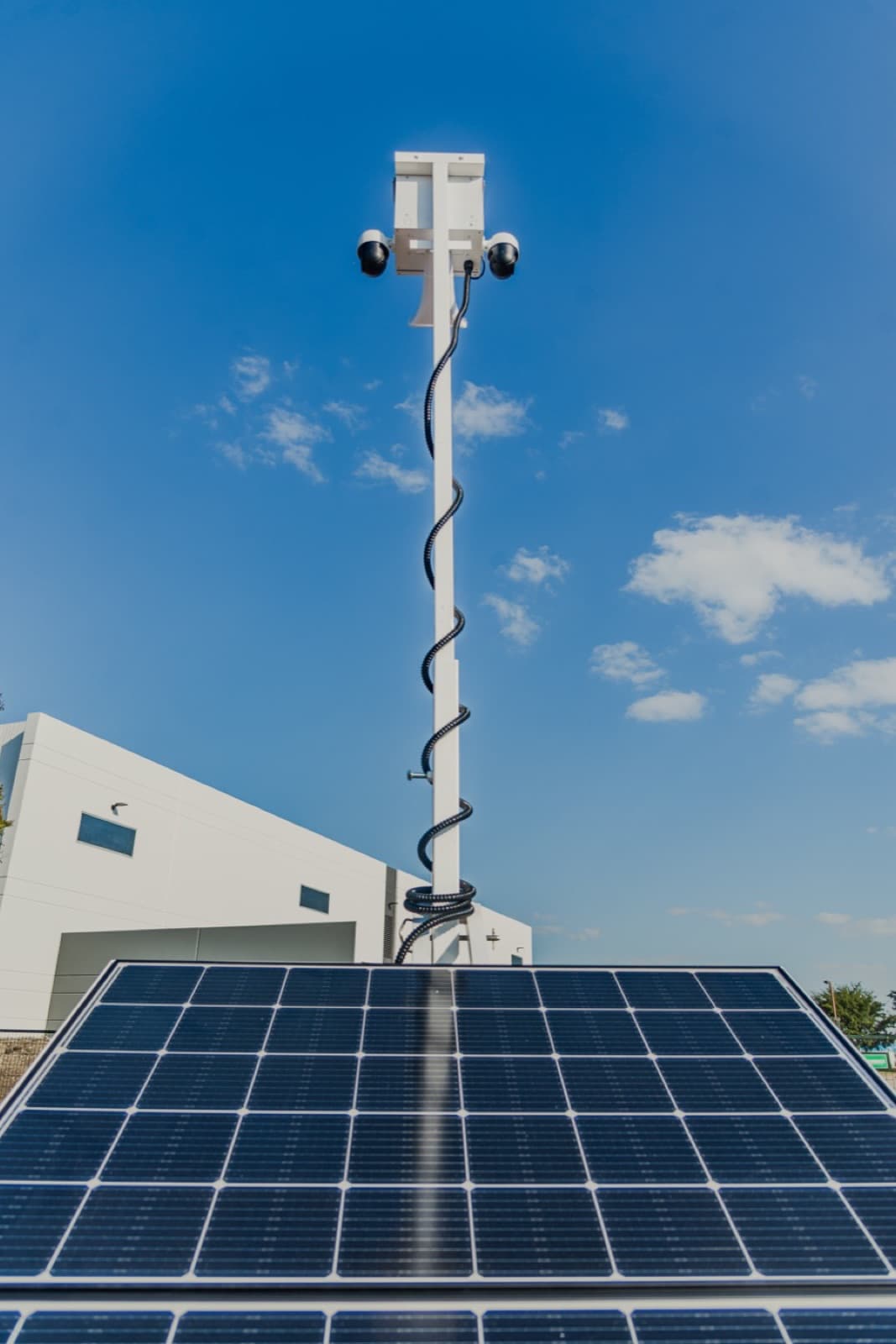
Two-section solar array feeding the battery bank in the cabinet. No generator, no shore-power run — the unit stands where it is spotted.
Plate 08 — Array to camera head
Procurement
Who buys security for a utility or energy site?
Utility operations managers, EPC contractors, and site supervisors are the ones who see the exposure first, usually right after an incident or right before a phase that stages expensive material at a remote pad. The EPC often carries it on the project rather than the asset owner carrying it on the site.
The number that justifies it is rarely the copper. It is the outage, the replacement of damaged equipment, and the crew time to make the site safe again. Sites that have already been hit once are the easiest cases to make, because the second theft is usually a matter of when.
Documentation follows the same path as any other site vendor: W-9, certificate of insurance with the additional-insured language your project requires, and net-30 after signature. Multi-site programs run on one account, with units assigned by which locations are exposed this quarter.
or call 214-299-4890
Common Questions
Asked by energy & utilities buyers.
Our site has no power and no cell service at the gate. Does it still work?
Power is never an issue: the trailer runs on its own solar and battery storage. Cellular coverage is the one thing we check before quoting, since the unit needs a signal to reach the monitoring center. We confirm that during the site assessment rather than after delivery.
Can it cover a site that is fenced but unlit?
Yes. The cameras are built for low light and the unit carries its own lighting, so darkness is the normal operating condition rather than a limitation. Unlit sites are where a live operator adds the most, because there is nothing else out there to notice an approach.
What happens if someone comes through the fence at 3 a.m.?
Detection goes to a live operator who verifies what the cameras are seeing. If a person is on site, they get a warning through the speaker and the escalation follows from there, including the call list and police. On live electrical infrastructure, that warning is often what turns someone around before a safety incident happens.
Can trailers move between sites as a project phases?
Yes. Repositioning to the next pad, substation, or laydown is a call to our crew rather than a new install, and a fleet of nearly 100 trailers means a multi-site program does not wait on equipment. Deployment typically runs 1–2 weeks from a signed quote.