
September 15, 2026 — Beyond the Bit Security Trailers
What's different about securing a jobsite in Tyler and East Texas?
Not the trailer, and not the monitoring chain behind it — those work the same wherever the unit sits. What changes is the market around the site. East Texas has a much thinner bench of monitored security options than Dallas–Fort Worth, response distances run longer for anyone who has to show up in person, and a lot of sites out here still sit on open ground with no fence, no streetlight, and no neighbor close enough to notice a truck idling at 2 a.m.
DFW has years of a crowded, camera-heavy commercial landscape behind it — fenced lots, monitored plazas, a general expectation that a site is being watched. East Texas doesn't have that backdrop yet. A superintendent who's only ever built inside the Metroplex and gets sent to a Smith County project for the first time is often surprised at how much of the usual visual deterrent simply isn't there.
Is monitored camera-trailer coverage even available around Tyler?
Yes, but the field is thinner than it looks from Dallas. National camera-trailer brands built their footprint in DFW first and treat everything east of it as an afterthought, if they reach it at all. Beyond the Bit works the Highway 69 and Loop 323 commercial ring, the medical-district construction going up around UT Health, and the equipment yards scattered through Smith County the same way it works Richardson — as home territory, not the edge of a service map.
That matters because a jobsite in Tyler doesn't get to skip the coverage question just because fewer vendors show up on a search results page. If anything the opposite is true. A thinner monitored-security market means a site left uncovered here is a softer target than the same site sitting inside the Metroplex, where a fenced and camera'd lot is closer to the norm than the exception.
What kinds of sites around Tyler actually need this?
Three patterns show up over and over: commercial builds along the Highway 69 and Loop 323 corridor, medical and institutional construction tied to the UT Health expansion, and oilfield-support equipment yards spread across Smith County and the surrounding counties. Each one has the same underlying problem: real equipment and material value sitting on ground that isn't secured the way a finished building is.
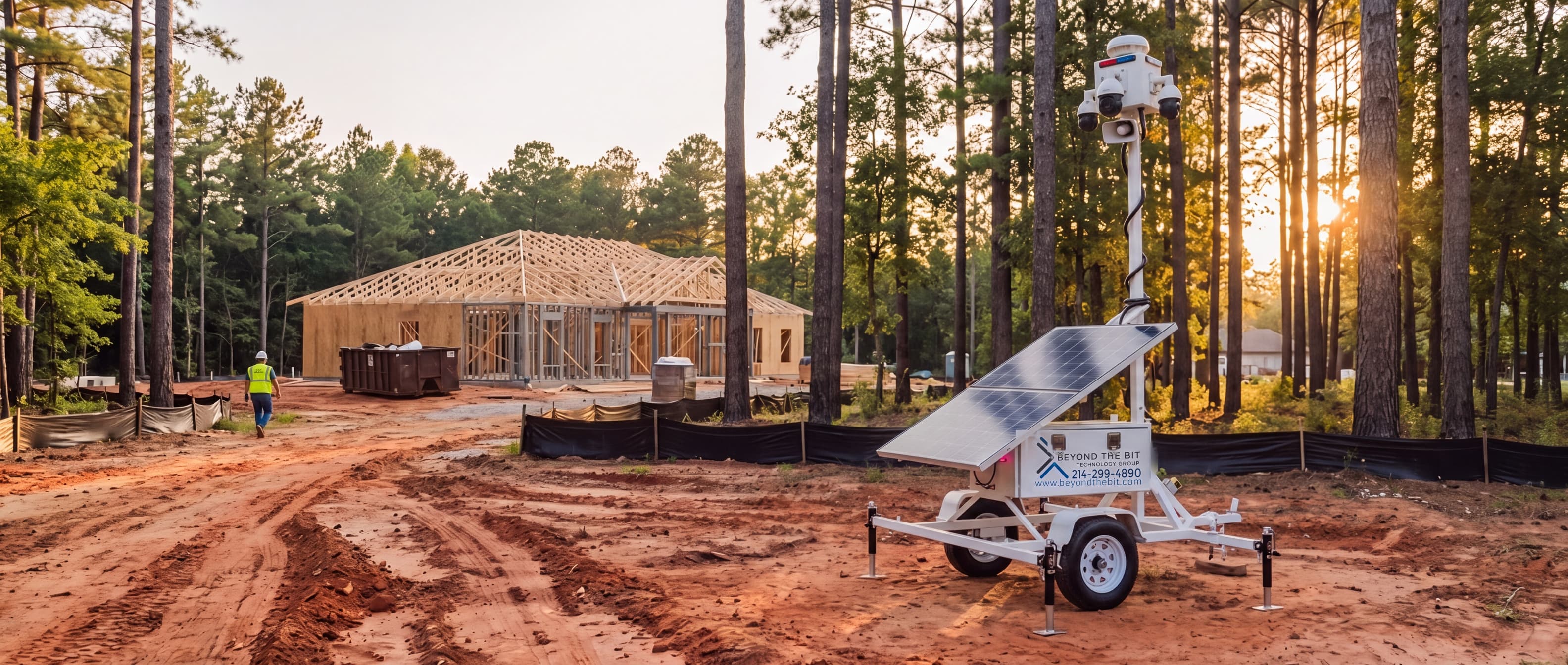
A construction site mid-build has staged material, rented equipment, and wire that hasn't been locked behind drywall yet. An oilfield-support yard often sits well outside town, holding generators, pipe, and fuel tanks in place for weeks between moves, with no foot traffic around to notice anything out of place. Both are exactly the kind of ground a solar security trailer is built to sit on — it doesn't need a fence to hang off of or a building to alarm, it just needs somewhere to park and a clear sightline.
Does a trailer work the same way here as it does in Dallas or Fort Worth?
Mechanically, yes. The same detect, verify, warn, respond chain runs regardless of geography: cameras spot motion and categorize it as a person, a vehicle, or something else, with zones masked off so a public road doesn't trigger a false alert every time a truck passes. That masking matters on a rural East Texas site the same way it matters on a DFW plaza, just for different reasons — an open field next to a Smith County jobsite is as likely to send a deer or a stray dog across frame as a person, and a trailer that alerts on every animal that wanders through trains the crew to ignore it. What can differ is how local police handle the response end of that chain. Dallas has run a verified-response ordinance since 2006, meaning officers aren't dispatched on an unverified alarm alone. Whether a department covering a Smith County site runs anything similar isn't something to assume. Confirm it with the agency that actually covers your site rather than carrying a DFW rule east with you.
What doesn't change is the part Beyond the Bit actually controls. A live operator at our Texas-licensed monitoring partner looks at real video before anyone calls anyone, works a customizable call list to confirm who should and shouldn't be on site, and can trigger the trailer's strobe and speaker to deliver a live audio warning. Most people leave before it goes any further than that, whether the site sits in Richardson or out past the Tyler loop.
How fast can a trailer actually get out to a Tyler-area site?
Richardson to Tyler runs about 90 minutes by road, which keeps East Texas inside the range Beyond the Bit treats as normal service territory rather than a special trip. Typical deployment still runs the same one-to-two-week window as anywhere else in the fleet's reach, from the first site walk to a trailer parked and live.
Tyler and East Texas, at a glance
What about sites with no power or a fixed internet connection yet?
It doesn't change anything. A solar-powered trailer with its own cellular data connection never depended on site power or a wired connection in the first place, in Tyler or anywhere else in the fleet's range. That matters more out here than it does in the Metroplex, because a rural equipment yard or a site still waiting on a permanent utility tap is closer to the rule than the exception east of Dallas.
Dual solar panels keep the battery box charged, the cameras and telescoping mast run off that stored power, and the cellular link handles video without leaning on a site's own internet at all. East Texas summers put that hardware through the same triple-digit heat and sudden thunderstorms the rest of the fleet is built around, so nothing about the climate here calls for different equipment, just the same gear doing what it already does. A crew can drop a trailer on raw ground before the first permanent utility pole goes in, and it starts working the same day.
What should a Tyler-area superintendent or property owner do next?
Start with a site walk rather than a guess. Coverage needs depend on the site's actual footprint — perimeter length, how many staging areas need eyes on them, how long the project runs — and that's the information a site assessment is built to gather before anything gets quoted. Every deployment runs on one flat monthly rate that bundles monitoring, delivery, install, cellular data, and teardown, so there's no separate line item to negotiate later.
For a superintendent used to fencing and a guard rotation as the only options on an East Texas job, a monitored trailer is a third one worth putting in the bid package before ground gets broken, not after something has already gone missing.