
Service Area — Travis County
Watched in
Austin, Texas.
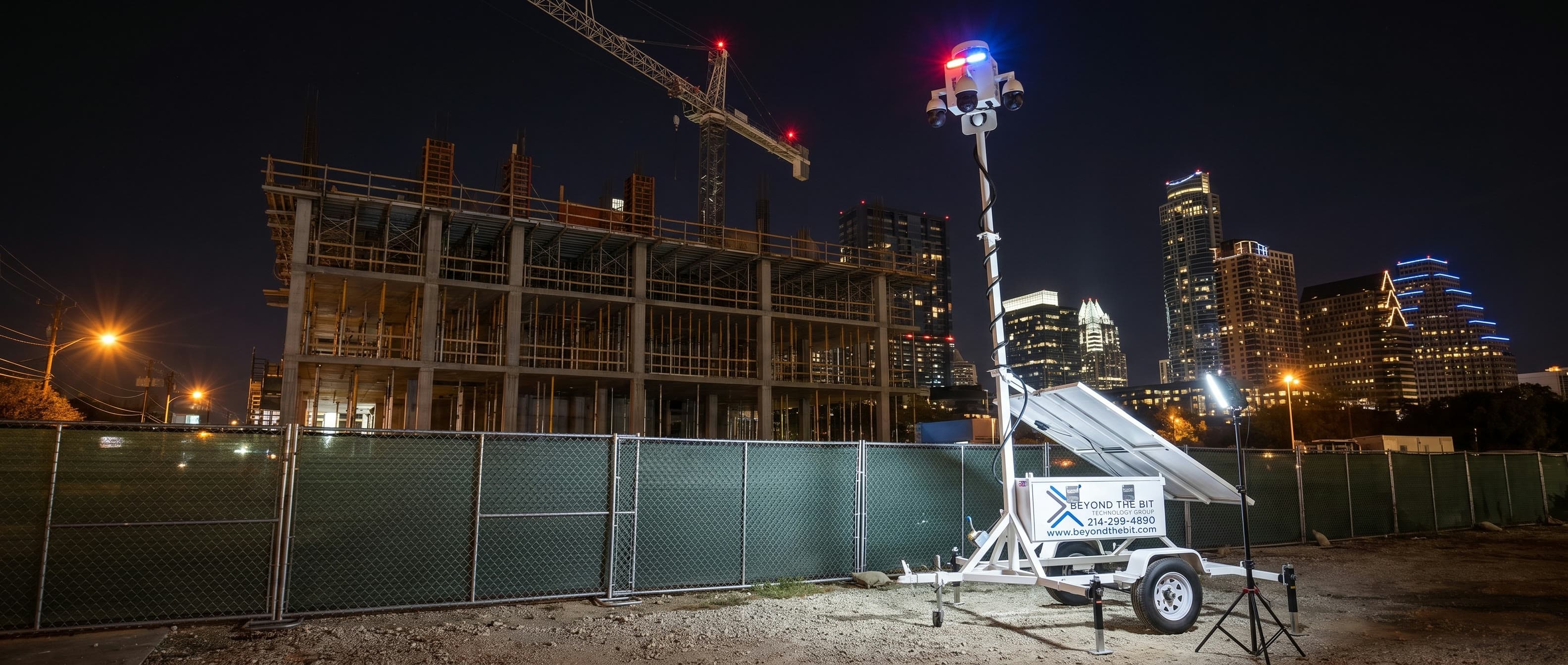
Austin builds on ground that was pasture a year earlier, and that is the whole security problem in one sentence. A new corridor site often has no neighbours, no street lighting, no established patrol route, and no permanent power — the ordinary background conditions that make a property feel watched simply have not arrived yet. A trailer brings its own power, its own light, and its own connection to a corner of the map that does not have any of them, which is why it works on Austin sites months before the building it is protecting has an electrical service.
North Burnet and the Domain, northeast Austin fabs and data centres, SH-130, and the I-35 corridor
The North Burnet and Domain redevelopment is dense vertical work — mixed-use towers and structured parking going up on lots surrounded by occupied buildings, where laydown space is scarce and material stages wherever a permit allows, often against a public sidewalk. Northeast Austin runs the opposite scale: semiconductor and data-centre construction on very large sites with long approach roads, high-value mechanical and electrical equipment staged for months, and security requirements that come down from the owner rather than the GC. The SH-130 and Del Valle industrial corridor is classic greenfield distribution — tilt-wall shells and truck courts on flat open land with almost nothing around them after dark. And the I-35 corridor mixed-use projects sit in between, close enough to traffic to be seen and far enough from anyone who would report what they saw. What links all four is speed: Austin sites move from raw dirt to enclosed shell fast, and the security plan usually has not caught up with the schedule.
The exposure window is between site work and permanent power
Every construction project has a stretch where there is real value on site and no permanent systems to protect it — no building alarm, no card access, no interior lighting, often no site power at all. On a mature urban infill job that window is short and the surroundings are busy. On an Austin growth-corridor site it can run most of a year on ground where nobody drives past at night.
That is the window a trailer is built for. Ours arrive self-contained: solar panels and a battery bank instead of a generator and a fuel run, a cellular connection instead of a site internet drop, and nothing to configure. The mast goes up the day the unit lands, which means coverage starts when the material starts arriving rather than when the electrician gets to it. Detection zones get drawn around the things that actually walk off — copper and cable reels, mechanical equipment, tools and small plant, the conex row — and the highway, the neighbouring pasture, and any public frontage are masked out so they never generate an alert. Cameras categorize motion as a person, a vehicle, or a bicycle, so wildlife on a Del Valle site does not put anyone on a call at 3 a.m.
When something does cross a live zone, an operator at our Texas-licensed monitoring partner is watching the video within moments. They verify it is a person, trigger the strobe and speak through the trailer, and work your call list while deciding whether police should be involved. On a site with no neighbours, that spoken warning is the only thing standing between somebody and an unhurried night's work.
What that looks like on an Austin site
A distribution shell off SH-130, tilt-wall panels set and braced, the electrical rough-in staged inside and a laydown of conduit and cable reels outside the future truck court. No permanent lighting, no occupied building within sight, and a paved approach road that makes backing a truck in easy. At 1:40 a.m. a vehicle comes up the approach road and stops short of the gate. The camera catalogues it as a vehicle and holds. Two people step out and cross into the material zone, and the classification changes to a person — an operator is on the feed before either of them reaches the reels. Strobe, then a voice describing them and the vehicle they arrived in. That is usually the end of it.
The part worth noticing is what did not happen. Nobody was woken up when the vehicle first appeared, because a vehicle on an approach road is not an event. Nobody reviewed footage the next morning to discover a loss. The chain ran live, on a site that had no power, no internet, and no neighbours — because the trailer brought all three with it.
Getting a trailer to Austin
Austin is about three hours from our Richardson yard, which puts it comfortably inside our normal service radius and makes it the most straightforward of our out-of-region metros. Deployment runs the usual 1–2 weeks from signed quote to a trailer standing on site, and multi-unit orders move on the same timeline because we are not waiting on equipment to come free — the fleet runs to nearly 100 trailers.
Our crew handles delivery, placement, mast raise, and camera aim with the monitoring center live on the call, then walks your site team through the call list before anyone drives off. If your owner or GC has a specific security specification — common on data-centre and semiconductor work, where requirements arrive from the owner's side — send it with the quote request and we will tell you plainly whether a camera trailer meets it, including where it does not. W-9, certificate of insurance, and net-30 terms are standard.
Field Photo — 2025 Deployment
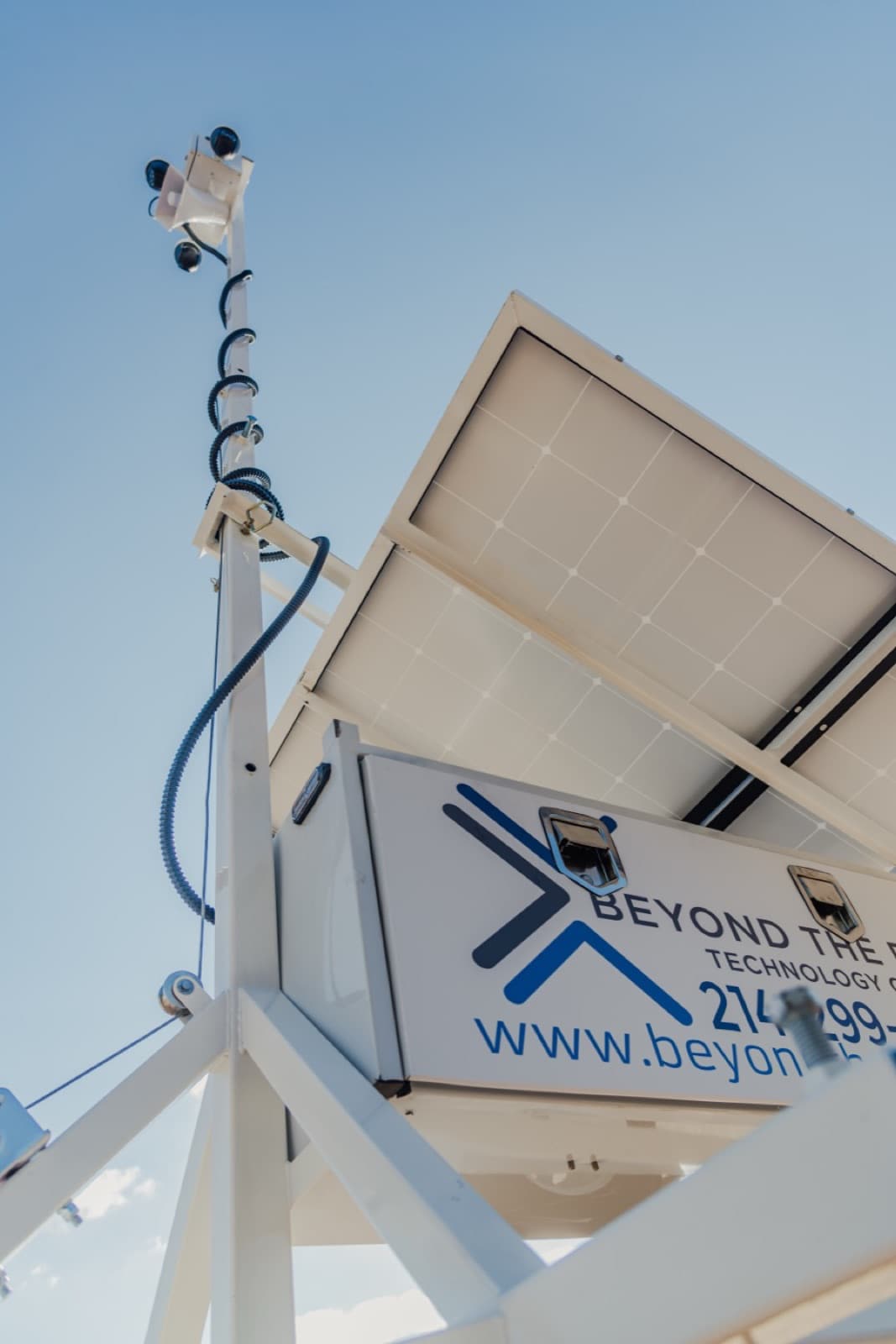
From under the tongue. Roughly fifteen feet of mast puts the cameras above stacked material, site trailers and most perimeter fence, with the panel underside just below.
Plate 06 — Mast, from the tongue
Where These Trailers Work
Common Austin deployments.
Watching a site in Austin? Call 214-299-4890
Questions — Austin
Asked before booking.
Can a trailer work on a site with no power and no internet?
That is the normal case for us, not the exception. Each trailer carries solar panels, a battery bank, and its own cellular connection, so it needs nothing from the site — no generator, no fuel run, no temporary power drop, no site Wi-Fi. It works the day it lands on raw dirt, which on an Austin greenfield corridor site is usually months before permanent power exists. If cellular coverage at your location looks thin, we test it during the free site assessment before you commit to anything.
How far in advance should an Austin project book a trailer?
Deployment runs 1–2 weeks from a signed quote, so the practical answer is to start the conversation about a month before material begins staging. Austin schedules move quickly and the exposure window opens the moment the first equipment or cable arrives — booking against that date rather than the enclosure date is what keeps the gap closed.
Ready to get a trailer on your Austin site? Get a quote built around your actual site.
Request a Free Site Assessment