
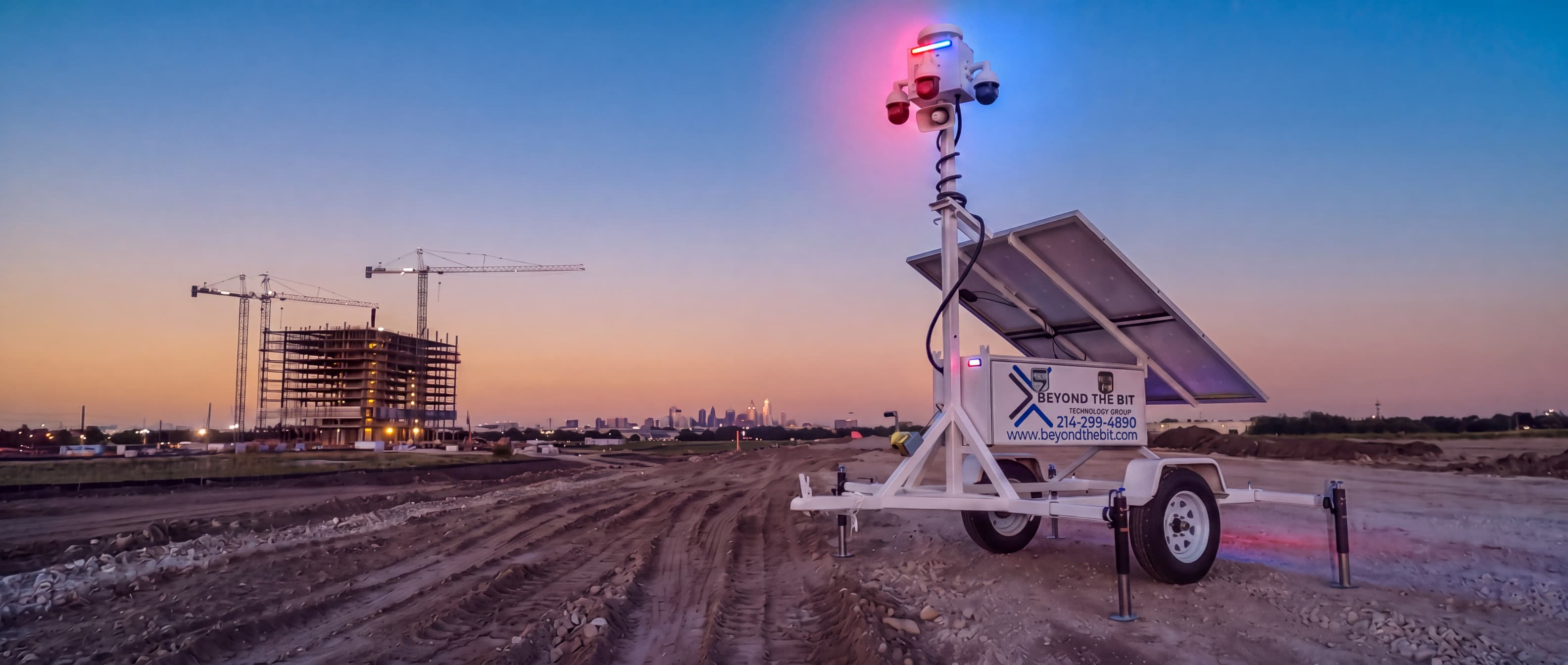
Service Area — Statewide Texas
Watched across
Texas.
For multi-trailer deployments, we cover every major Texas metro inside about four hours of Dallas — Austin, Houston, San Antonio, Waco and the Killeen–Temple corridor — and we go past that radius for planned projects, out to Abilene, the Permian Basin and the Panhandle. Trailers stage on our own trucks, not on a freight broker's schedule, which is how a job in Waco gets the same deployment window as one in Plano. This isn't a side business bolted onto a DFW operation. It's the same fleet, the same monitoring chain, and the same crew running a longer route.
Austin, Houston, San Antonio, Waco and the I-35 corridor
Waco sits closest, roughly two hours down I-35, and is often where a statewide deployment starts — corridor growth along the interstate has brought steady commercial and multifamily construction that looks a lot like what we run daily in DFW. Austin runs three to three and a half hours south, a market defined by dense infill construction, tight urban lots, and a construction pace that's stayed hot even as other things about the city have cooled. Houston, at roughly four hours, is Texas's other major metro for the kind of large-scale industrial, logistics, and commercial construction that generates multi-trailer orders — refinery-adjacent projects, port logistics, and sprawling suburban development all draw the same theft patterns we see in DFW, just at a bigger geographic spread. San Antonio, also around four hours, mixes military-adjacent construction, medical-district growth, and steady residential expansion that puts material on open lots the same way McKinney or Frisco does. Killeen, Temple and Belton sit about three hours down the same interstate, where distribution, advanced manufacturing and data center projects are all building at once. All of it gets the same fleet, the same monitoring chain, and the same install standard as a Richardson-yard job twenty minutes away.
West Texas and the Panhandle, past the four-hour line
Four hours is our core radius, not a hard edge, and three markets sit deliberately outside it. Abilene, about three and a half hours west on I-20, has some of the largest data center construction in the country going up on open ground with almost no local monitored-trailer supply. Midland and Odessa, roughly five hours out, are less about construction than about permanent unmanned assets — well pads, tank batteries and service yards on lease roads with no power and nobody for miles, in a basin where oilfield theft has grown organized enough that the state created a dedicated task force to work it. Amarillo and the Panhandle, five and a half hours north, are building generation and data capacity at campus scale on parcels measured in thousands of acres.
We quote those three differently, and it is worth being upfront about why. At that distance a single trailer on a single site does not pencil, for us or for you, and we would rather say so than write a quote nobody should sign. What does work is a planned programme: several units scoped on the ground, delivered together on our own trucks, monitored through the same chain and the same call list, and priced for the length of the project rather than by the month. Flat, open West Texas ground is also the best case this equipment has — a mast raised roughly two storeys with nothing to block the sightline covers far more area than the same unit would in a built-up market.
Why multi-trailer projects work at this distance
A single trailer heading four hours south doesn't make financial sense on its own, and we don't pretend otherwise — this reach is built for multi-trailer deployments, the kind of order a large GC places when a project needs several units covering different zones of a big site. Trailers stage on our own trucks rather than a third-party freight line, which keeps the timeline in our control instead of a broker's schedule. That matters most on large industrial or logistics builds in Houston or San Antonio, where a delayed delivery can sit a crew idle for a day. We run the fleet of nearly 100 trailers as one pool, so a ten-unit Austin order and a ten-unit Plano order draw from the same equipment base — nothing held back for one market at the expense of another.
A lot of what drives a statewide request isn't a company relocating its whole operation south — it's a DFW-based GC or developer that's landed a project in Austin or San Antonio and would rather bring a security vendor they already trust than vet a new one three hundred miles from home. That's most of what we see: existing relationships extending to a new job address, not a separate statewide sales effort. The equipment, the crew training, and the monitoring chain don't change; only the drive does.
What to expect on a statewide deployment
Timelines run longer than a DFW job simply because of drive time, but the deployment process is identical: site assessment, a flat monthly quote covering everything — delivery, install, live monitoring, cellular data, solar power, maintenance, and teardown — and installation with the monitoring center live on the call before our crew leaves. W-9, certificate of insurance, and net-30 terms are standard on statewide jobs the same as local ones. Timelines stretch further again on the West Texas and Panhandle jobs, and those are scoped on the ground before anything is priced. If a project sits somewhere we don't have a page for — an Oklahoma-border site, or somewhere further out than Amarillo — ask; we've made exceptions for the right project and the right order size. Whatever the mileage, the honest baseline is the same one we quote everywhere: one flat monthly rate, everything included, and a quote built around the actual site rather than a distance surcharge tacked on after the fact.
Field Photo — 2025 Deployment
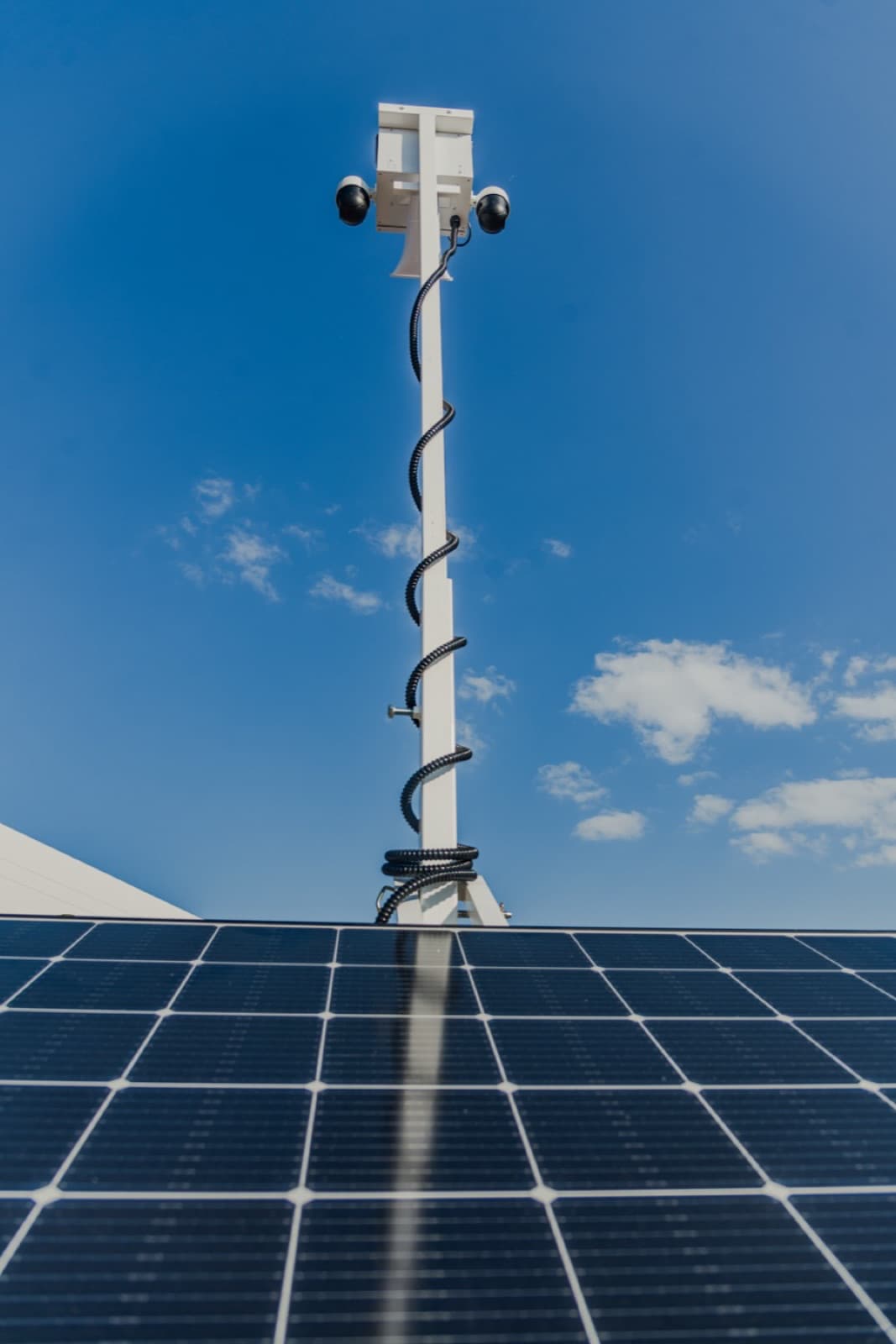
The head assembly: two PTZ cameras on the bracket, a horn speaker under them, and the coiled cable that carries power and video down the mast.
Plate 05 — Mast head, from the array
Where These Trailers Work
Built for every industry we serve.
Anywhere in Texas, call 214-299-4890
Questions — Statewide
Asked before booking.
Do you serve construction sites outside the Dallas–Fort Worth Metroplex?
Yes, for multi-trailer projects. We cover every major Texas metro inside about a four-hour drive of Dallas — Austin, Houston, San Antonio, Waco and the Killeen–Temple corridor — using the same fleet, monitoring chain, and install standard as a DFW job, and we run past that radius on planned projects to Abilene, the Permian Basin and the Panhandle. Trailers stage on our own trucks rather than a freight broker, which keeps a statewide delivery on the same 1–2 week planning timeline as a local one.
Is a single trailer available for a job in Austin or Houston?
Statewide reach is built around multi-trailer orders — the kind of deployment a large GC needs when a big site requires several units covering different zones. A single-unit request that far from Richardson is worth a conversation; ask during your site assessment and we'll tell you honestly whether it pencils for your project rather than quoting something that doesn't work for either of us.
Running a multi-trailer project outside DFW? Get a quote built around your actual site.
Request a Free Site Assessment