
Industry — Commercial Property
Commercial Property Security Cameras
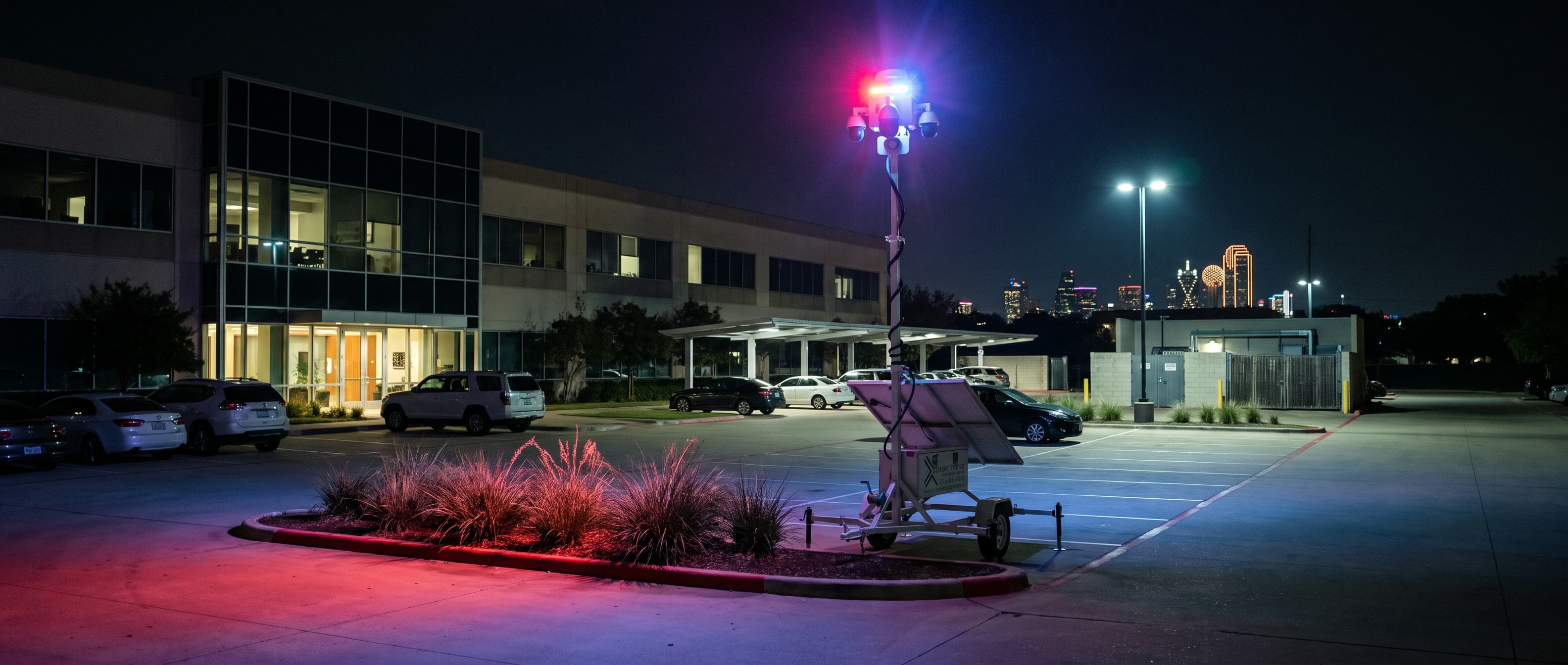
A shopping center is busy until nine and empty by ten. The lights stay on, but nobody is watching the back row of the lot, the dock behind the anchor tenant, or the condenser pad by the dumpster enclosure. That is the window when cars get broken into, converters get cut, and copper walks off the roof. The tenants find out in the morning, and the call goes to the property manager. This trailer puts eyes on the lot from close to open without a guard on the payroll or a permanent camera install.
Exposure
What goes wrong on an occupied property after hours?
The exposure on a working commercial property is the gap between the last employee leaving and the first one arriving. Retail centers, office parks and medical buildings all have it, and it lands on the owner as tenant complaints, insurance claims and a reputation for being the center where cars get hit. Daytime traffic hides the problem. It is the eight quiet hours that cost money.
Parking lot break-ins and converter theft
Employee and customer lots draw smash-and-grabs and catalytic converter cuts once the storefronts go dark. Restaurant staff parked at the back of the lot until close are the usual victims, and one bad month is enough for a tenant to raise it at lease renewal.
Loading docks and rear corridors
The service side of a center is out of view from the street: pallets left at the dock, delivery cages, propped rear doors, and the dumpster enclosure that doubles as a place to sleep. Almost every after-hours incident starts back there.
HVAC copper on rooftops and pads
Occupied buildings lose condenser coils the same way empty ones do. A ground pad behind a strip center is reachable from the alley, and a stripped unit means a tenant with no air on a July morning and a five-figure replacement on the owner.
Loitering, vandalism and dumping
Tagging on the rear wall, contractors dropping debris behind the building, and groups gathering in a corner of the lot at 1 a.m. all get reported to the property manager, not the tenant, and all pull down the center's leasing story.
Deployment
Where does the trailer sit on a working property?
Placement follows where the incidents happen, which on an occupied center is almost never the front door. The usual first unit covers the back row of the lot and the service drive in one field of view: rear doors, dock, dumpster enclosure and the pad behind the building. On a larger site a second unit watches the far corner of the lot that the pole lights do not quite reach. The mast puts the cameras above parked cars and box trucks, so a row of vehicles does not hide what is happening behind it.
The trailer works around the tenants, not against them. It takes one parking space, the cameras are zoned so the public sidewalk and the street are masked out, and the strobe and speaker only fire on a verified person on the property after hours. Customers during the day see a white trailer with a mast on it. The people who notice it most are the ones deciding whether to work the lot that night.
Setup does not touch the building or the tenant spaces. No electrical tie-in, no data drop, no permit, nothing routed through a suite. Solar power and cellular data mean it goes to work the day it is delivered and moves to the next property in the portfolio when the problem moves.
Field Placement
Placed to cover the back row of the lot, the service drive and the mechanical pad in one field of view; takes one parking space and moves across a portfolio as the problem moves.
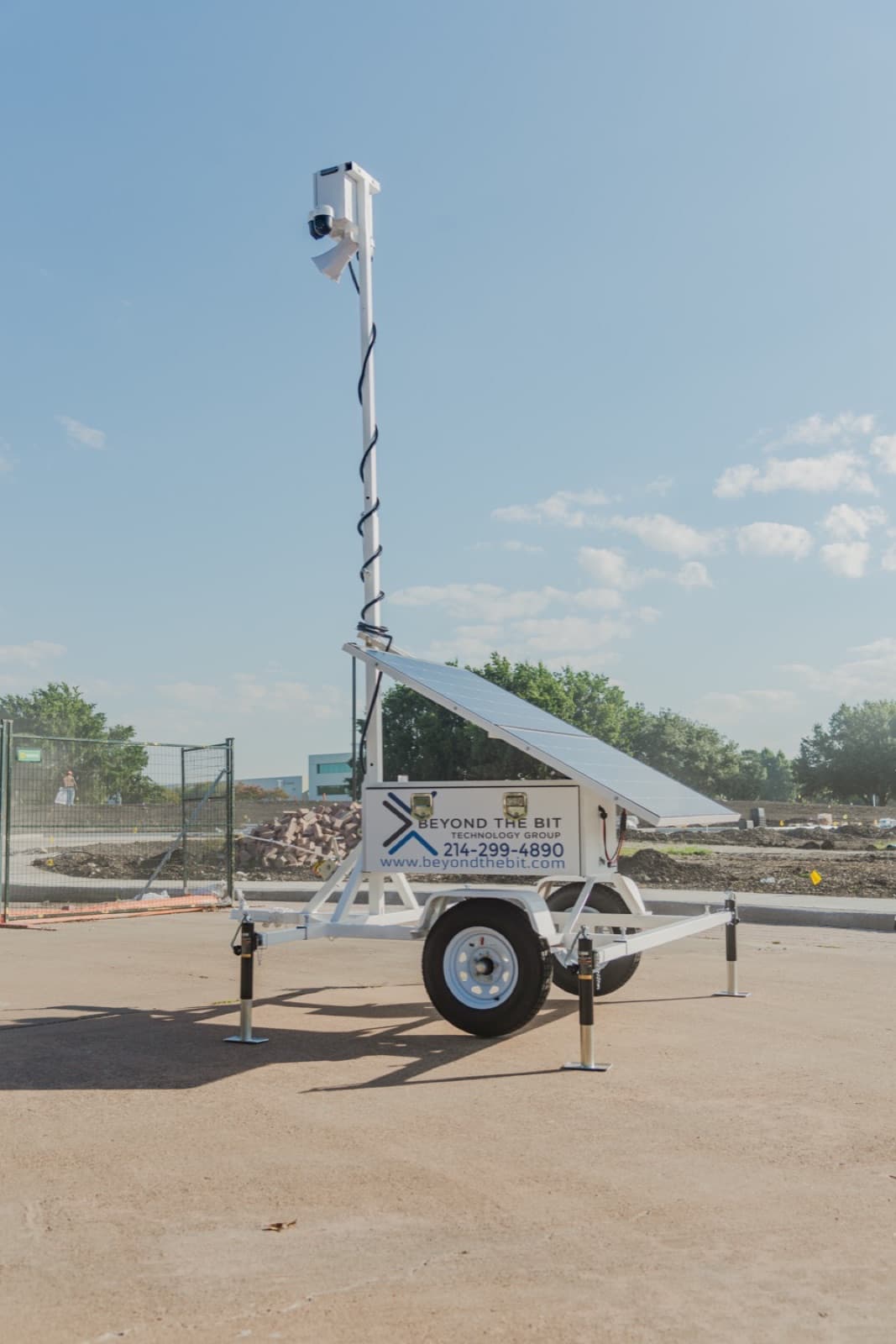
Field Photo — 2025 Deployment
Mast at full extension on a commercial pad. Four jacks down, panel tracked to the afternoon sun, cameras above the fence line — the way every unit is left after installation.
Plate 01 — Full unit, mast raised
Procurement
Who signs off on a security trailer for a commercial property?
Property managers and owners make the call, usually after a run of tenant complaints or a claim, and they weigh it against a guard contract or a permanent camera install. Most management companies do not run a security department, so the decision sits with the same person who handles landscaping and parking-lot lighting.
Paperwork mirrors any other property vendor: W-9, certificate of insurance, and net-30 billing terms are standard, so it slots into the existing AP process without a special exception. Common-area maintenance is the line it usually lands on.
Portfolio accounts are common. If your company manages several centers or office parks across DFW, one relationship covers all of them, and units move between properties as the problem moves instead of each site needing its own vendor setup.
Get a quote for your center or office park →
or call 214-299-4890
Common Questions
Asked by commercial property buyers.
Will the trailer bother tenants or customers during the day?
No. During business hours it is a white trailer in one parking space. The strobe and speaker only respond to a verified person on the property after hours, and the cameras are zoned so the sidewalk and street are ignored. Tenants generally like seeing it there.
Can one trailer cover a whole shopping center lot?
Usually one covers the side where the incidents happen, which is the back row and the service drive. A large center or an L-shaped lot may take two so the far corner is not left to the pole lights. We walk the site and place it based on where the reports have actually come from.
Does the property need power or a permit to host it?
No. The trailer runs on solar power and connects over cellular data, so there is nothing to wire, trench, or permit, and nothing routed through a tenant space. It goes to work on delivery.
How fast can a trailer get to a property after a run of break-ins?
Typically one to two weeks from a signed quote to a trailer on site, and often faster inside the Metroplex since our yard is in Richardson. If tenants are already reporting losses, say so when you request a quote and we prioritize it.