
September 1, 2026 — Beyond the Bit Security Trailers
Why doesn’t a No Trespassing sign stop loitering?
Because a sign only works on people who were already inclined to leave. It states a rule without attaching any consequence to breaking it, and after the first night nobody gets moved along, it stops being a rule and becomes scenery. Signage is legally useful. It is almost never behaviorally useful on its own.
That matters more than it sounds, because a sign is usually the first thing a property manager tries and the reason the second thing never gets budgeted. The sign goes up, the problem continues, and the conclusion drawn is that nothing works here. What actually happened is that the property announced a boundary it had no way to enforce, which reads from the outside as an invitation rather than a warning.
Why do security cameras alone rarely change anything?
Because a recording camera is a documentation tool, not a deterrent. It produces footage someone reviews after the fact, usually days later, usually because a tenant complained. Nobody standing in your parking lot at eleven at night experiences a recording camera as a reason to be somewhere else.
There is also a credibility problem specific to loitering. Fixed cameras on commercial property are so common that they have stopped signaling anything. People assume, correctly most of the time, that no one is watching the feed live, that the recording will never be pulled unless something serious happens, and that standing in a parking lot is not serious enough to trigger any of it. The camera is real. The consequence is theoretical.
What actually makes someone leave?
Being addressed. Specifically, being addressed by a person who can describe what you are wearing and where you are standing, out loud, in the moment. That combination communicates something a sign and a lens cannot: this property is occupied by someone’s attention right now, and the next call is not going to be a surprise to anyone.
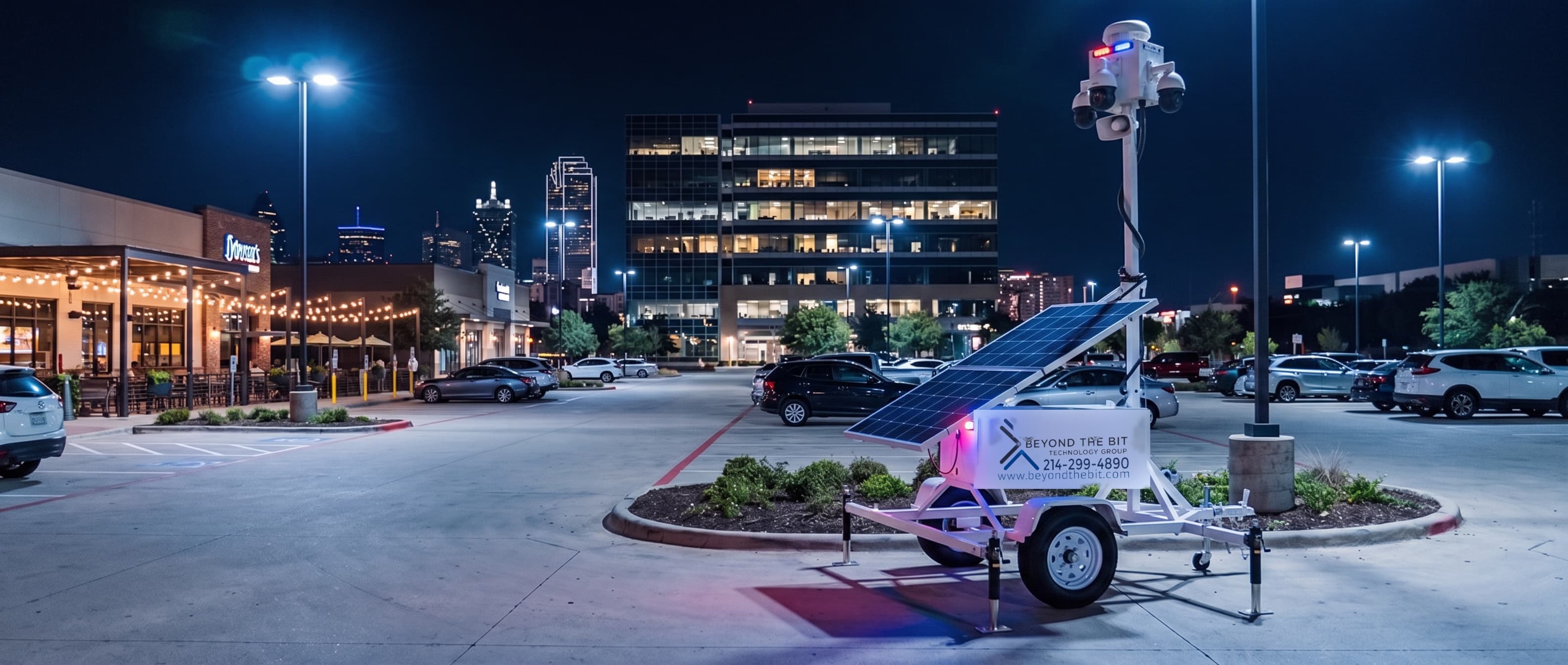
That is the whole design principle behind a visibly monitored trailer. The mast is tall and lit on purpose, the camera head is visible rather than hidden, and the strobe is unmistakable from across a lot. When motion is verified inside a zone that should be empty, an operator at our Texas-licensed monitoring partner can key the loudspeaker and speak directly. Most of the time the conversation is one-sided and very short. People who are loitering are, by definition, not committed to being there.
Where does loitering actually concentrate on a commercial property?
Almost always in the places the building was not designed to be looked at from. The interior of a property is watched by its own occupants; the edges are watched by nobody. Loitering, panhandling, dumping and after-hours drinking all collect in the same handful of spots, and they are predictable enough to plan around.
- The rear service drive and the area around the dumpster enclosure
- Back corners of the parking lot where lighting falls off and cars are rare
- Covered walkways, stairwells and recessed entries that offer shelter
- Vacant suites and the strip of lot in front of them after a tenant leaves
- Alleyways and shared access easements between two properties
Those places have one thing in common: from the ground, at night, nobody can see into them. From a mast raised roughly two stories, all of them are in view at once, which is why a trailer positioned at the back of a lot usually does more work than three more fixed cameras on the building.
Does moving people along just push the problem next door?
Sometimes, and it is worth being honest about that rather than pretending otherwise. A deterrent changes where an activity happens before it changes whether it happens. What it does reliably do is stop your property from being the path of least resistance, which is the realistic goal for a property manager who is responsible for one address and not for a neighborhood.
The larger pattern is worth understanding too. Loitering that persists on a commercial property is rarely random; it is a spot that has been learned. It got learned because nothing happened there for long enough. Unlearning takes less time than learning did, which is why the first two weeks of a deployment are usually noisier than the two months after it.
Is there a liability argument, not just a nuisance argument?
There is, and it is often the one that gets a budget approved. Persistent loitering on a property is the sort of thing that shows up in a premises-liability conversation as prior notice: the owner knew about a condition on the property and can be asked what they did about it. “We put up a sign” is a weaker answer than “we had verified, monitored coverage on the areas where it was happening.”
Recorded video of verified events is the practical output there. It gives you dated evidence of what actually occurred and what was done in response, which is useful to a police report, an insurer, and a tenant asking why their staff do not feel safe walking to their cars. That is the same evidence chain we describe on the commercial property side of the business, and it is worth more than a hard drive full of footage nobody has watched.
What does this look like on a Texas property at eleven at night?
A retail center off a busy road, half the suites dark, the back drive unlit and out of sight of the street. Four people settle in behind the dumpster enclosure with a case of beer. The tenants find the mess in the morning and the manager finds the complaint.
With a trailer parked at the back of the lot, the sequence is different. Motion analytics tag people entering the service-drive zone within seconds, and the street frontage and the neighboring lot are masked out, so passing traffic generates nothing all night. An operator pulls the live feed, sees four people rather than a delivery, and fires the strobe. The speaker describes them and the corner they are standing in. That is usually the end of it. When it is not, the operator works the property’s call list with video in hand, which in some Texas cities is the difference between a dispatch and a report taken later — Dallas has not dispatched on unverified commercial alarms since 2006.
None of that requires anyone from your team to be awake. It also does not require the property to look like a compound. On a fast-growing suburban market where half the neighboring parcels are still under construction, a single lit mast at the back of a lot changes what the property reads as from the road — which is where the decision to stop gets made in the first place.