
September 22, 2026 — Beyond the Bit Security Trailers
Does a portfolio account actually work across more than one Texas market?
Yes. A single account can cover properties spread across the whole Dallas–Fort Worth Metroplex, and the same fleet reaches Dallas , Tyler, Waco, Austin, Houston, and San Antonio out of the Richardson yard, a roughly four-hour radius. A company running centers or office parks in more than one Texas market doesn't need a separate vendor search for every city on the rent roll.
That matters more than it sounds like it should, because most property owners who manage more than one site are used to sourcing security site by site — one guard company for the Plano center, a different camera install for the office park in Arlington, a third arrangement for whatever sits vacant between tenants. A portfolio account collapses that into one relationship, one point of contact, and one paper trail covering every address under it.
How does coverage move as risk shifts from one property to the next?
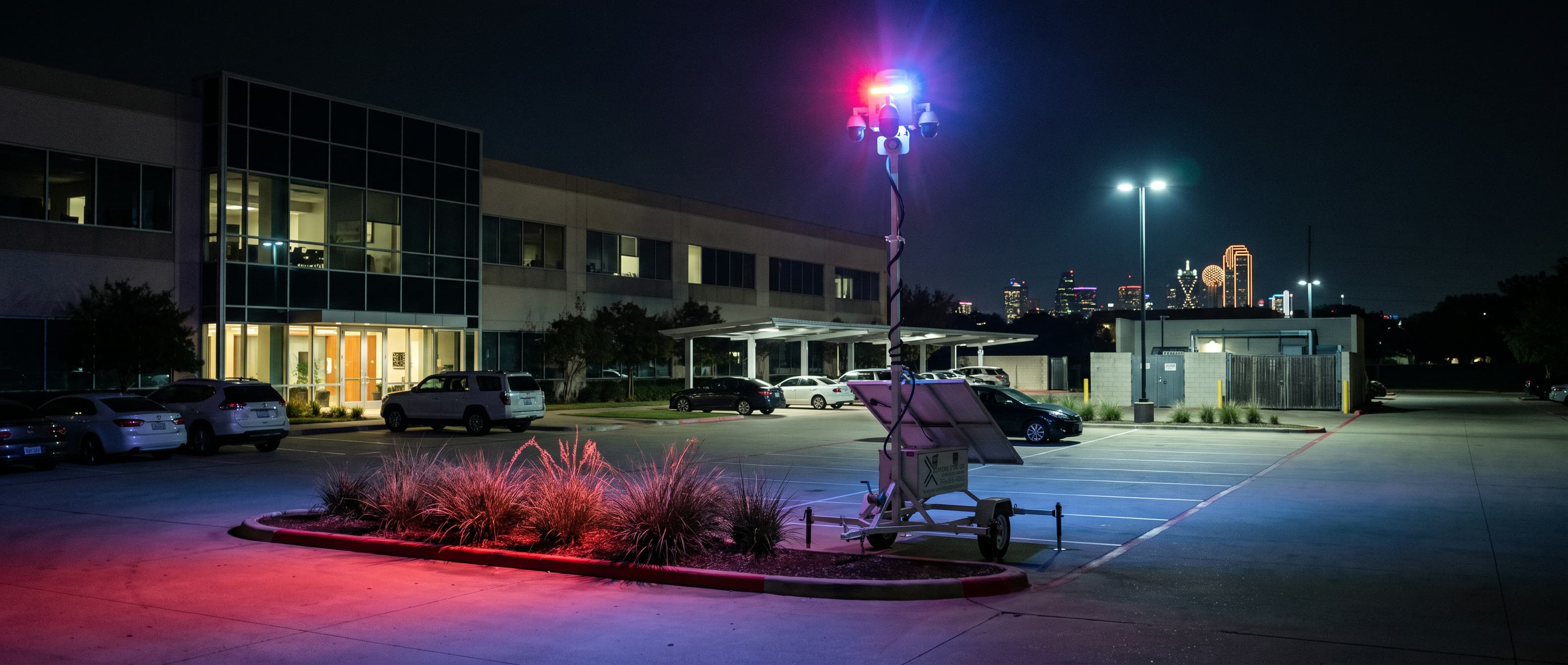
A unit reassigns with a phone call, not a new install. The trailers are towable, so a camera trailer that spent the winter watching a slow-leasing retail pad can move to the office park two exits over the week a break-in run starts there, and move again once that pattern quiets down. Nothing about the hardware changes between stops — no rewiring, no new permit, no new account setup at the receiving property.
That flexibility is the actual value of a portfolio account over a single-site contract. Risk on a group of properties doesn't sit still. A dock that was quiet all year can start drawing dumping the month a neighboring lot goes vacant, and a center that never had a problem can pick one up the moment a nearby development pushes foot traffic its way. Coverage that can move to meet that is worth more than the same number of units nailed to fixed addresses.
Does every property in a portfolio need its own dedicated trailer?
No. Some properties justify a standing unit and some only need coverage for a stretch — a run of after-hours break-ins, a vacancy between tenants, a construction phase on an outparcel. A fleet of nearly 100 trailers is what makes that kind of rotation practical: a ten-unit order across several active properties doesn't wait on equipment, and multiple units can be staged on 18-wheelers and set on the same day when a portfolio needs several sites covered at once.
The sizing conversation still happens property by property. A crew walks each site the same way it would for a single standalone job, because a strip center's back row and a warehouse yard's loading apron aren't covered the same way, even under one account. What changes at the portfolio level is who has to have that conversation — one manager coordinating placement across a group of properties, instead of each property manager starting from zero.
What kinds of properties can sit under the same account?
Retail centers, office parks, and mixed-use commercial properties make up most of a typical portfolio account, but a vacant or transitional building between leases sits under the same relationship without needing a separate vendor conversation. An ownership group holding a leased office campus, a vacant retail box awaiting a new tenant, and a construction outparcel mid-build at the same time can run all three off one account rather than treating the vacant asset and the active build as different problems that need different companies.
The exposure differs by property type — a leased center loses lot traffic and HVAC copper, a vacant building draws dumping and squatting, a construction pad loses material and equipment — but the underlying coverage is the same trailer, aimed and configured for whatever that property is actually exposed to.
Who manages the vendor relationship, and how does billing work across multiple sites?
Usually a regional property manager or an asset manager at the ownership group, the same person who already signs off on landscaping and lot-lighting vendors across the portfolio, not a security department most management companies don't carry. Paperwork follows the same pattern as any other property vendor, just filed once instead of once per address: a single W-9, a certificate of insurance with the additional-insured language a portfolio's master agreement requires, and net-30 terms across every property rather than a separate credit application at each site.
Every unit still runs on one flat rate that bundles monitoring, delivery, install, cellular data, and teardown, so a portfolio manager comparing a ten-property rollout isn't assembling line items from ten different quotes. The full detection, verification, and response chain runs the same at every address in the account, so a manager overseeing several properties isn't learning a different system at each one.
What a portfolio account actually centralizes
How fast can a newly acquired property get added to an existing account?
Typically one to two weeks from a site walk to a unit parked and live, the same window as a first-time standalone customer, because adding a property to an existing portfolio account doesn't skip the part that actually takes time: someone has to walk the new address, decide where the exposure concentrates, and place the unit against that, not against a template. What the existing relationship removes is everything around that walk — the paperwork is already on file, the account is already billing correctly, and the call list already has the right names on it.
That speed matters most right after an acquisition, when a new property often comes with an unknown security history and a management team that hasn't walked it at night yet. Getting a camera trailer on site inside the same window a standalone customer would wait means a newly acquired center or office park isn't sitting exposed for a full leasing quarter while someone works out what it needs.
What should a portfolio manager ask before signing one vendor across every property?
Start with licensing, not price. Ask whether the company holds an actual Texas security license and can produce the number — Beyond the Bit's is Texas DPS Private Security License #B31111401 — rather than a general contractor's liability policy standing in for one. Ask how fast a unit can reposition between properties once it's already under contract, since that reassignment speed is most of what a portfolio account is actually buying. And ask who is watching the video: a live, Texas-licensed monitoring partner watching in real time is a different product than a camera that only records for someone to review after the fact.
A property manager who has already read up on what actually moves people along on a single property already has most of the questions a portfolio conversation needs — the only thing that changes at scale is how many addresses get the same answer at once. A site walk still comes first at every property, whether it's the only one on the account or the tenth.