
September 1, 2026 — Beyond the Bit Security Trailers
Why does the same spot keep getting dumped on?
Because it worked the first time. Illegal dumping is not random — it collects at locations that have been tested and found safe. Somewhere with vehicle access, no occupants, no lighting, and no sign that anything happened the last time is a known location within a fairly small circle of people, and it stays known until something changes.
That is why the problem escalates rather than staying flat. One mattress behind a vacant suite becomes a pile, because a pile is itself a signal that dumping here has no consequence. Most property managers meet the problem well after the location has been established, which is also why removing the pile without changing anything else buys about a fortnight.
Who pays to clean it up?
The property owner, almost always. Waste dumped on private ground becomes the owner’s problem to remove and to pay for, and depending on the material and the municipality it can also become a code enforcement matter against the owner rather than against whoever left it. The person who did it is rarely the person who pays.
The costs also scale badly with the material. Household bulk is a haul-off charge. Construction and demolition debris is a bigger one. Tires, appliances with refrigerant, and anything that might be a regulated waste move into a different disposal category entirely, and a load that took someone four minutes to unload can take considerably longer than that to lawfully get rid of.
There is a second cost that never appears as a haul-off invoice. A property with visible debris on it tells everyone who drives past that nobody is minding it, and that signal does not stay confined to dumping. The same conditions that make a back lot attractive to somebody with a truckload of drywall make it attractive for converter theft, for after-hours drinking, and eventually for people sleeping there. Owners tend to meet those problems one at a time and treat them as separate line items, when they are usually the same problem arriving in order.
What does Texas law actually say about it?
Illegal dumping is a criminal offense in Texas, not merely a civil nuisance. The Health and Safety Code makes it an offense to dispose of solid waste at an unauthorized site, with the severity graded by the weight or volume of the material and rising with repeat offenses. Some categories and quantities reach felony territory.
The gap is not the statute. It is evidence. A prosecutor needs to establish who did it, and a pile of debris establishes nothing about the person who left it. That is the whole reason these cases so rarely go anywhere, and it is worth understanding before spending money on anything that does not close that specific gap.
Why don’t ordinary cameras solve it?
Because dumping takes about as long as a camera takes to be useless. The whole event is four minutes at two in the morning by a vehicle that is gone before anyone reviews anything. Recorded footage might tell you it happened. It usually does not tell you enough about who, and nobody was there to do anything about it at the time.
There is also a placement problem. Dumping happens in exactly the parts of a property that building-mounted cameras were never aimed at: the back of the lot, the service drive, the easement, the ground behind a vacant suite. A camera on the building is watching the building.
- Rear service drives and the ground around dumpster enclosures
- Vacant suites and the lot in front of them after a tenant leaves
- Undeveloped parcels with a curb cut and no gate
- Shared alleyways and access easements between two owners
- Construction sites during shutdown, where a dumpster is already on site
What actually stops it?
Being seen and being spoken to, while the tailgate is still down. Dumping is an unusually interruptible activity because it requires the person to stay put for several minutes, beside a vehicle, doing something obviously wrong. That is a much easier thing to stop in progress than a theft that takes thirty seconds.
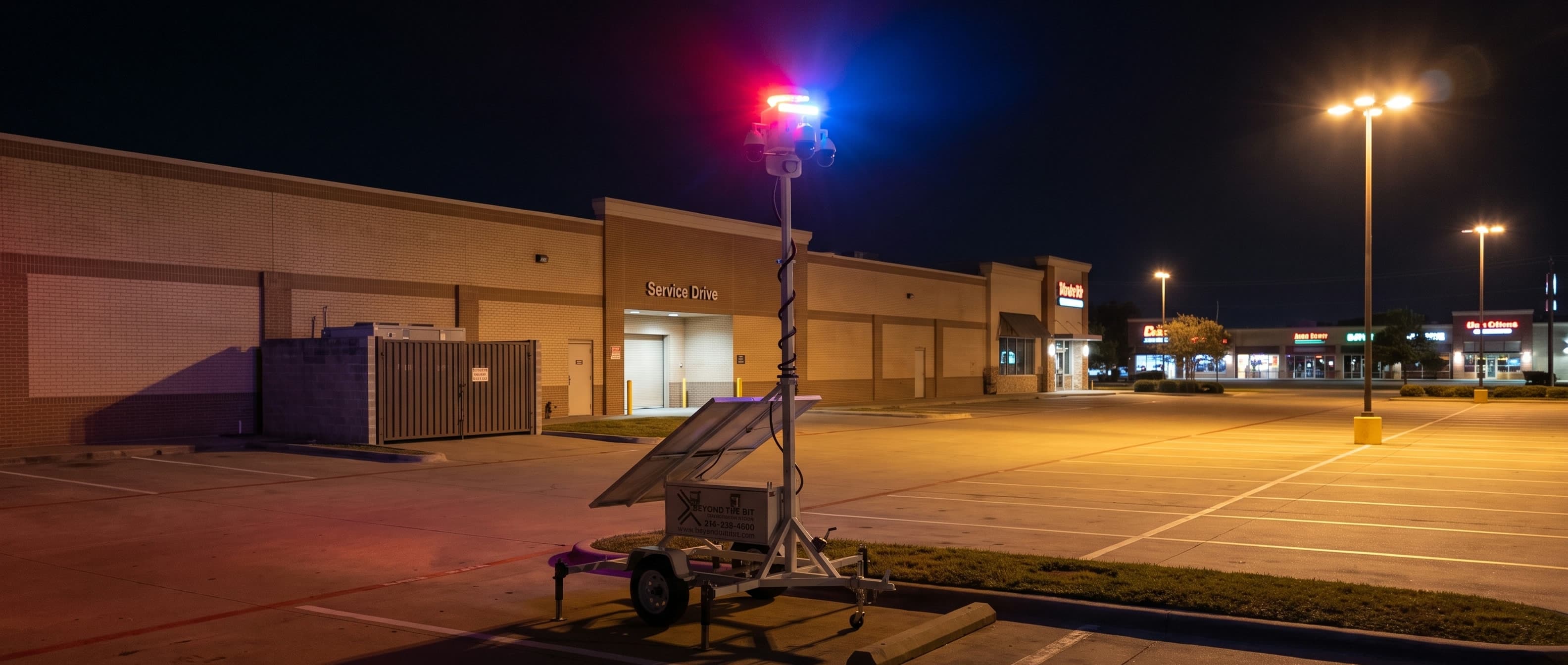
On a monitored trailer, motion analytics tag a vehicle entering a zone that should be empty, then tag the person who gets out of it. An operator at our Texas-licensed monitoring partner has live video before the load is off the truck, fires the strobe, and speaks through the loudspeaker — describing the vehicle, where it is parked and what the person is standing next to. Somebody who chose this spot because it was unobserved does not usually finish unloading. The visible-deterrence side of this does a lot of the work before anyone even arrives: a lit mast at the back of a lot changes what the property reads as from the road.
Does video actually help if you want to prosecute?
It is generally the difference between a case and a complaint. Recorded video of a verified event gives a code enforcement officer or a police department something to work with: footage of the vehicle, the act itself, and the person doing it, timestamped. That is a materially different filing than a photograph of a pile taken the next morning.
Municipalities have reached the same conclusion about their own problem sites. The City of Dallas has publicly moved to put surveillance trailers on chronic illegal dumping locations specifically because the sites are remote, hard to see from the road, and impossible to prosecute without evidence of who is doing it. That is the same reasoning a private owner applies to a back lot — and in Dallas it connects to a second issue, since the city has not dispatched on unverified commercial alarms since 2006.
What should an owner do about a chronic dumping site?
Start by making the location less convenient, because some of that is free. Then cover the gap that physical measures cannot, which is that nobody is there when it happens.
Blocking the vehicle path matters more than blocking the person — bollards, a cable gate, or repositioned dumpsters that prevent backing up to the spot remove most of the appeal, because nobody carries a mattress far. Clear the pile promptly and keep clearing it, since accumulated debris is an advertisement. Light the area if the service is there. And on a property where the exposure is a vacant suite or an empty parcel, recognize that the ground is going to look unattended no matter what you do to it, which is precisely the condition a monitored unit is there to change. On a fast-growing market with a lot of undeveloped parcels sitting between finished ones, that is most of the portfolio.