
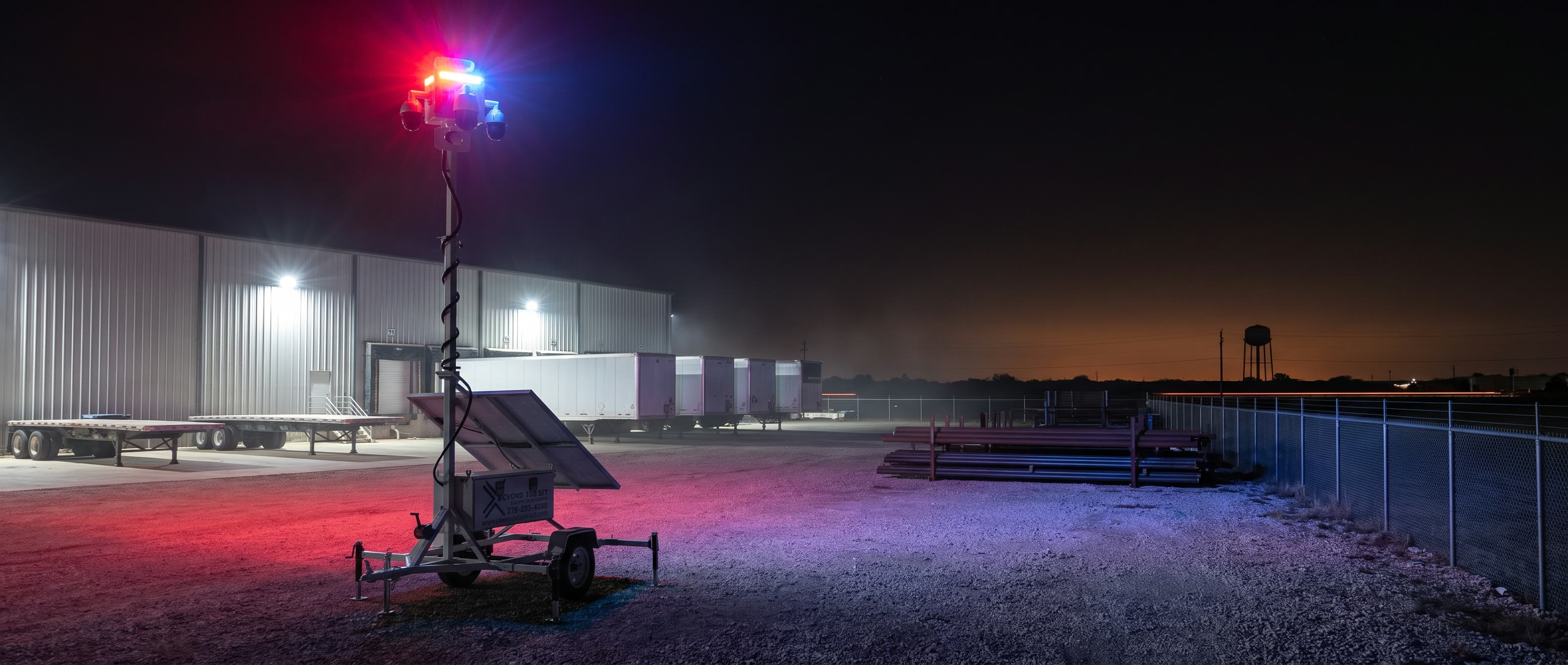
Service Area — Bell County
Watched in
Killeen, Texas.
Killeen is about three hours down I-35, which puts Bell County inside the range we cover as a matter of course rather than as a special trip. Central Texas is doing something unusual right now: distribution, advanced manufacturing and data capacity are all being built along the same stretch of interstate at the same time, plus the steady contractor and support work that a very large military installation generates next door. Different buildings, same problem — laydown yards on the edge of town, well outside anybody's night patrol route.
The I-35 corridor through Temple and Belton
The run from Belton up through Temple is one of the more active industrial corridors in the state, and it has the shape a camera trailer suits best: very large flat footprints, long temporary fences, and gravel laydowns holding structural steel, precast and mechanical gear for months before there is a building to put any of it in. Temple's manufacturing base adds process equipment and fabrication material to the same picture. Data center projects moving through Bell County zoning add the heaviest electrical exposure of the three — switchgear, transformers, feeder cable and conduit in quantities that make a single night's work worth somebody's while.
Around Killeen itself the pattern is different again. Contractor and support work tied to Fort Cavazos means yards full of plant and vehicles, often on leased ground at the edge of the built-up area, and a steady flow of subcontractors who come and go on their own schedules. Commercial and multifamily construction fills in behind the growth. What all of it shares is that the valuable material lives outside the building for most of the schedule, behind a fence that was specified to satisfy a requirement rather than to stop anybody.
Why a corridor site is exposed in a way an urban site is not
On a downtown project the site is hemmed in. There is traffic at all hours, a neighboring building with somebody in it, and a limited number of ways in. On a corridor site off I-35 there is a mile of fence, a frontage road, and an empty parcel next door. Somebody can pick a spot on the back fence that cannot be seen from any road and take as long as they like.
That geometry is also what makes a mast work. One trailer raised roughly two storeys over flat, open ground takes in a great deal of it, because there is nothing to block the sightline — no towers, no structured parking, no adjacent buildings throwing shadows. Detection zones get drawn around the laydown, the equipment corral and the truck court, while the interstate frontage and the neighboring empty lot are masked out entirely. That masking is not a nicety. A corridor site generates headlights all night, and a system that alerts on every one of them gets muted by the second week.
When something does cross into a zone that should be empty, the cameras categorize it — person, vehicle, bicycle — and a person inside the zone routes to a live operator at our Texas-licensed monitoring partner. They look at the actual video, not a motion event, and decide. If it is real the strobe fires and the operator speaks through the trailer's loudspeaker while it is still happening, then works your call list and escalates to Bell County or Killeen PD with verified video rather than an unconfirmed alarm.
Getting a trailer onto your Bell County site
Three hours down I-35, which is inside our normal service radius and scheduled accordingly — typical deployment is 1–2 weeks from signed quote to a trailer standing on your site. Bell County work is usually quoted for the length of the project rather than month to month, because the sites here tend to be long builds where the exposure moves through phases rather than short jobs.
Our crew handles delivery, placement, mast raise and camera aim with the monitoring center live on the call, then walks your site team through the call list before driving back. Solar power and cellular data mean the unit does not wait on the site's utilities or a network drop. On a phased build, plan the repositioning in at the site assessment: the trailer that covers the laydown during structure is usually better placed at the truck court once the building is enclosed, and moving it on the same project is part of the job rather than a separate event. With a fleet of nearly 100 trailers, a multi-unit order for a long perimeter stages on our own trucks rather than waiting on a freight broker. W-9, certificate of insurance and net-30 terms are standard.
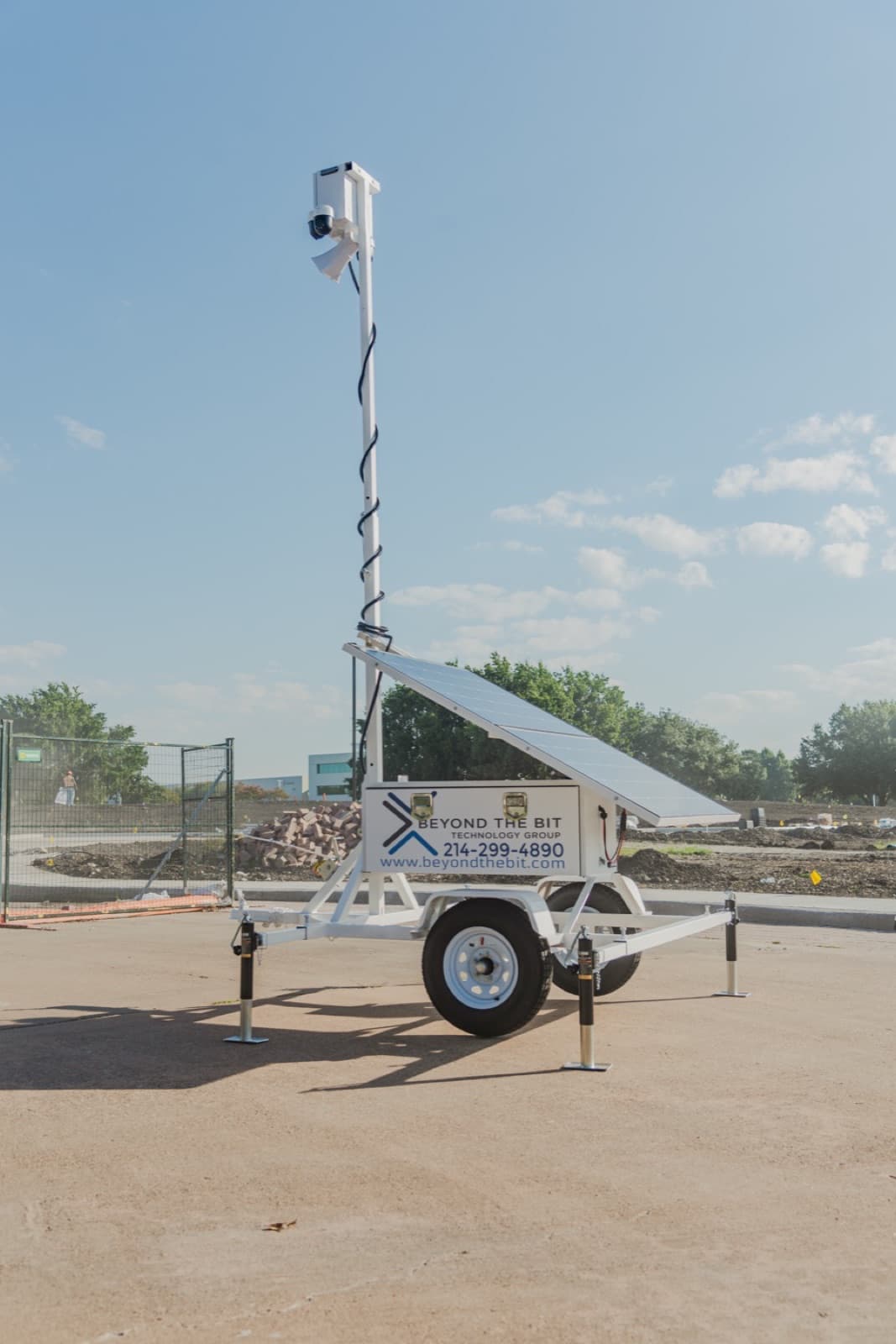
Field Photo — 2025 Deployment
Mast at full extension on a commercial pad. Four jacks down, panel tracked to the afternoon sun, cameras above the fence line — the way every unit is left after installation.
Plate 01 — Full unit, mast raised
Where These Trailers Work
Common Killeen deployments.
Watching a site in Killeen? Call 214-299-4890
Questions — Killeen
Asked before booking.
Is Killeen inside your normal service area or is it a special trip?
Inside it. Killeen and the Temple–Belton corridor sit about three hours from our Richardson yard, well within the roughly four-hour radius we treat as core territory, so Bell County is scheduled like any other market with the same 1–2 week deployment window. Longer Central Texas projects are usually quoted for the duration of the build rather than month to month, which is a structure question rather than a distance surcharge.
What gets stolen from a Central Texas industrial or data center build?
Electrical material, mostly, and the heavier the build the more of it. Copper wire and cable reels, conduit, switchgear components, grounding material and anything with recoverable copper in it, alongside the usual small plant, power tools, fuel, batteries and catalytic converters off vehicles left overnight. Rooftop mechanical units staged at grade are the expensive outlier — high value, sitting in the open for weeks waiting on a crane. That mix is why the detection zones go around the laydown and the equipment corral rather than around the building footprint.
Ready to get a trailer on your Killeen site? Get a quote built around your actual site.
Request a Free Site Assessment