
October 13, 2026 — Beyond the Bit Security Trailers
Do security camera trailers actually work at night?
Yes — night is when they matter most. The cameras, the strobe, and the live monitoring behind them run the same way at 2 a.m. as they do at 2 p.m., because the unit never clocks out. A solar trailer’s whole design point is continuous operation after dark, not daytime coverage with a gap once the sun goes down.
That matters because most jobsite and commercial-property losses happen in the hours nobody is around, and in Texas those hours have gotten longer as the year has moved past the fall equinox. A site that felt adequately lit and watched in July is sitting in two extra hours of darkness by late October, and the risk window widens right along with it. A unit sized for that window doesn’t get smaller or weaker once the sun is gone; it does the same job it was doing an hour earlier, watching the same ground at the same resolution.
How well do the cameras actually see in the dark?
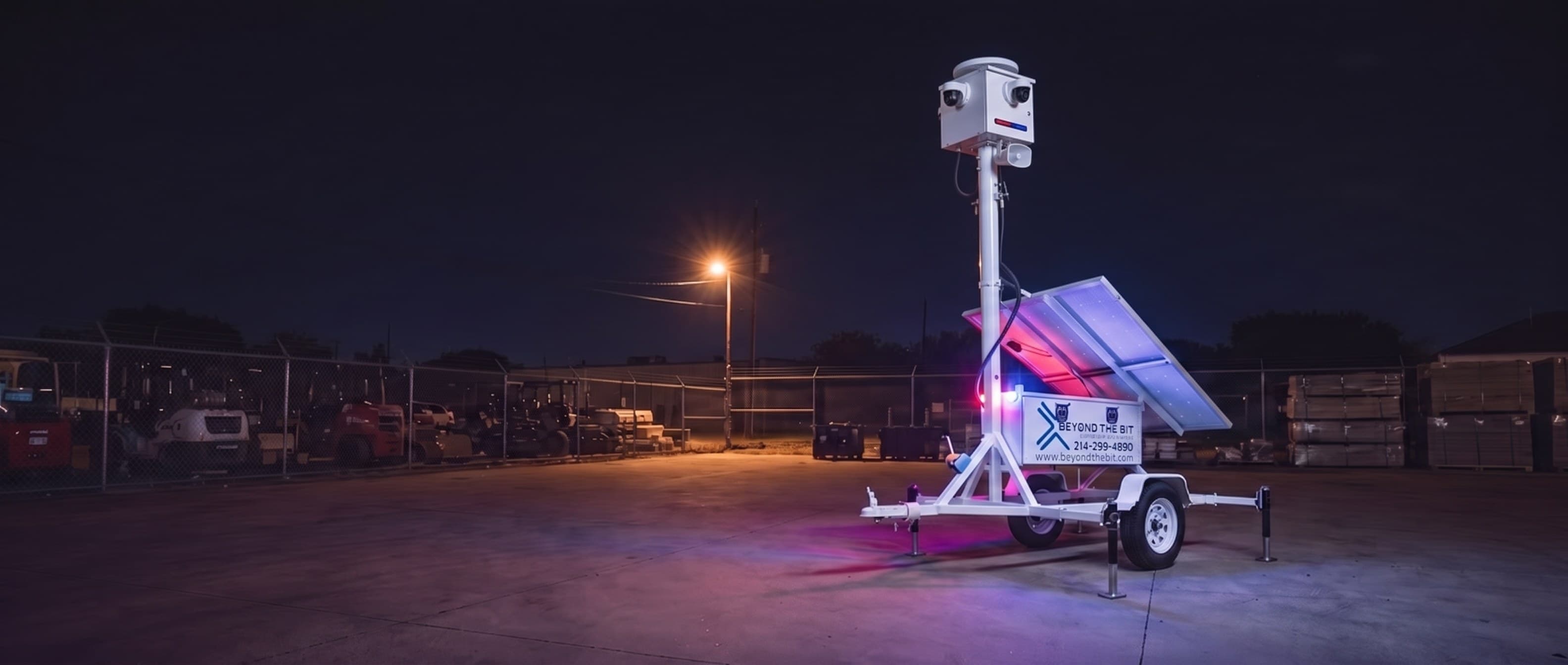
Well enough to tell a person from a shadow, which is the bar that matters. The mast carries a pan-tilt-zoom camera an operator can drive in real time alongside fixed wide-angle cameras covering gates and blind corners, and both are built for low-light work rather than daylight work with a flashlight bolted on. If something flags near a gate at midnight, the operator can zoom in on it the same way they would at noon, rather than squinting at a grainy frame and guessing.
The strobe does part of the job too. Once an event is verified, a blue strobe fires before anyone near the fence line can mistake it for a porch light or a dashcam, so the visual signal that someone is being watched arrives at the same moment the live operator does. That combination of a camera that can actually resolve what it is looking at and a light that announces it is a different thing from a dumb motion floodlight, which lights up a yard and nothing more.
Does Texas heat cause problems for the equipment?
It is accounted for, not fought. The hardware on the mast and in the battery box is built to sit outside through a full Texas summer, running on solar and battery power that does the same job in triple-digit heat as it does in March. Nothing about the detection chain depends on a climate-controlled enclosure the way an indoor system would.
Heat is a bigger story for the power system than for the cameras, and it runs the opposite direction from what most people expect: more sun generally means more charge, not less. The harder season for a solar trailer is actually winter, when the days get short and the sun sits lower in the sky — a detail covered in full in how these units handle no power and no Wi-Fi, including how the battery bank is sized against the worst stretch of weather rather than an average one.
What happens to a unit during a hailstorm or a high-wind day?
It keeps running, and the mast and camera housings are built as exterior hardware meant to stand outside year-round, not delicate gear that needs to be struck every time a storm rolls in. On a site where conditions genuinely call for it, the mast can be lowered and the unit repositioned, and that is a conversation we have directly with the site contact rather than something decided from a spec sheet with nobody watching the forecast.
Texas hail season runs hardest from March into May, but the honest answer is that no vendor can promise a piece of equipment sitting outdoors will take every hit from every storm without a mark on it. What we can promise is a live person on the account rather than a sensor that goes quiet and nobody notices until the next site walk.
That matters more on the sites that get hit hardest. A storm that damages a fence line or knocks out a site light is exactly the kind of event that leaves a property more exposed right after it happens, not less, and a unit that keeps working through it is doing its most important job on the worst day of the month.
Do storms and wind cause a flood of false alerts?
Not the way a basic motion sensor does. Detection on these units runs through zone masking and object categorization set up at install — the system is told what counts as a vehicle, a person, or a bicycle, and anything outside the fence line or outside those categories gets filtered out before it ever reaches a human. A tree limb thrashing in thirty-mile-an-hour wind does not read as an intruder.
- Zones drawn around the actual property, not the public street or sidewalk
- Motion sorted by category before it ever reaches a live operator
- A person reviews every flagged event instead of a siren firing on its own
That filtering is the difference between a system that is useful at 3 a.m. in a thunderstorm and one that trains everyone on site to ignore it after the fifth false alarm in a week. A superintendent running a crew through a bad weather stretch does not have time to chase alerts that turn out to be blowing debris.
Why does the shrinking daylight window matter right now?
Because the hours a site sits unattended and dark are expanding every week through the fall, and a coverage plan built around summer daylight is already behind. A gate that used to go dark at 8:30 p.m. in June is dark by 6:30 by late October, and that extra two hours a night is exactly the stretch when material gets staged, trailers get parked, and nobody’s truck is still on site.
A guard on a day shift does not help with any of that, and a guard working overnight only covers the one post they are standing at. A trailer’s mast watches the same ground continuously whether the sun sets at 8:45 or 5:45, which is the specific advantage worth re-checking on any site that was scoped for security back when the days were long. We walk through that full comparison, shift costs included, in guards versus a camera trailer.
Night and weather, at a glance
How does this play out across a state as big as Texas?
Unevenly, which is exactly why a generic spec sheet is the wrong tool. A Panhandle site and a Gulf Coast site are not fighting the same weather, and a statewide deployment has to account for hail risk, humidity, and daylight hours that shift differently by latitude and region, not one blanket assumption applied to every address on the account.
That is the actual point of a site assessment rather than a sales call: someone looks at the specific ground, the specific exposure, and the specific season the project is running through, and comes back with a plan sized for that site instead of an average case that fits nothing particularly well. The chain behind every one of those plans, from detection through a live voice on the loudspeaker, is laid out in full on how it works, and it runs the same way whether the forecast says clear or calls for hail.