
September 1, 2026 — Beyond the Bit Security Trailers
Can a security camera really run with no power on site?
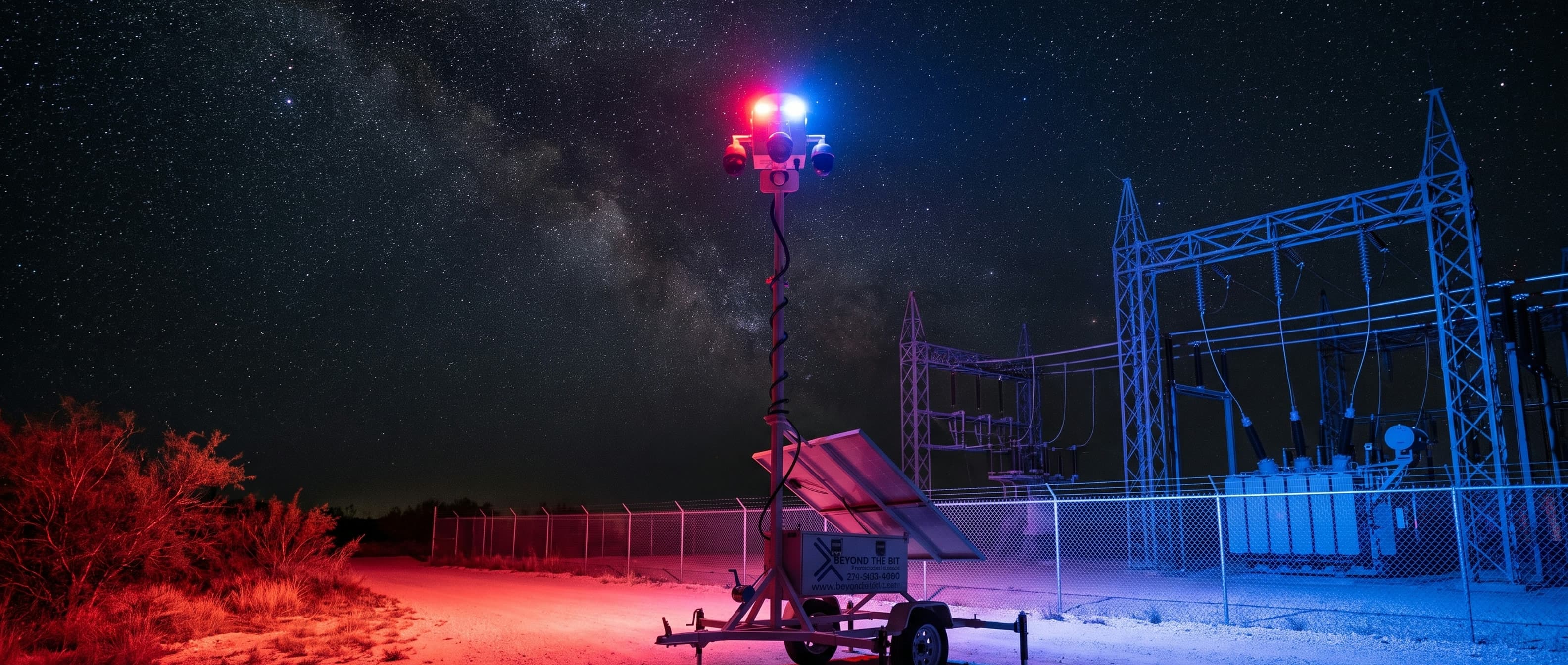
Yes, and on most of the sites that need one it has to. A solar camera trailer carries its own panels and its own battery bank, so it does not touch the site’s electrical service at all. There is no shore power connection, no generator, no fuel run, and no waiting on a temporary service to be energized before it can start working.
That independence is the point rather than a convenience. The window when a site is most exposed is almost exactly the window before it has utilities: raw ground with material already staged on it, a temporary fence, and months to go before there is a building with a service entrance. Any camera that needs power to be installed arrives after the risk does.
What happens after a week of overcast days?
The battery bank carries it. Solar sizing on a unit like this is not done for a sunny day — it is done for the worst realistic stretch, so the panels overproduce in normal conditions and bank the surplus. A run of grey weather draws the reserve down rather than taking the unit offline.
It is a fair question to ask a vendor directly, though, and worth asking in a specific form: not “does it have solar” but “how many days of autonomy does the bank hold at your normal duty cycle.” Duty cycle is the part that varies. A unit running lights and a PTZ camera hard every night draws considerably more than one sitting in low-light standby, and a panel array sized for the second will not carry the first.
How does the video get out with no site internet?
Over cellular. The trailer carries its own LTE modem, so it connects the same way a phone does — no site network, no fiber drop, no IT ticket, and no coordination with a general contractor’s network provider who has not been engaged yet. As far as the site is concerned, the trailer arrives already connected.
This is the piece that most often surprises people who have specified fixed camera systems before. A conventional install is not really a camera project; it is a low-voltage project with conduit, terminations, a network switch and a closet to put it in, all of which has to be designed, permitted and built before the first frame of video exists. A trailer skips that entire path, which is why it can be watching a laydown yard in the same week the laydown yard appeared.
What the trailer does not need
Would a generator do the same job?
It would power the cameras and create three new problems. A generator needs fuel, which means somebody driving to the site on a schedule. It makes noise, which is a problem on anything near housing. And it is itself one of the most stolen items on a jobsite, so you have added an asset that needs watching to a system whose job is watching assets.
Fuel is the quiet one. Diesel walks off sites constantly, and a generator is a tank sitting in the open with a known refill schedule. There is a reason the equipment yards we cover in energy and utility work treat fuel as a theft category of its own rather than as a running cost.
What does this actually change on a remote site?
It changes what is possible at all. On a well pad, a substation, a renewable laydown or a greenfield campus, there is frequently no electrical service, no network, and no realistic path to either for months. The choice on those sites has never been between a good camera system and a cheap one. It has been between a self-contained unit and nothing.
- Well pads and tank batteries on lease roads with no service of any kind
- Substation and transmission work where the only power is the thing being built
- Wind and solar laydowns sitting on caliche miles from a paved road
- Greenfield industrial and data center sites months ahead of permanent power
- Vacant property where the service was disconnected when the tenant left
The Permian Basin is the clearest version of this. A pad twenty miles from the nearest occupied building has no utilities, no fence worth the name, and no one close enough to notice anything. Every part of a conventional security design assumes infrastructure that does not exist there.
What can’t a solar trailer do?
Plenty, and it is worth being straight about it. It is not a fence and it is not a guard. It cannot physically stop anyone, it cannot cover a thousand acres, and it cannot see through a building. It is one mast with a defined field of view, and where the value on your site sits relative to that field of view is the entire design question.
It also depends on cellular coverage. Most of Texas has it, including most of the remote ground people assume does not, but “most” is not “all,” and it is something to confirm during a site assessment rather than discover after delivery. Anyone who tells you signal is never an issue has not deployed in enough places.
Winter is the harder test than weather, incidentally, and it is the one people forget to ask about. The panels see materially fewer hours of usable sun in December than in July regardless of cloud cover, so a system sized on summer output has a lean January whether the sky is clear or not. Sizing is done against the worst month rather than the average one, which is why a unit that has run without incident since spring is not really evidence of anything until it has been through a winter.
How fast can a self-contained unit actually be working?
Deployment runs one to two weeks from a signed quote, and almost none of that is installation. Our crew tows the unit in, sets it on its stabilizer jacks, raises the mast and aims the cameras with the monitoring center live on the call, then walks your site contact through the call list before leaving. No pad, no foundation, no trenching, no terminations.
What is happening during those one to two weeks is mostly the site assessment and the scheduling, which is where the useful work is anyway — deciding where the mast goes, which zones get drawn, and what gets masked out so the system does not alert on a road all night. That whole sequence is laid out in how it works, and it is the same on a downtown infill lot as it is on a lease road, because the hours nobody is on site are the same problem in both places.