
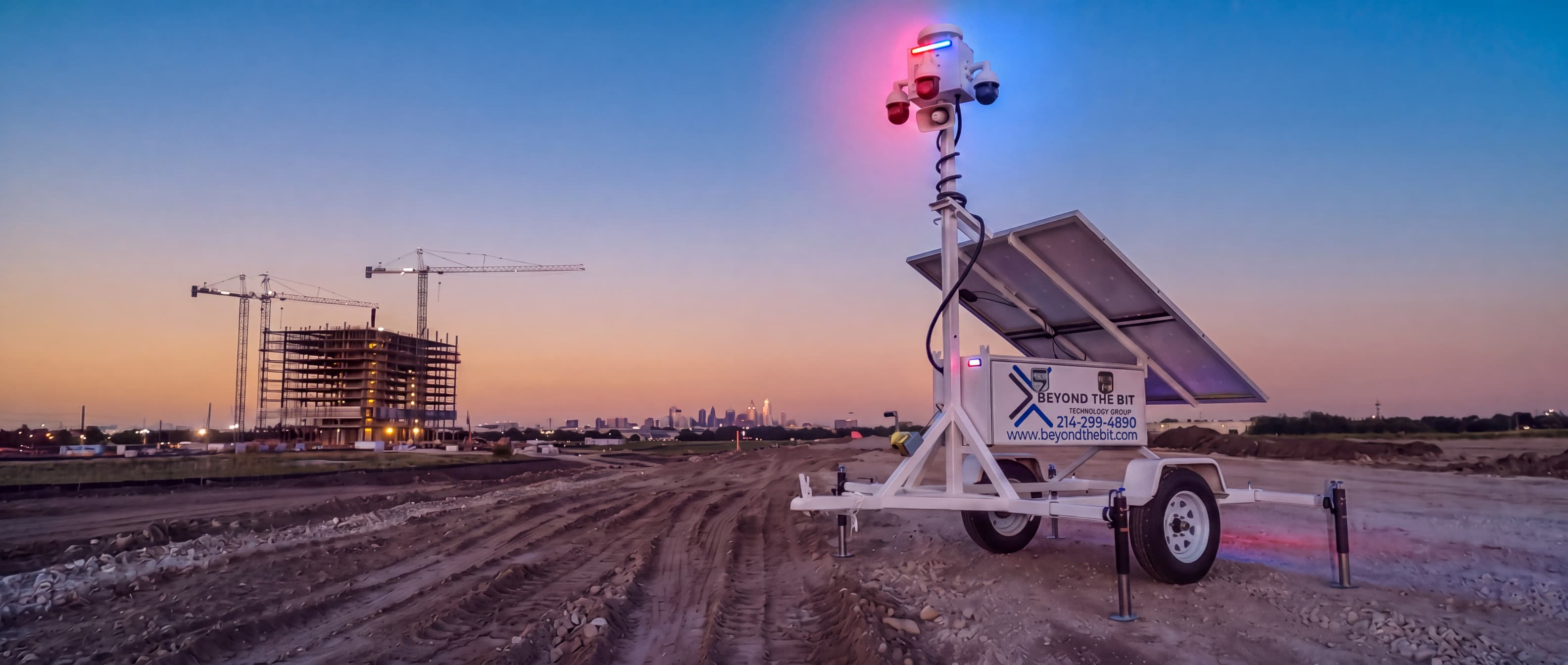
Full Specification
Every camera, every alert, every response — documented.
This is the full spec: what's mounted on the trailer, what the monitoring chain actually does when someone walks onto your site, and how fast we can get a mast standing on yours.
01 — The Unit
One trailer, six systems, zero site power required.
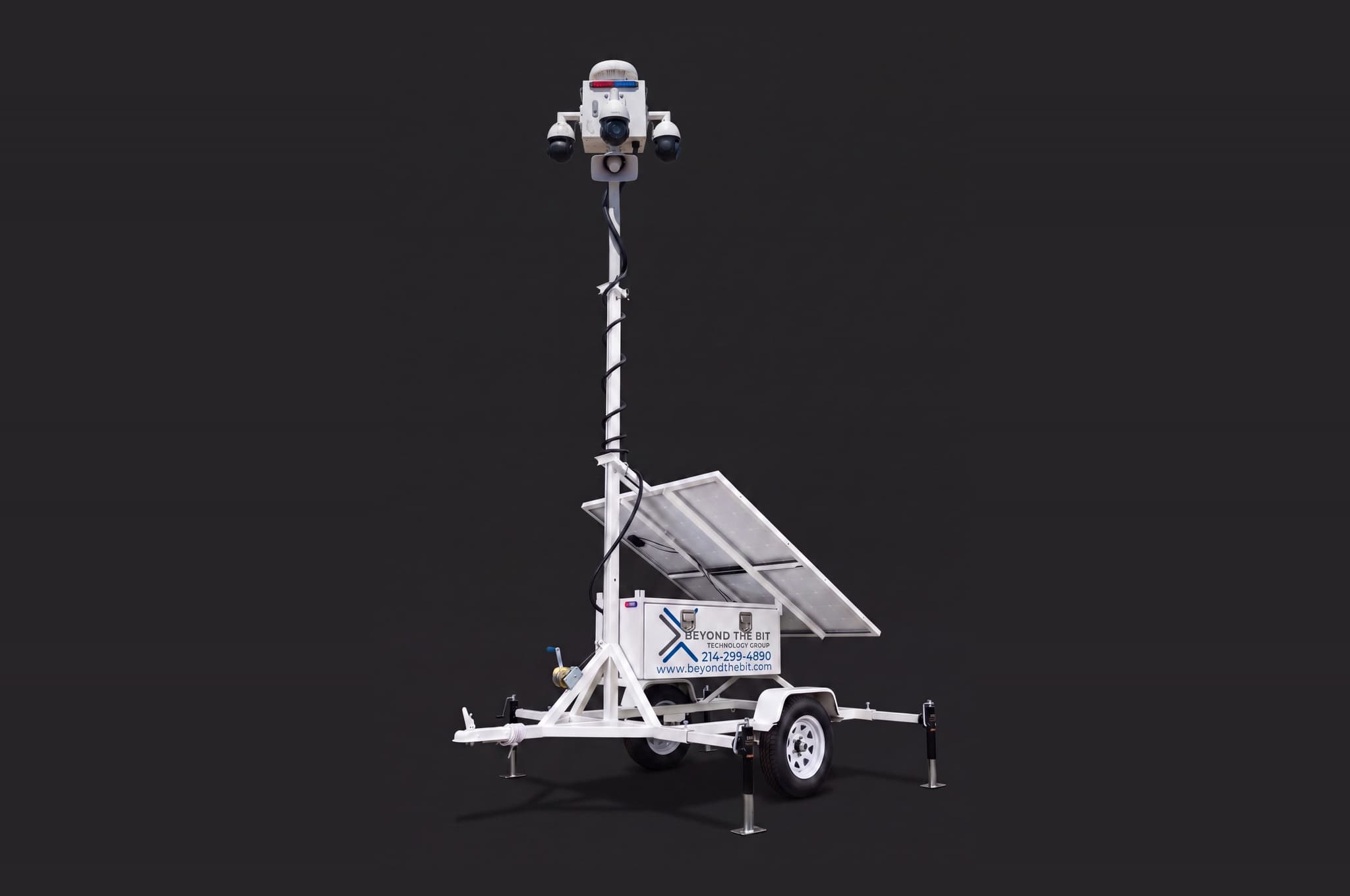
You will see this called a security trailer, a camera trailer, or a mobile surveillance unit. They are the same thing: a towable chassis carrying cameras, solar power, and a cellular link, built to watch a site that has no power, no network, and nobody on it after dark.
| Component | What it does |
|---|---|
| Camera Mast | Telescoping mast carrying a PTZ camera — pan, tilt, zoom, operator-controlled from the monitoring center — alongside fixed wide-angle cameras that keep entries, gates, and blind corners covered without anyone touching a joystick. |
| Power | Dual solar panels charge an onboard battery bank around the clock. No shore power, no generator, no fuel run. The trailer keeps working when a site's temporary power goes down. |
| Strobe | A blue strobe fires on a verified alert — visible well before anyone reaches the fence line, and unmistakably not a porch light or a dashcam. |
| Loudspeaker | Mounted speaker for live two-way audio. A real operator talks through it in real time, not a recorded loop. |
| Connectivity | Cellular LTE modem handles the video and alert traffic. No site internet, no phone line, no IT ticket. |
| Chassis | Single-axle towable trailer with stabilizer jacks that level and lock it on rough dirt, gravel, or asphalt — no pad or foundation work. |
02 — The Response Chain
What happens when someone walks onto your site.
Four systems, in order, every time a camera trips. None of them skip a step, and none of them depend on someone happening to be looking at a monitor.
28 05 13
Detection & Zone Masking
Cameras run motion analytics that categorize what's moving — person, vehicle, bicycle — instead of firing on every shadow and blowing leaf. During setup, our crew draws detection zones around the property and masks out anything outside your fence line: the public sidewalk, the road, the neighbor's lot. A city bus rolling past at 3 a.m. doesn't open a ticket. A person climbing over your fence does. That masking step is why the alert volume stays low enough for a live operator to actually watch every one, instead of a flood of false positives training everyone to ignore the system.
28 05 16
Live Video Verification
A flagged event routes to a live operator at our Texas-licensed third-party monitoring partner, who pulls up the video and looks at it in real time — usually within moments of the trigger. This is the step most camera systems skip entirely. A doorbell camera or a game camera records the same motion and stops there; nobody's watching, so nobody acts until someone checks the footage later. Here, a person decides in the moment whether it's a raccoon, a delivery driver who wandered off the drive, or someone who doesn't belong. Software flags. A person decides.
28 05 19
Audio Warning
If the operator confirms a real intrusion, the trailer's strobe fires and a live voice comes through the loudspeaker — not a canned recording, an operator speaking directly to whoever is on your site, describing what they're wearing and where they're standing. That specificity is what makes it land. Most people who came to steal copper or a generator did not sign up to be talked to by name in real time, and they leave before the second sentence.
28 05 23
Call List & Dispatch
In parallel, the operator works a call list your team builds during install — site super, PM, whoever should know first. That list is customizable and gets updated as your project staffing changes; add a night-shift foreman, drop someone who rolled off the job, no new hardware or truck roll required. If the situation is confirmed real and unresolved, the operator contacts police with the verified video in hand. In Dallas, that verification is the difference between a call that gets logged and a call that gets a dispatch.
03 — Deployment
From signed quote to standing mast.
01
Site Assessment
We walk the site — or review site plans if the ground isn't ready yet — and work out where a trailer actually needs to sit to see what you need watched: the gate, the laydown yard, the equipment row. This is also where we scope how many units a multi-acre site needs.
02
Placement & Aiming
Our crew delivers the trailer, raises the mast, and aims every camera with the monitoring center live on the line — confirming coverage in real time instead of guessing and coming back later to fix it.
03
Walkthrough
Before we leave, we walk your team through the call list, confirm who gets contacted on an alert, and answer whatever's still unclear. Nobody's left guessing what happens the first time the strobe fires.
Typical turnaround is one to two weeks from signed quote to a trailer standing on site, and it often runs faster inside DFW — our yard is in Richardson, so most of the Metroplex is a same-day drive. Multi-unit orders don't wait on equipment; we run a fleet of nearly 100 trailers and have staged them on 18-wheelers to set several sites in a single day.
04 — What It Replaces
Against a guard, a fence, and a game camera.
| Security Trailer | Guard | Fencing | Game Camera | |
|---|---|---|---|---|
| Coverage after dark | Continuous — cameras don't clock out, and the mast is lit and visible all night. | Depends on the shift, the route, and whether the guard is awake at 3 a.m. | None. A fence slows down foot traffic; it doesn't watch anything. | None. Passive recording only — no one is looking at the feed live. |
| Response to activity in progress | Live operator verifies and can intervene by voice within moments. | One person, one location — can't watch the whole perimeter at once. | None — a determined person climbs, cuts, or drives through it. | None — footage is reviewed later, after whatever happened already happened. |
| Deters before an incident starts | Lit mast, visible camera head, and a strobe change the math before anyone commits. | Some deterrent value, but a single visible person is easier to watch and time around. | Modest — mainly stops casual walk-ons, not a planned theft. | Minimal — most units are deliberately hidden, so there's nothing to see and avoid. |
| Site infrastructure required | None. Solar power and cellular data — works on raw dirt the day it arrives. | None, but requires scheduling, coverage gaps, and turnover management. | Installation and removal labor, plus storage between jobs. | Battery swaps and manual card pulls; no live connectivity. |
| Evidence when something happens | Video-verified footage, available for police reports and insurance documentation. | A written incident report, if the guard saw it happen. | None. | Recorded footage, if the camera was aimed right and the card didn't fill up. |
05 — Dallas Response
Will police actually respond?
In Dallas, yes — because the alert is video-verified. Dallas PD has operated under a verified-response ordinance since 2006: officers are not dispatched to unverified commercial burglar alarms. A live operator watching a real person on your site is exactly the verification that clears that bar.
That's the gap an unmonitored camera or a silent alarm falls into — no one to confirm what triggered it, so no dispatch. It's also why most incidents on a monitored trailer never reach that point at all. Between the strobe and a live voice through the speaker, the majority of intruders are gone before an operator finishes deciding whether to call. When someone doesn't leave, the same video that triggered the warning is what gets police moving — and it's available afterward for the police report and for your insurance documentation.
Common Questions
On the spec, answered.
What happens when a camera detects someone at 2 a.m.?
A live operator sees it within moments. The cameras categorize motion — person, vehicle, bicycle — and ignore masked-off areas like public roads, so false alarms don't pile up. Our Texas-licensed monitoring partner verifies the video, works your call list to confirm whether anyone should be on site, can issue a live audio warning through the trailer's speaker, and contacts police when it's real.
Who is actually watching the cameras?
Trained human operators at a Texas-licensed third-party monitoring center, backed by AI motion analytics. The software flags movement; a person decides what it is and what happens next. That combination is what keeps false alerts from burning out a response — and what makes the response real when it counts.
Will police actually respond to an alert?
In Dallas, video verification is the difference. Dallas PD has operated under a verified-response ordinance since 2006 — officers are not dispatched to unverified commercial burglar alarms. A live operator watching a person on your site is exactly the verification that gets a dispatch. Most intruders never wait that long: the strobe and a voice calling them out sends them running.
How fast can you deploy a trailer in Dallas–Fort Worth?
Typically one to two weeks from signed quote to a trailer standing on your site, and often faster inside the Metroplex — our yard is in Richardson. We run a fleet of nearly 100 trailers, so multi-unit orders don't wait on equipment. For large deployments we've staged trailers on 18-wheelers and set several sites in a day.
What does the trailer need from my site?
A parking-space-sized patch of reasonably level ground with a clear view of what you want watched. That's it. Our crew places the trailer, raises the mast, aims the cameras with the monitoring center live, and walks your team through the call list before leaving the site.