
Solution — Monitoring & Response
Software flags it. A person decides.
Every alert from a Beyond the Bit trailer goes through a live human operator before anything happens next — verification, a call list, a warning, and police contact backed by video proof.
The Flow
Five steps, every alert, no exceptions.
Motion analytics do the first pass. Everything that follows is a decision made by a trained person watching real video, not an algorithm acting on its own.
01
Alert
Onboard analytics flag motion inside a masked zone and route the clip to the monitoring center — usually within seconds of the trigger.
02
Live Human Assessment
A trained operator opens the video and looks at it in real time. Software narrowed down what to check; the operator decides what it actually is.
03
Call-List Confirmation
If it's a person who might have a legitimate reason to be there, the operator works your call list to confirm before escalating further.
04
Audio Intervention
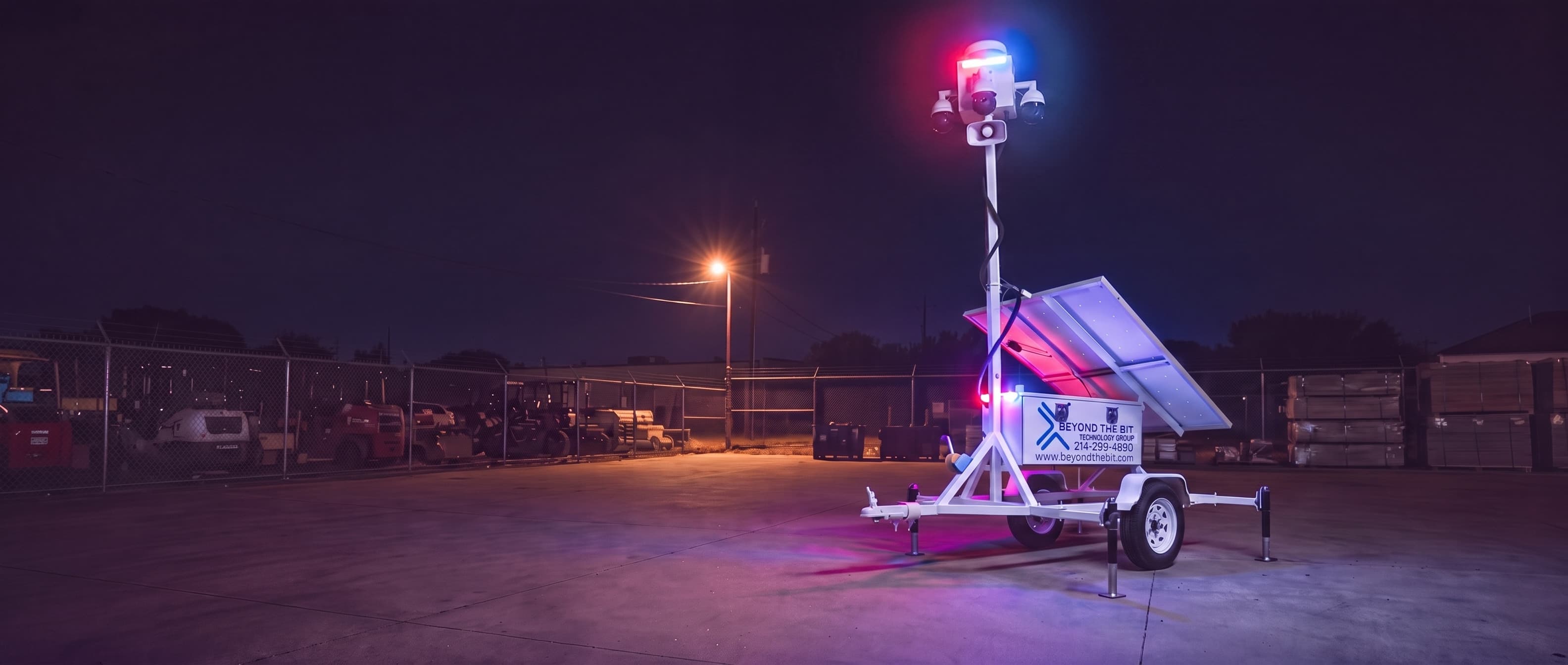
If it's not legitimate, the strobe fires and the operator speaks through the trailer's loudspeaker directly to whoever's on site.
05
Police Contact
If the person doesn't leave, the operator contacts police with verified video in hand — the exact evidence Dallas requires for a dispatch.
Humans + Software
The algorithm doesn't make the call.
Analytics are what make live monitoring practical at scale — categorizing person, vehicle, and bicycle motion, and masking out the areas outside your fence line so a fleet of trailers isn't drowning operators in false alerts. But analytics don't decide what happens to a real event. A trained person at our Texas-licensed monitoring partner watches the actual video and makes that call, every time.
That distinction matters because an algorithm alone can't tell the difference between a subcontractor grabbing a tool bag off hours and someone cutting a lock. A person can, and a person is who decides whether to escalate, whether to warn, and whether to call police. The software's job is narrowing a jobsite full of motion down to the handful of moments that need a human's judgment — not replacing it.
Dallas Response
Why video verification is the whole game in Dallas.
Dallas PD does not dispatch officers to unverified commercial burglar alarms — that's been the policy since a verified-response ordinance took effect in 2006. A silent alarm or an unmonitored camera can trip all night without a single unit ever rolling.
Live video verification is built to clear that bar. When our operator watches a real person on your site and confirms it before calling, that call comes in as a verified alarm — the category Dallas PD actually responds to. It's the reason a monitored trailer produces a different outcome than a camera that only records: one gets police moving, the other gets a clip somebody watches Monday morning.
The same principle applies statewide — Fort Worth, Plano, Tyler, wherever the trailer sits. Departments increasingly weight verified alarms over unverified ones, and a live human watching your camera is what puts an alert in that category.
After an Incident
The footage doesn't disappear when the alert closes.
Every verified event is recorded video, not a log entry. If police need it for a report, it's available. If you need it for an insurance claim on stolen material or a damaged fence, it's available for that too. You're not reconstructing what happened from memory or a guard's handwritten note — there's footage of the actual event, tied to a timestamped alert, on file.
That record also helps with the disputes that never make it to a police report — a subcontractor claiming they never touched a locked laydown area, a delivery driver and a site super disagreeing about when a gate was left open. Instead of two accounts that don't match, there's a clip. It settles the question in minutes instead of becoming a back-and-forth nobody can win.
Common Questions
On response, answered.
Who is actually watching the cameras?
Trained human operators at a Texas-licensed third-party monitoring center, backed by AI motion analytics. The software flags movement; a person decides what it is and what happens next. That combination is what keeps false alerts from burning out a response — and what makes the response real when it counts.
Will police actually respond to an alert?
In Dallas, video verification is the difference. Dallas PD has operated under a verified-response ordinance since 2006 — officers are not dispatched to unverified commercial burglar alarms. A live operator watching a person on your site is exactly the verification that gets a dispatch. Most intruders never wait that long: the strobe and a voice calling them out sends them running.
Is Beyond the Bit licensed for this work?
Yes. Beyond the Bit Technology Group holds Texas DPS Private Security License #B31111401 under Occupations Code Chapter 1702, covering security contracting, alarm, and electronic access work — and our third-party monitoring center is Texas-licensed as well. Licensing is the floor for doing monitored security legally in Texas — ask any provider you're comparing for theirs.