
Service Area — Denton County
Watched in
Denton, Texas.
Denton is forty-five minutes from our Richardson yard, and it is some of the busiest ground in North Texas that most security vendors still treat as the edge of the map. Census estimates put the county's growth at roughly a fifth since 2020, and the building has followed in every direction at once — master-planned communities off I-35W, retail and light industrial along US-380, campus-edge work around UNT and Texas Woman's University. What that adds up to at night is a great deal of half-finished property standing in the dark on streets that do not have neighbours yet.
Two interstates, a triangle, and a lot of open ground
Denton is the only city in the Metroplex where I-35 splits, and the triangle between the two branches has become its own construction economy. West of I-35W, Robson Ranch Road and the Landmark development have put thousands of acres into phased build-out — horizontal work first, then slabs, then framing, moving across the ground a section at a time. East along US-380 and around Rayzor Ranch, the work is commercial: pad sites, retail shells, medical office, the kind of building that goes up fast and sits unoccupied between certificate of occupancy and tenant fit-out. South of the city the parcels get bigger and the buildings get plainer — distribution and light industrial serving the run between Denton and Alliance.
Those three patterns fail in three different ways, and it is worth being specific about which one you have. A subdivision phase loses lumber packages, appliances and copper off open slabs. A retail shell loses rooftop mechanical units, wire and conduit, and whatever the mechanical sub staged on Friday. An industrial laydown loses plant, fuel and cable reels. What they share is a fence that exists to satisfy a requirement and a night that nobody is standing through.
Why new-growth ground is a softer target than old ground
The thing that protects an established commercial block is not its fence. It is that people are around. A closed restaurant has a neighbour above it, a patrol route passes it, somebody walks a dog past it at eleven. New-growth ground has none of that yet, and Denton County has a great deal of new-growth ground.
A phase that broke ground last month sits on a street with no occupied houses, no street lighting energised, and no reason for anyone to drive down it after dark. That is a site where somebody can work unhurried, back a truck up to a slab, and take their time — which is exactly the condition that turns a smash-and-grab into a loaded trailer. It is also why a camera that only records is close to useless out here. Nobody is going to hear an alarm, and the footage gets reviewed on Monday, by which point the material is gone and the report is an insurance formality.
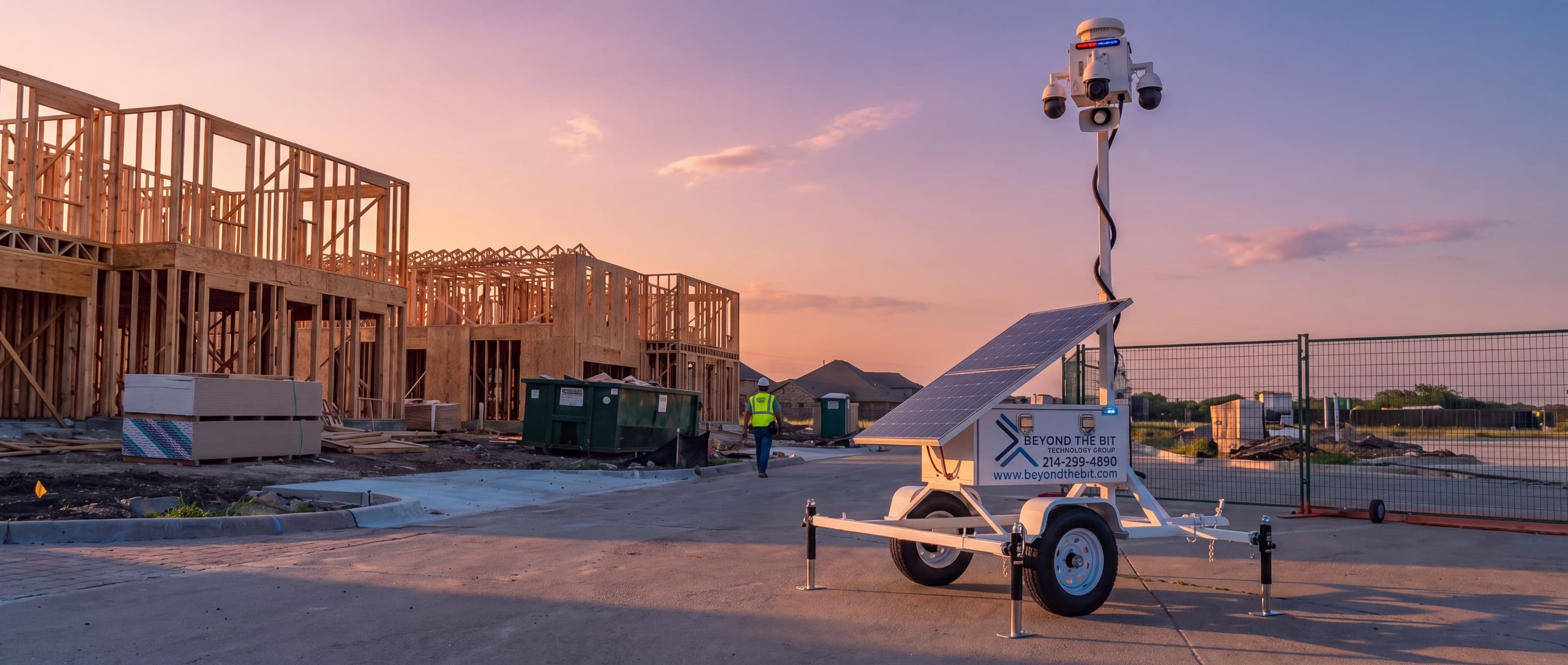
A monitored trailer changes what the site is. The mast is tall and lit on purpose and the strobe is unmistakable, so the property stops reading as unattended from the road. Detection zones get drawn around the slabs, the material drop and the equipment corral, with the through street and the neighboring pasture masked out so headlights and livestock do not generate anything. When something crosses into a zone that should be empty, an operator at our Texas-licensed monitoring partner has live video within moments and can speak through the trailer while it is still happening.
What that looks like on a Denton site
A subdivision phase off I-35W, twenty slabs poured and eight of them framed, lumber banded and stacked where the crane set it Friday afternoon. No occupied house on the street. At 1:40 a.m. a pickup with a flatbed pulls past the entrance, turns around, and backs down to the third slab.
The camera tags the vehicle the moment it enters the material zone, then tags the person who steps out of it. An operator is watching before the tailgate is down. The strobe fires and the loudspeaker names the truck, where it is parked, and what the person in the bed is standing next to. Most of the time that ends it — a job that was supposed to take four minutes stops being worth it the moment somebody is describing you out loud. If it does not end it, the operator is already working your call list with video in hand, which is what turns a call to the sheriff's office into a report a deputy can actually act on.
The part that makes this liveable is everything that did not generate an alert: the traffic on the frontage road, the coyote crossing the graded pad, the framing crew's own truck arriving at six. Those are outside the zones on purpose. A system that cries wolf on a growth-corridor site gets muted inside a fortnight, and a muted system is the same as no system.
Getting a trailer onto your Denton site
Forty-five minutes from the yard, scheduled the same way we schedule a Frisco or Arlington delivery — no special trip, no distance premium. Typical deployment is 1–2 weeks from signed quote to a trailer standing on your ground, and with a fleet of nearly 100 trailers a multi-unit order for a phased community does not wait behind other jobs.
Our crew places the unit, raises the mast and aims the cameras with the monitoring center live on the call, then walks your site contact through the call list before leaving. Phased work is the normal case in Denton County rather than the exception, so plan the moves into the deployment: the position that covers the slab field during framing is usually the wrong one once the phase closes and the exposure shifts to the next section. Repositioning on the same project is part of the job, not a separate event. W-9, certificate of insurance and net-30 terms are standard — send them with your quote request if a vendor packet has to clear before a purchase order does.
Field Photo — 2025 Deployment
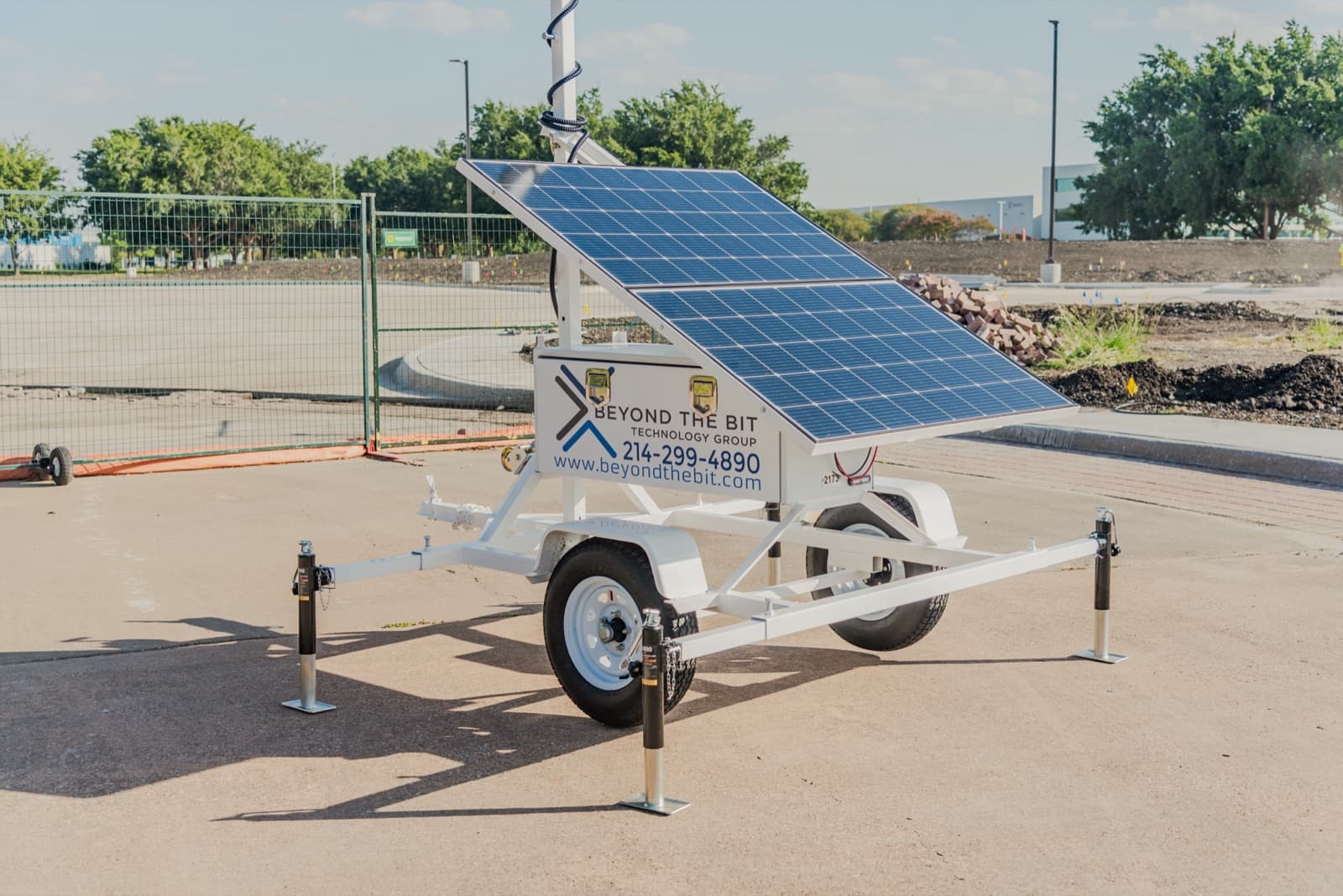
Tongue, axle, two-section array and the equipment cabinet in one frame. Single axle, levelled on four drop-leg jacks once it is spotted.
Plate 02 — Chassis, three-quarter
Where These Trailers Work
Common Denton deployments.
Watching a site in Denton? Call 214-299-4890
Questions — Denton
Asked before booking.
Do you charge more for Denton than for a Dallas or Plano site?
No. Denton is about forty-five minutes from our Richardson yard, well inside the range we treat as normal territory, so it is scheduled and quoted like any other Metroplex job with the same 1–2 week deployment window. Quotes are one flat monthly number with delivery, installation, live monitoring, cellular data, solar power, maintenance and teardown included, and none of that changes because the site is on I-35W rather than US-75.
Can a trailer cover a subdivision that is being built in phases?
Yes, and phasing is the thing to tell us about at the site assessment rather than afterwards. One mast raised over a flat, open phase takes in a lot of ground because there is nothing to block the sightline, but the right position during framing is rarely the right position once that section closes and work moves to the next. We plan the repositioning into the deployment, and moving a unit on the same project is included rather than billed as a new event. Larger communities are usually covered with more than one trailer so the material drop and the active slabs are both watched at once.
What actually goes missing from a Denton County jobsite?
Whatever has a short carry and an easy resale. On residential phases that means lumber packages, appliances waiting on install, water heaters, HVAC condensers off finished houses, and copper wire pulled out of open framing. On the commercial and industrial side it is rooftop mechanical units staged at grade, cable reels and conduit, small plant and power tools, fuel, and catalytic converters off anything parked overnight. The building itself is almost never the target, which is why detection zones go around the material drop, the equipment corral and the parked plant rather than around the footprint.
Ready to get a trailer on your Denton site? Get a quote built around your actual site.
Request a Free Site Assessment