
September 8, 2026 — Beyond the Bit Security Trailers
What makes an event site or municipal yard different from a normal jobsite?
The exposure shows up in bursts instead of running the length of one continuous build. A festival ground sits fully loaded with stages and fencing for a few days, then goes empty again. A public works yard holds equipment between projects with nobody assigned to walk it. Security has to match that calendar, not a fixed guard shift or a long-term lease.
That's the gap a standard security contract misses. Guard companies price around a shift pattern and a minimum term, because their cost is a person's hours, not a piece of equipment sitting idle. A jobsite fence company installs for the length of one build and has no reason to think about what happens to the site after the ribbon-cutting. Neither model fits a site that needs full coverage for four days, then nothing for eleven months, then four days again next year. Our events and municipal deployments scope against the actual timeline of the event or the yard, not a template built for a year-long commercial build.
What's actually at risk during load-in, teardown, and the months in between?
Four things, in practice: staged stages and AV gear sitting overnight before and after an event, pipe and barricades in a public works yard nobody checks daily, a seasonal venue idle most of the year, and parks or rec facilities exposed after closing. Each one is exposed exactly when nobody's scheduled to be there.
That last one is easy to miss because a park or a pool has staff around all day. The problem is the hours nobody's there — a fixed patrol schedule is predictable, and a facility with no live monitoring gives someone the whole night to work once the gates are locked, which is why vandalism and break-ins at municipal facilities tend to cluster right after closing.
A fairground or amphitheater that runs a handful of weekends a year has more in common with an empty commercial building than with an active construction site — long stretches with no one present, then a short window where everything staged on the property is genuinely valuable. The same logic that covers a vacant property between tenants applies to a venue between seasons: the risk isn't one dramatic break-in, it's weeks of nobody looking.
How fast can coverage go up before a festival or ahead of a bid deadline?
A trailer typically deploys in one to two weeks from booking, which fits a festival load-in schedule or a municipal bid timeline without forcing the event date to move around the vendor. Delivery, raising the mast, and confirming the camera zones are the only steps on the front end.
Pickup runs the same way once the site is clear — there's no removal crew to schedule or infrastructure to tear out, because there wasn't any to begin with. That matters for an event operator working against a load-out deadline the venue enforces, and for a public works crew that needs the yard back to normal the moment the project closes out.
Does the trailer need power or a network hookup on-site?
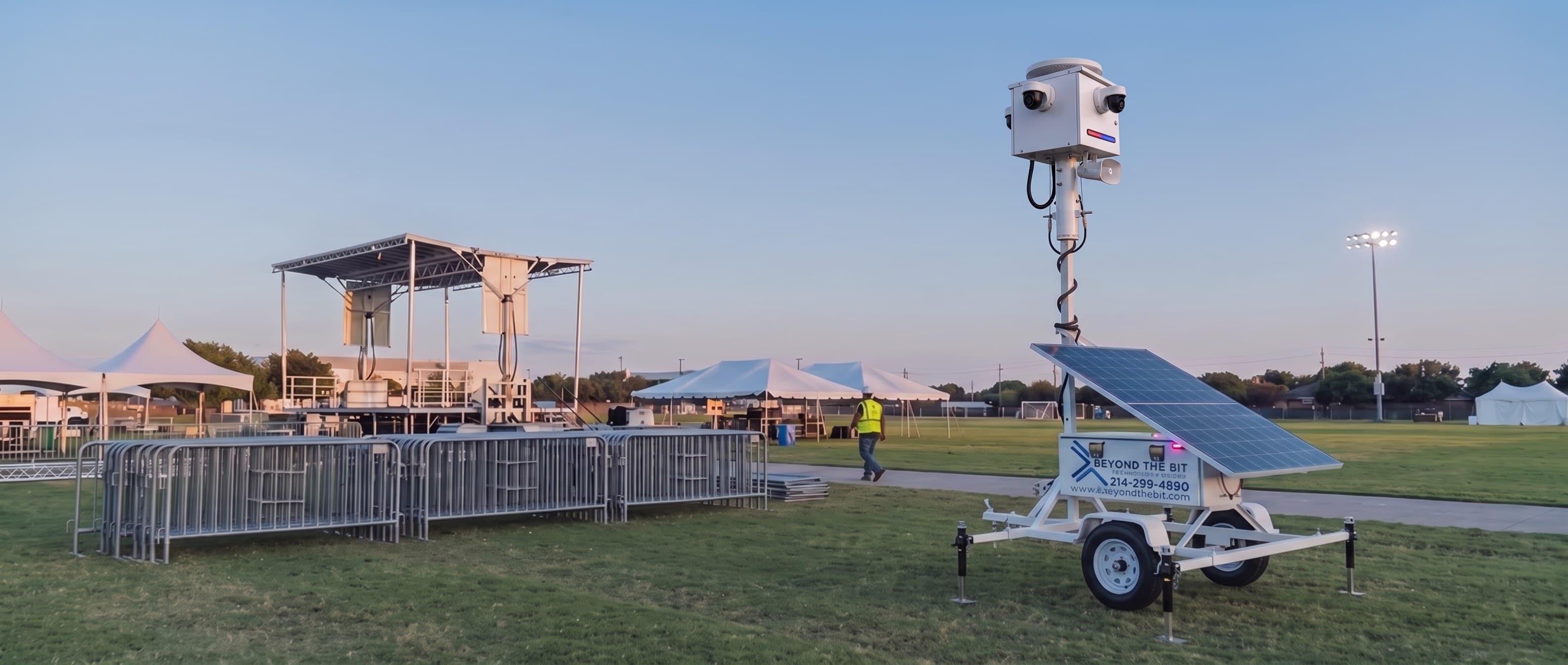
No. Dual solar panels and a battery box run the unit, and it connects over cellular, so it works on open ground, a festival field, or a yard with nothing built yet. There's no power tie-in to schedule with a facility manager and no data line to run before the trailer can go live.
That's a real advantage over a fixed camera system, which needs conduit, a power drop, and often a permit before the first camera turns on. Our explainer on solar and cellular coverage goes through how that works on a site with no existing infrastructure at all — which describes most event grounds and public yards better than it describes a finished building.
What a short-term deployment actually needs
Who actually approves security for a public event or municipal yard?
For a single event, the event operator or facilities director usually makes the call directly. For a public agency, it typically runs through city or county procurement as a formal bid or purchase order process. Either way, the paperwork is the same standard vendor packet — W-9, certificate of insurance, and net-30 terms — filled out with the quote rather than chased down after.
That procurement path is familiar territory for a Dallas–Fort Worth municipal buyer working through an annual bid cycle, and it doesn't change for a smaller city or county running the same process on a tighter budget. A recurring event — a fair or festival that runs every year — can lock in the same placement and timeline instead of re-scoping the request from scratch each season, which matters when the person filing the purchase order changes from one budget cycle to the next but the site itself never does.
Can coverage scale down to just a few days around one event?
Yes. Short-term placements measured in days are normal for event work, and the deployment and monitoring cost the same to run as a longer commercial job — the arrangement scales to the actual window, not a minimum-term assumption built for a year-long jobsite.
That's a different math than most people expect walking in, because purchase and long-lease pricing across the industry is built around continuous use. Our piece on renting versus buying a security trailer walks through that math for a project-based business, and the same logic holds for a four-day festival: paying for exactly the window you need beats carrying a unit, or a contract, for the other fifty weeks of the year. A vendor priced around ownership has no good answer for a site that only needs coverage a handful of weekends a year — the unit either sits unused most of the time or gets left off the site entirely, and the site goes back to being watched by nobody.
What happens if something happens on site after hours during an event?
The same chain runs on an event site as anywhere else: cameras detect motion and categorize it, a live operator at our Texas-licensed monitoring partner verifies what's actually on camera, the trailer's strobe and speaker deliver a live warning, and the operator works a call list and brings in police if it isn't resolved.
Nothing about that sequence changes because the site is a festival ground instead of a construction yard. The zones get masked to the actual footprint being watched — the staging area, the equipment laydown, the facility entrance — so a public sidewalk, a road, or a line of parked cars along the venue's edge doesn't trigger a false alert every time someone walks or drives past. That masking step matters more on an event site than on a fenced jobsite, because a festival ground or a public yard usually has more open access points and more foot traffic passing near the property line without ever entering it.
What changes from one site to the next is only how long the trailer stays: exactly as long as the event or the project needs it watched, and not a day longer. A crew scopes that window against the actual event calendar or bid timeline before the trailer ever ships, which is the same planning step that makes the one-to-two-week deployment above work in the first place.