
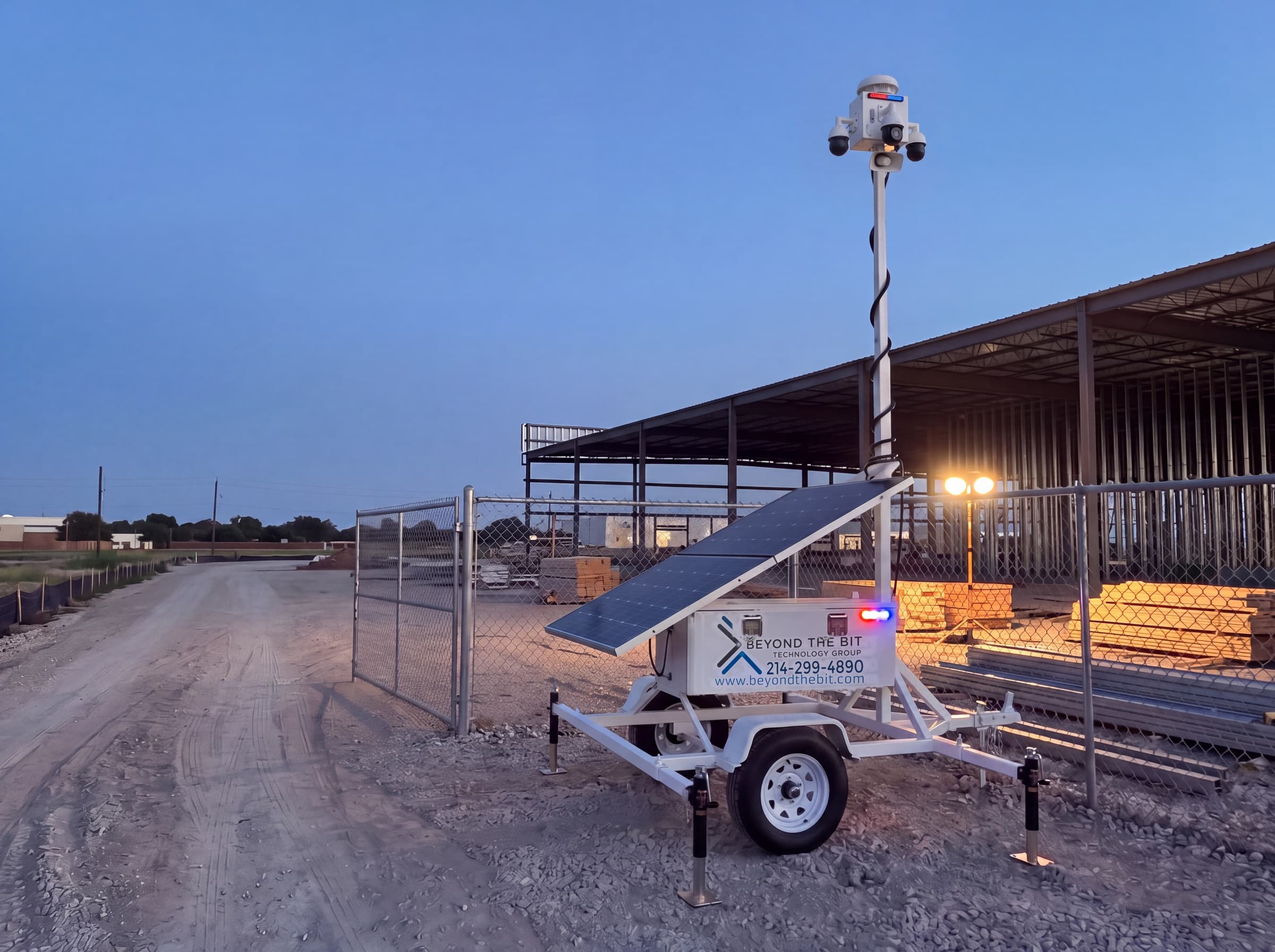
September 1, 2026 — Beyond the Bit Security Trailers
What actually decides whether you should rent or buy?
Project length and repeat use, mostly. A security trailer earns its keep differently for a company running one job at a time than for one that always has three or four sites open at once. The shorter and more one-off the work, the more renting wins. The more sites running continuously, the closer the math gets to buying.
Most project-based businesses never actually reach that second category. A general contractor that opens a job, runs it for eight or ten months, and closes it out before the next one starts is renting equipment for most of the year anyway — scaffolding, lifts, generators. A security trailer fits that same pattern more often than it doesn’t.
The other input is how much internal capacity the company already has. A firm with a yard, a maintenance bay, and someone whose job includes keeping equipment running is closer to being able to own security trailers than a firm that treats every piece of specialty gear the same way it treats a rented boom lift — show up, use it, hand it back. Most project-based contractors are the second kind, whether they think of themselves that way or not.
How long does a project need to run before buying starts to make sense?
There is no fixed month count, but the honest answer is that buying only starts to compete once a company is running trailers close to year-round, across multiple sites, not job to job. A single crew on one site for six months is nowhere near the utilization that makes ownership worth the added work.
Think about it the way a superintendent thinks about a scissor lift. Nobody buys a lift for one job unless the company owns lifts already and rotates them across a steady pipeline of work. A trailer that sits idle in a yard between projects isn’t an asset. It’s a depreciating line item with a battery that needs attention whether it’s working or not.
What does owning a trailer actually cost beyond the purchase?
A lot more than the invoice for the unit. Maintenance, tires, battery and solar panel service, insurance, storage between jobs, and someone on staff who actually understands the electronics are all costs a rental folds into one flat monthly rate. An owner carries every one of them alone, on top of the purchase.
None of that shows up on the spec sheet a buyer looks at when comparing units side by side. It shows up eighteen months later, when a solar controller fails mid-project and there’s no vendor on the hook to send a technician — just a superintendent trying to find a repair shop that services this specific equipment.
Connectivity is its own line item, too. A monitored trailer needs a live data connection wherever it sits, and an owner is the one negotiating that account, troubleshooting it when a site is out of range, and paying for it whether the unit is deployed or sitting in a yard. A rental rate folds that in as one number regardless of which site the trailer lands on next.
Rent vs. buy, at a glance
Does renting make more sense for a company running several sites at once?
Usually, because it turns a fleet problem into a phone call. A company juggling four active sites doesn’t want to be the one troubleshooting a dead battery on unit three while also trying to close out unit one. That’s overhead a rental company absorbs instead of a project manager.
- No yard space tied up storing units between jobs
- No maintenance schedule to track across a growing fleet
- One point of contact instead of a warranty claim and a parts search
- Units can move between sites as a project phases, without a resale decision
That last point matters more than it looks. A job that needed two trailers at grading and needs six at closeout isn’t a scenario an owned fleet handles gracefully. A rental relationship does.
What happens to a trailer’s technology while you own it?
It ages while nobody’s watching, and that’s the part owners tend to underestimate. Camera resolution, detection software, and connectivity all move fast, and a trailer that was current three years ago is behind on the exact features that make live monitoring actually work well.
A rental company has a reason to keep its fleet current, because the units are still working somewhere next year and the year after that. An owner has a reason to keep squeezing use out of a purchase that’s already been paid for, which is exactly how a site ends up running five-year-old detection software on its highest-risk hours.
Texas weather adds its own wear on top of that. A unit that sits through a full run of hail season, a summer of triple-digit heat, and a winter freeze is aging on a faster clock than the same equipment somewhere with a milder climate. An owner absorbs that depreciation directly. A rental company spreads it across a whole fleet and a maintenance program built around exactly that wear pattern.
Is there a middle option between renting one job and buying outright?
For most companies, yes — a standing rental relationship that scales up and down with the pipeline, rather than a single-job contract renewed from scratch every time. A company that always has at least one site running can keep a baseline number of units on rent and add more as new jobs break ground, without ever carrying the maintenance, storage, or technology risk that comes with ownership.
That structure captures most of what buying is supposed to offer — predictable access, no scramble to source a unit when a job starts — without the parts of ownership that make the math worse the longer a trailer sits idle between projects.
Who should actually lean toward buying?
A company running enough units, on enough sites, for enough of the year that a dedicated person can own maintenance and utilization stays high — a genuinely small slice of the market. For nearly everyone else running project-based work, the math points the other way, and the decision comes down to size, footprint, and how many months the site actually needs coverage.
That’s a question worth answering with real numbers instead of a guess, and it’s the same question a rate comparison like guards versus a camera trailer eventually runs into — the answer depends on the specific site, not a rule of thumb that applies to every job the same way. A site assessment walks the actual footprint, perimeter, and project length and comes back with one flat monthly number covering however many units the site needs, rather than a purchase decision made off a spec sheet before anyone’s seen the ground.