
September 1, 2026 — Beyond the Bit Security Trailers
Why is copper the first thing to go?
Because it is the only thing on a jobsite that converts to cash the same afternoon. Copper has a standing commodity price, a buyer in every county, and no serial number. A skid steer is worth far more and is far harder to move, trace and sell. A spool of wire is worth less and disappears completely.
That combination is what makes copper the baseline theft on almost every commercial project, from a subdivision to a data center. It is not opportunistic in the way a stolen toolbox is. Copper theft is the reliable, repeatable version of jobsite crime, and the people who do it regularly understand construction schedules better than most owners would be comfortable knowing.
When exactly is a jobsite most exposed?
In the window between rough-in and cover. Wire that has been pulled but not yet buried behind drywall, poured into a slab, or energized is both accessible and valuable, and that window is short, predictable, and visible from outside the fence to anyone who knows what a building at that stage looks like.
The other window is the laydown. On larger work — distribution shells, industrial buildings, anything with a substantial electrical scope — cable reels, conduit and switchgear arrive long before the building can take them and sit in the open for weeks. That material is not tucked inside a partially enclosed structure. It is stacked on gravel behind a temporary fence, in quantities that make one night’s work worth planning for.
The exposure window
How much is copper theft actually costing the industry?
The honest answer is that nobody knows precisely, and you should be suspicious of anyone who quotes a figure to the dollar. Construction and insurance industry estimates for copper stolen from US jobsites are routinely put in the hundreds of millions to around a billion dollars a year, with the wide spread reflecting how much theft is never reported at all.
Under-reporting is the part worth dwelling on. A superintendent who loses a few hundred feet of wire on a Saturday often absorbs it rather than filing, because the claim is below the deductible and a claims history has its own cost. So the published numbers are a floor, not a measurement, and the loss that shows up in your own job-cost report is almost certainly larger than the loss that shows up in anyone’s statistics.
Why does Texas get hit harder than most states?
Volume and geography, mostly. Equipment-theft tracking groups have for years placed Texas at or near the top of state-level construction theft reporting, and the explanation is not mysterious: the state simply has more active construction than almost anywhere else, spread across long highway corridors that make moving material out of an area straightforward.
The current building cycle sharpens it further. Semiconductor, data center and large-scale industrial construction all carry electrical scopes far heavier than a typical commercial build, which means far more copper sitting outside for far longer. A Grayson County supplier building near the semiconductor megasite is staging material that a strip-center project would never see, on ground that had cattle on it two years ago.
Does locking the reels up actually help?
It helps at the margin and it is worth doing, but it solves a smaller part of the problem than most site teams expect. Physical measures raise the time cost of a theft. They do not introduce any risk of being caught, and on an empty site at two in the morning, time is the one thing a thief has plenty of.
- Store reels and spools inside a locked conex rather than on open gravel where you can
- Sequence deliveries so wire arrives close to the pull rather than weeks ahead
- Keep the laydown away from the fence line and out of sight of the frontage road
- Photograph and log what is on site before a long weekend, not after
- Drain or lock fuel on anything parked over a holiday shutdown
Every one of those is cheap and every one of them narrows the opening. None of them changes the basic fact that nobody is there. A cut lock is a delay; an empty site is an invitation. That is why the sequencing conversation and the monitoring conversation are different conversations.
What actually interrupts a copper theft in progress?
A voice. Interruption, not documentation, is what stops the loss, and the only thing that interrupts somebody standing over a cable reel is evidence that a person is watching them do it right now. That is the entire reason our chain runs through a live operator instead of a motion alert on somebody’s phone.
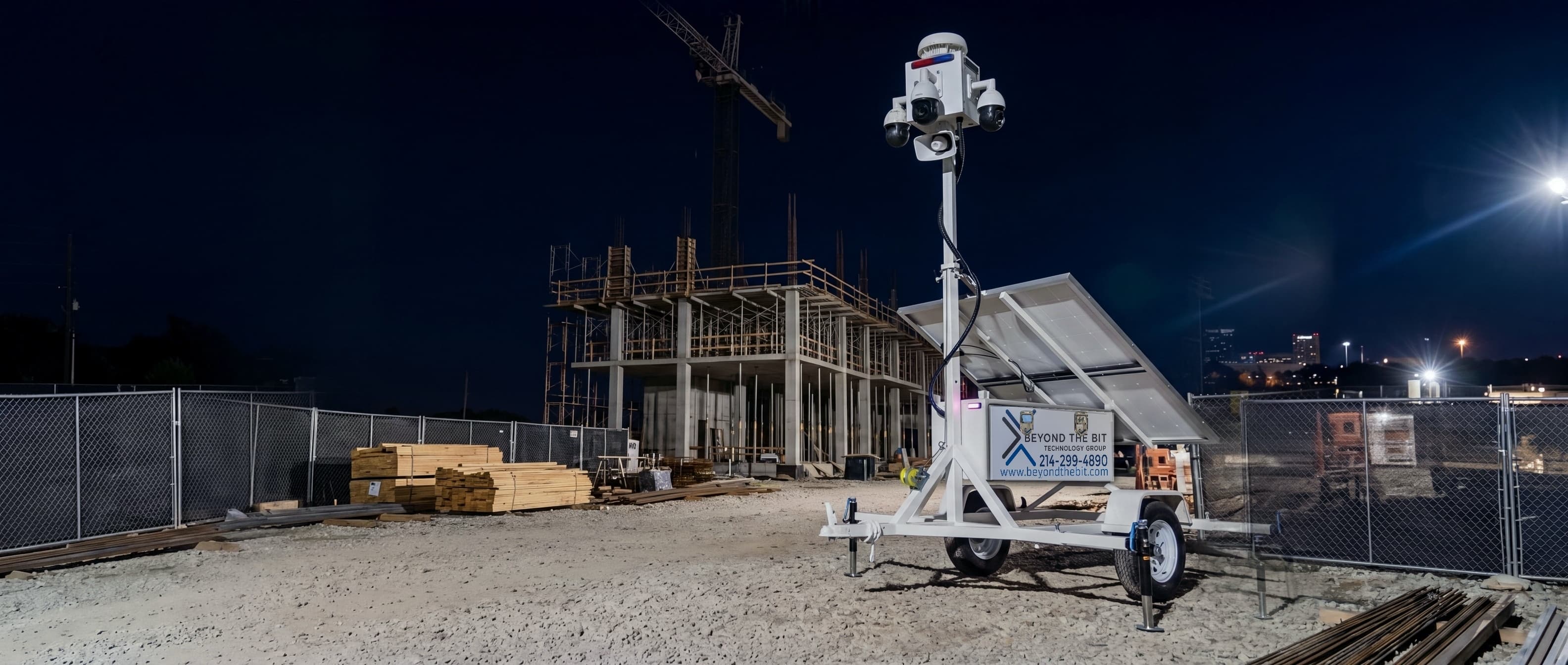
Motion analytics do the first pass and categorize what moved — person, vehicle, bicycle — inside zones drawn around the laydown and the equipment corral, with the road frontage masked out so headlights generate nothing. When a person crosses into a zone that should be empty, it routes to an operator at our Texas-licensed monitoring partner, who looks at the actual video and decides. Software flags; a person decides. If it is real, the strobe fires and the operator describes the intruder through the trailer’s loudspeaker. You can read the full sequence on how monitoring and response works.
The second thing it produces is a verified report. Video of a burglary actually in progress is a materially different thing to hand a sheriff’s office than an alarm panel that tripped, and it is the version that gets a unit moving at the time rather than a report taken in the morning.
What should a superintendent change before the next long weekend?
Work the schedule first, because it is free. Look at what is landing on site Thursday and ask whether it needs to be there before Monday. Most copper losses happen to material that arrived earlier than the work required, staged where the delivery truck found it convenient rather than where the site could watch it.
Then look honestly at the hours nobody is there. A weeknight is eight or ten hours of exposure. A holiday shutdown is three or four days, and that gap is exactly where equipment losses cluster as well. Whatever covers that gap has to work without anybody from your team being awake, which rules out most of what gets sold as jobsite security. Our construction deployments exist for that specific stretch of hours, and everything else on the site is already doing its job the rest of the time.