
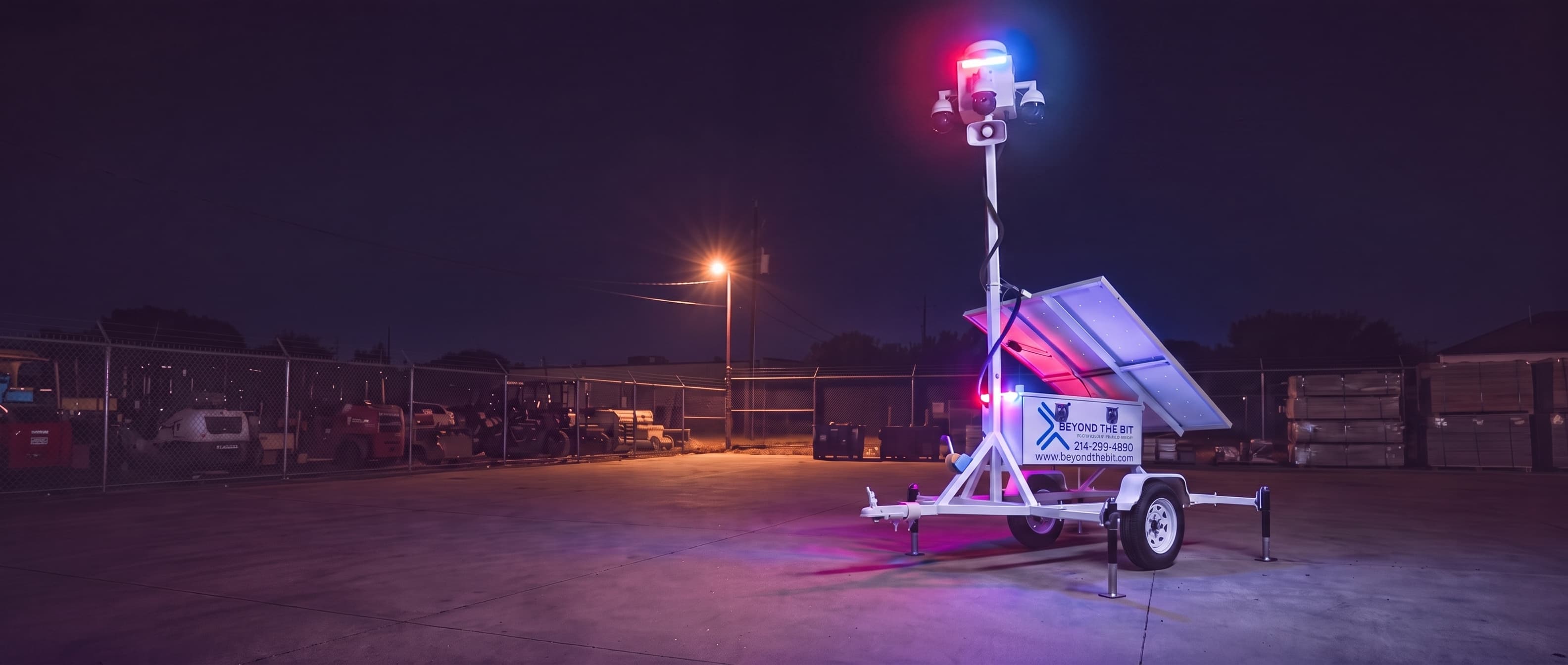
October 20, 2026 — Beyond the Bit Security Trailers
Why do some security camera trailers send so many false alerts?
Because a plain motion sensor can’t tell what moved, only that something did. A plastic bag rolling across a laydown yard, a shadow swinging past a floodlight, a stray dog cutting through the lot at 3 a.m. — all of it trips the same sensor a trespasser walking up to a gate would trip. A trailer built around AI-based object detection classifies what’s actually in frame before anything gets flagged, which is the biggest reason one system drowns an operator in nothing and another doesn’t.
That gap is not a minor spec difference. It’s the thing that decides whether a monitored camera is actually monitored, in any way that matters, three months into a contract. A system that fires on every truck headlight, every piece of blowing tarp, and every passing bird teaches whoever reviews it to tune the noise out — and a system that’s been tuned out is functionally the same as no system at all, just with a monthly invoice attached.
What’s the real difference between motion detection and AI detection?
Motion detection measures pixel change between frames and fires on any of it. AI detection looks at what changed and sorts it — person, vehicle, bicycle, or background noise the system can discard on its own — before a human ever sees a clip. On a Beyond the Bit trailer, that classification runs alongside zone masking, so a public sidewalk or a road at the edge of the property doesn’t generate a flag every time someone walks or drives past it.
The combination is what makes live video verification practical at fleet scale. A human operator still makes every real call, but software has already thrown out the overwhelming majority of motion that was never going to matter, so the operator is looking at the handful of moments a person actually needs to judge.
Why does it matter if a human is watching the feed anyway?
Because a human watching hundreds of meaningless clips in a shift stops watching them carefully, and that’s a documented problem across the alarm and monitoring industry, not a theoretical one. Security researchers and monitoring operators have long described it as alert fatigue: the more noise a system produces, the less attention each individual alert gets, and the real event eventually gets the same half-second glance as the hundredth false one that day.
Cutting the false-alert volume at the camera, before a clip ever reaches a person, is what keeps that half-second glance from happening to the one alert that was actually a break-in. It’s a detection problem with a monitoring consequence, which is why the two get sold together instead of separately.
Scale makes this worse, not better. One camera on one building can tolerate a sloppy false-alert rate. A monitoring center covering a fleet of trailers across a dozen sites at once can’t — if every unit flags a possum crossing a yard at 2 a.m., the operators are drowning before midnight. Filtering has to happen at the camera, not after the clip lands in a queue.
What gets flagged to an operator
Does fewer false alerts actually change how fast police respond?
In a lot of Texas cities, yes, because the response itself is gated on verification, not on the alarm firing. Dallas has run a verified-response policy since 2006, meaning officers aren’t dispatched to a commercial alarm until something confirms a person is actually there. A system that buries real motion under constant false triggers makes that confirmation slower to reach, not faster — the operator has to work through more noise to get to the signal that actually justifies a call.
A detection system that filters hard before anything reaches a person shortens that path. It doesn’t change the ordinance or guarantee a response time — no honest vendor should claim a dispatch SLA — but it does mean the clip a human reviews is far more likely to be the one that actually needed a look.
Can AI detection even work on a jobsite that doesn’t have a fence yet?
Yes, and it’s where zone-based detection earns its keep the most. Most active construction sites go months without a finished perimeter, which means there’s no fence line to hang a camera on and no gate to watch for an opening. Zones get drawn against what’s actually there instead — the material laydown area, the equipment row, the trailer compound — and get redrawn as the site changes shape.
That’s a different setup process than a fixed camera bolted to a building, and it’s one reason a camera trailer can start working the same week a laydown yard appears rather than waiting on a permanent perimeter to exist first.
It also means the zones aren’t static once they’re set. A site that’s bare dirt in week one and has lumber stacked where the camera is aimed by week six needs its masked areas adjusted along the way — that’s part of the service, not a one-time setup step a vendor walks away from.
What should I ask a vendor about detection before I sign a quote?
Ask what gets classified, who draws the zones, and who actually looks at a flagged clip before anything happens. Those three answers tell you more about a system than any spec sheet will, and they’re the questions a sales pitch is least likely to volunteer on its own — the pitch tends to lead with camera resolution and mast height, which matter less to false-alert volume than the software deciding what’s worth looking at in the first place.
- What does the system classify — person, vehicle, bicycle — versus just “motion”?
- Who draws and adjusts the masked zones, and how often can they be changed as the site changes?
- Does a live person review a flagged clip, or does an algorithm decide on its own whether to escalate?
- How does the system hold up with no site power or network, since that’s when most of this ground is actually exposed?
That last question matters more than it sounds like it should. A detection system is only as good as the power and connectivity it runs on, and a unit that loses either one is back to being a camera nobody’s watching, however good its classification logic is on paper. Ask it the way you’d ask about any other piece of site equipment: not whether it has a feature, but what happens on the specific week your site has no fence, no power, and no network yet — because that week is usually the one the system was bought for.
What does this actually look like once a trailer is on site?
It looks like far fewer alerts reaching anyone, and the ones that do reach a person carrying more weight because they aren’t competing with hundreds of false ones from the same week. The full chain — detect, classify, verify, respond — is laid out on how it works, and detection is the first link in it for a reason: everything downstream, including how fast a real event gets a human’s attention, depends on how well the system throws out what was never a threat in the first place.
None of that means false alerts are solved just because a vendor says the word “AI” in a proposal. It means asking the specific questions above, and watching how the system performs on your actual site — a tree line nobody mentioned in the walkthrough, a loading dock with forklift traffic all night — not just in a demo.