
November 24, 2026 — Beyond the Bit Security Trailers
Does builders-risk insurance require jobsite cameras in Texas?
Usually not as a flat rule written into the policy. Most builders-risk forms don’t name a camera system as a condition of coverage. What’s changed is that more underwriters now ask about jobsite security during quoting and lean on it again if a claim gets filed, so it’s a question worth raising with your broker early, not a box you check once and forget.
That distinction matters. A requirement is something a policy either has or doesn’t. Underwriting is a conversation, and the honest answer is that it varies by carrier, by project value, and by what else is going on at the site. We’re not an insurance agency and we’re not going to pretend otherwise, but we talk to enough general contractors and property owners to know this question comes up on almost every large project.
What do underwriters actually ask about jobsite security?
The questions we hear about secondhand, from brokers and from clients repeating what their broker asked, tend to cluster around the same handful of things: is the perimeter fenced, is there lighting after dark, is anyone watching the site overnight, and if something happens, is there a record of it.
Simply put, a carrier underwriting a multi-million-dollar structure in progress wants to know the site isn’t wide open at two in the morning. That doesn’t mean every site needs the same answer. A tight infill job with material delivered just-in-time is a different risk than a long-running commercial build with months of electrical and mechanical gear staged in the open. On the other hand, a broker can only answer for the carriers they work with, which is exactly why this is a conversation to have directly rather than a rule to assume.
Let’s say two contractors call the same broker about two different projects. One is a small retail remodel closing in behind drywall in eight weeks. The other is a ground-up build that will sit open, with staged material and running equipment, for most of a year. The broker’s questions about security on those two jobs are not going to sound the same, because the exposure isn’t the same, even if both policies come from the same carrier.
In most cases, the longer and more exposed the job, the more that conversation matters.
Why does documentation matter more than the camera itself?
Because a claim isn’t won or lost on whether a camera existed. It’s won or lost on whether there’s a clear record of what happened and when. A camera that was running but nobody can pull usable footage from is barely better than no camera at all once an adjuster is asking questions.
Let’s say a load of copper or electrical gear disappears overnight, the kind of loss we’ve written about before on DFW jobsites. A police report with a timestamp, a description of what was taken, and footage or a monitoring log to back it up moves faster through a claim than a superintendent’s best recollection of when the material was last seen. That’s not a guess on our part, it’s just how any claims process works: the better the record, the fewer questions get asked twice.
That being said, a record is only useful if someone can actually find it when they need it. A camera that was recording to a hard drive that got stolen along with the equipment, or that overwrote itself a week before anyone noticed the loss, leaves you in roughly the same spot as having nothing. The record has to survive the incident it was meant to catch.
What a claim actually needs
What’s the difference between recorded footage and a monitored, verified incident for a claim?
A plain recording only proves something happened after the fact, once somebody takes the time to review hours of footage looking for the right few minutes. Live, human-reviewed monitoring creates a real-time record instead: a trained operator sees the event as it happens, logs it, and in most cases contacts the property owner or police with specifics rather than a vague description pieced together days later.
That same distinction is what drives dispatch policy in cities like Dallas, where police won’t respond to an unverified alarm in the first place. A verified incident, logged with a timestamp and a description, is a stronger starting point for an insurance claim for the same reason it’s a stronger starting point for a police response: somebody can say exactly what occurred instead of guessing from an empty gap in the schedule.
Could a monitored trailer lower your premium?
Maybe, and we’re not going to promise it will. A lot of people assume better security equipment automatically means a lower rate, and sometimes it factors in, but pricing is the underwriter’s call, not ours, and it depends on the carrier, the project, and the rest of the risk picture. The honest answer is that this is a question for your broker, not a claim we’re in a position to make on their behalf.
What we can say is that documented, monitored coverage gives your broker something real to bring to the underwriter instead of a general assurance that the site is “watched.” A specific answer tends to land better than a vague one, in insurance and pretty much everywhere else. Whether that specific answer moves the number is between your broker and your carrier, and we’d rather say that plainly than oversell it.
What should a GC or owner ask their broker before breaking ground?
A short list, raised early rather than after a loss, usually covers the ground that matters:
- Does our policy or carrier ask about jobsite security measures during underwriting?
- What documentation would a theft or vandalism claim actually need from us?
- Does monitored coverage, versus an unmonitored camera, change anything on their end?
- Is there a difference in how they’d view a long-duration project versus a short one?
A broker who handles builders-risk regularly should be able to answer all four without much hesitation. If they can’t, that tells you something too.
So where does a security trailer fit into the insurance conversation?
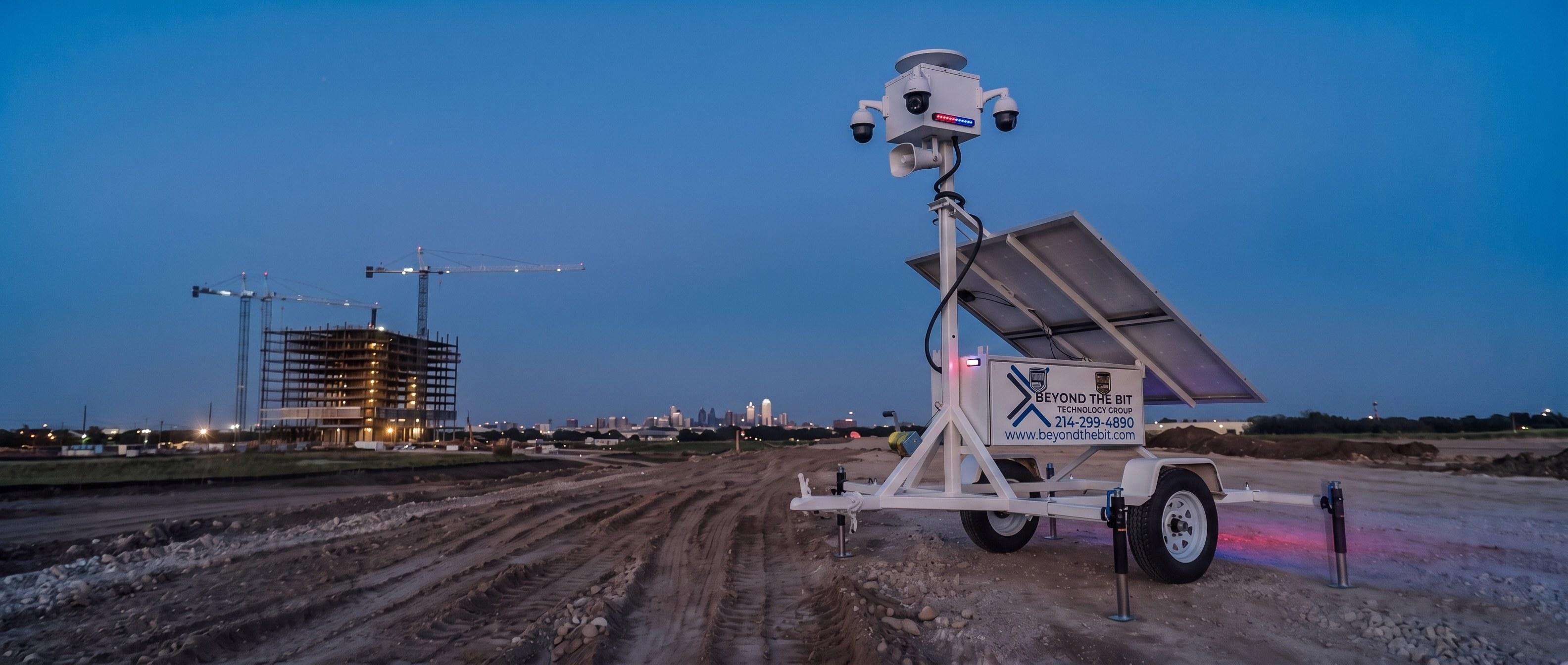
As one part of a bigger answer, not the whole thing. A monitored camera trailer on a construction site gives you fencing-level visibility plus a live, documented response, which is the kind of concrete detail a broker can actually use when they’re talking to an underwriter on your behalf. It doesn’t replace that conversation, but it gives it something real to point to.
If you’re weighing site security as part of getting a project insured, we’re happy to walk the ground with you and talk through what coverage would actually look like, even before you’ve finished that conversation with your broker. A free site assessment gives you one more real answer to bring back to them.